What Do We Know About the Missions of the IRGC Navy?
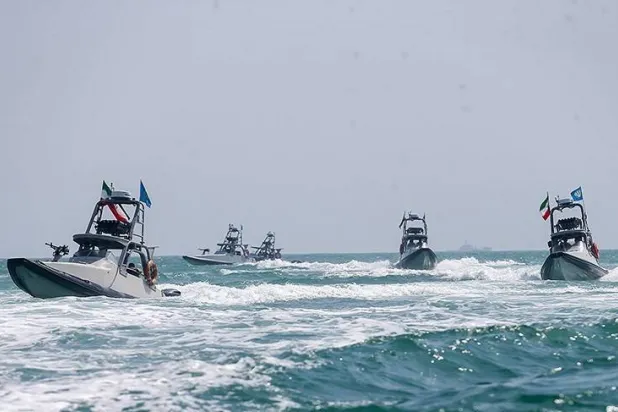
The IRGC Navy operates as a parallel force to Iran's regular army, but it performs a different function from the conventional navy.
The IRGC Navy operates as a parallel force to Iran's regular army, but it performs a different function from the conventional navy. It was founded on a doctrine designed for the narrow and sensitive waters of the Persian Gulf and the Strait of Hormuz, where energy trade intersects with islands, foreign bases, and international shipping lanes.
In this environment, the force relies on near-shore deployment, fast boats, missiles, and interception units, rather than the model of large fleets designed for widespread ocean deployment.
Officially, Iran's military leadership denies any 'parallelism' in the missions of the army and the IRGC, presenting it as a division of roles imposed by the nature of threats.
However, the deployment map reveals two naval forces within the same military system, with the regular navy responsible for the Sea of Oman, the Caspian Sea, and distant missions, while the IRGC Navy is stationed in the Persian Gulf and the Strait of Hormuz, at the most sensitive points of friction with the United States and its allies.
A burning frigate as seen at Iran's Konarak naval base following Israeli-American strikes on February 28 last month (Reuters)
This force was officially established in 1985, during the Iran-Iraq war, after years of small naval units affiliated with the IRGC operating in marshes, riverways, and coastal environments. By the end of the war, it gradually evolved into an independent naval arm within the IRGC, based on fast boats, surface-to-sea missiles, commando units, and coastal defense, with a lesser role for large ships compared to conventional navies.
Since 1999, the IRGC Navy's position has strengthened after it was tasked with securing Iranian waters in the Persian Gulf and the Strait of Hormuz, within a range extending about 1,200 kilometers of maritime borders. This assignment transformed the force born in war into a body that handles one of the most sensitive naval cards in Iran's hands: the passage through which a large part of global oil and gas trade transits.
Five Naval Zones
The IRGC divided its area of operations in the Persian Gulf into five operational zones. The first zone is based in Bandar Abbas, known as 'Saheb al-Zaman', and is its closest naval zone to the Strait of Hormuz. Its mission focuses on defensive and offensive operations within the strait's range.
The second zone is based in Bushehr, known as 'Nooh al-Nabi'. Its primary mission is to protect Kharg Island and ensure the continuity of Iranian oil exports.
The third zone is based in Mahshahr port and covers the northern Persian Gulf, from Mahshahr to the Shatt al-Arab, i.e., the coastal waters of Khuzestan province, which has an Arab-majority population. The 'Arvandkenar' base in the city of Qasba, adjacent to Iraq's Faw, is one of its prominent bases.
The fourth zone is located in Asaluyeh and covers the strip extending from Kish Island to Ras Matf, with a length of about 350 kilometers. Its importance derives from its proximity to the South Pars gas field, a pillar of Iran's economy, geologically shared with Qatar's North Field.
IRGC Navy infantry members storm a ship that was attempting to cross the Strait of Hormuz (AFP)
The fifth zone, headquartered in Bandar Lengeh, was established in 2012 after separating part of the first zone's area. It covers Abu Musa, Greater Tunb, and Lesser Tunb islands, in addition to Sirri Island, and its range extends from the end of Qeshm Island to west of Kish Island. The aim of this division was to concentrate the first zone's tasks on the Strait of Hormuz and to assign an independent zone for the islands.
In each of these zones, along with fast boats, there are coastal-to-sea missile units, independent air defense groups, special units, commando forces, and naval infantry. This structure reflects a naval doctrine based on asymmetric, dense, and near-shore warfare aimed at confounding a larger adversary.
Fast boats form the backbone of this doctrine, used for interception, maneuvering, approaching ships, and hit-and-run operations. These boats appear within a multi-layered threat system that includes coastal missiles, drones, mines, and electronic jamming.
The IRGC Navy has also developed larger platforms, as well as helicopter, drone, and naval air defense systems such as 'Soum Khordad' and 'Tabas'. Tehran presents these platforms as a step toward expanding the IRGC Navy's presence beyond near waters.
An Iranian IRGC warship during a military exercise in the Strait of Hormuz, southern Iran, last December (Archive - EPA)
A Blow at the Center of Gravity
The Iranian navy suffered a massive blow during the recent war, affecting ships, bases, and facilities related to naval military production. The US Central Command said its campaign damaged or destroyed more than two-thirds of missile and drone production facilities, naval capabilities, and shipyards, indicating that the confrontation targets the structure Tehran relied on to threaten navigation.
According to US Central Command, 92 percent of Iran's largest naval ships were destroyed. The material losses came with a leadership blow within the IRGC Navy, following the killing of its commander Ali Reza Tangsiri during the war. Tangsiri was one of the most prominent figures associated with the IRGC's naval pressure doctrine.
A propaganda banner on a building in Tehran depicting the closure of the Strait of Hormuz, with a central image of Ali Reza Tangsiri, commander of the IRGC Navy who was killed in the US-Israeli strikes, alongside Rais Ali Delvari, an Iranian figure who fought British forces during World War I (Reuters)
About four months after his death, Tehran officially appointed Ali Azmaei as the new commander of the IRGC Navy. The change came at a time when the image of Iranian naval deterrence had declined under the weight of losses, making the new commander's task linked to reorganizing damaged units, repairing the network of bases and platforms, and restoring confidence in an arena that Tehran considers one of its most important cards in confronting the United States.
Read also
Original source: Asharq Al-Awsat
Comments (0)
Be the first to comment.