Who Benefits from the Damascus Bombings in a Sensitive Location and Critical Timing?
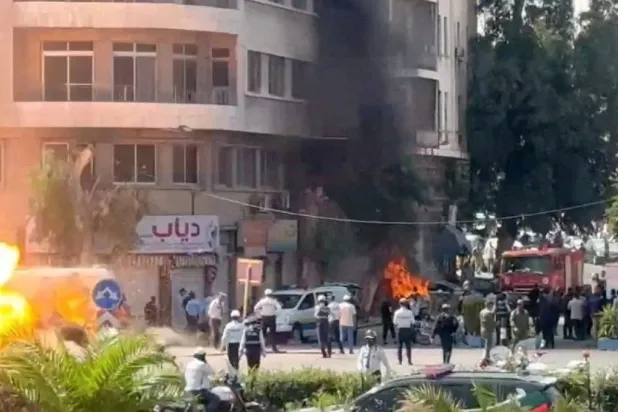
Many parties may benefit from this operation, foremost among them the 'remnants' and those harmed by the French-Syrian rapprochement.
In a time and place of extreme sensitivity and embarrassment for the Syrian authorities, two consecutive explosions occurred about 10 kilometers from the residence of the French president during his visit to Syria.
Sources close to the government told Asharq Al-Awsat that many parties may benefit from this operation, foremost among them the 'remnants' and those harmed by the French-Syrian rapprochement. However, other monitoring sources suggested that the Islamic State (ISIS) group was responsible for the bombing, as the group remains the most prominent security challenge in Syria.
At least 18 people were wounded, including the deputy minister of tourism and four police officers, in two consecutive explosions near the Ministry of Tourism, in the vicinity of the Four Seasons Hotel, the residence of French President Emmanuel Macron. This came less than a week after an explosion at a lawyers' café near the Palace of Justice killed 10 civilians and wounded about 20 others.
According to security expert Abdullah al-Najjar, these bombings bear the hallmarks of the 'remnants' of the former regime, aiming to 'abort the transitional justice process, which will certainly target them, and to show that Syria is unsafe.'
He told Asharq Al-Awsat: 'The devices are primitive and do not spare anyone, civilians or military,' and they aim to demonstrate a lack of good security control, noting that 'the security standard' in these bombings 'does not indicate security fragility' because any criminal could place a primitive explosive device in a garbage container and another in a parked vehicle, as happened in Tuesday's bombing.
Syrian security personnel inspect a burnt car near the Four Seasons Hotel as Syrian President Ahmed al-Shara meets French President Emmanuel Macron at the presidential palace in Damascus on Tuesday (AP).
For his part, political analyst and former diplomat Bassam Barabandi told Asharq Al-Awsat that whenever 'serious signs' of recovery appear in Syria, reactions emerge from parties harmed by the improved situation in the country, and in this, the interests of the remnants, ISIS, Lebanese Hezbollah, Iran, and Israel converge.
Taking into account that large numbers of elements who were part of the former repressive regime still live 'among us and within several layers,' the fact that cannot be ignored, according to Barabandi, is that state institutions are still in the process of formation, and the personnel of security agencies are new and have not yet acquired the experience and full capacity to maintain security.
The political analyst pointed out that the scale of the bombings indicates two things: either the perpetrator is individuals or affected groups, or it is 'a party capable of carrying out large operations, but its goal is not destruction in a country that is already destroyed, but rather to spread instability everywhere in Syria.'
Barabandi stressed that there is an international desire to consolidate stability in Syria, and support for building security institutions will likely increase. On the economic level, large investments will probably not be affected as they are based on political calculations, while local economies and small projects will be affected.
People wave the French flag in front of the hotel where President Emmanuel Macron is staying during his visit to Damascus (AFP).
Sources close to the government told Asharq Al-Awsat that this type of primitive devices is often not detected by explosives scanning operations, and their use is more political than security, noting that initial data points to the 'remnants' more than ISIS, which primarily targets security personnel and military personnel in the state, and those it considers 'apostates.' Moreover, the group's strikes are 'very mean' in terms of the damage they cause, 'unless the group changes its approach to operations overnight.'
For his part, security expert Diaa Qaddour considered those opinions to be speculation due to the parties benefiting from the bombings at this extremely sensitive and embarrassing time for Syria, but 'you cannot cover the sun with a sieve' in that ISIS remains 'the biggest and most prominent security challenge in Syria.'
Syrian Interior Minister Anas Khattab inspects an area near the Four Seasons Hotel after two explosions in Damascus near the hotel where French President Emmanuel Macron was staying (AFP).
He told Asharq Al-Awsat that the complex bombing that occurred on Tuesday resembles the explosion that took place in the Bab Sharqi area of Damascus last May, near a building belonging to the Ministry of Defense, which resulted in the death of a soldier and the injury of a number of civilians, and was claimed by ISIS.
Qaddour believed that the danger 'lies not only in the presence of an active and experienced ISIS cell operating in the heart of the capital and in the most sensitive areas, but also in the fact that this cell operates when it wants and can strike whenever it wishes,' despite the great efforts made by the Ministry of Interior to combat terrorist organizations, especially ISIS, which carries out qualitative and sometimes preemptive operations.
The recent escalation of operations gave a negative image of the relative stability that Syria has experienced recently, and this is what those behind these bombings want, according to Qaddour, who called on the Ministry of Interior and intelligence to 'conduct painful and harsh reviews of the approach to dealing with security threats, and to develop a comprehensive strategy to eliminate and reduce these threats.'
The Syrian Ministry of Interior announced that 'two explosions occurred near the Ministry of Tourism in Damascus, resulting in the injury of 18 people, including 4 police officers.' The ministry said the location of the explosion was outside the security perimeter of the French president's residence.
The streets of the Syrian capital witnessed tight security measures, including many neighborhoods, and many roads were closed, in conjunction with the French president's visit to Damascus.
Original source: Asharq Al-Awsat

Comments (0)
Be the first to comment.