Mistaken Identity Protocol Leads to Embolo's Red Card
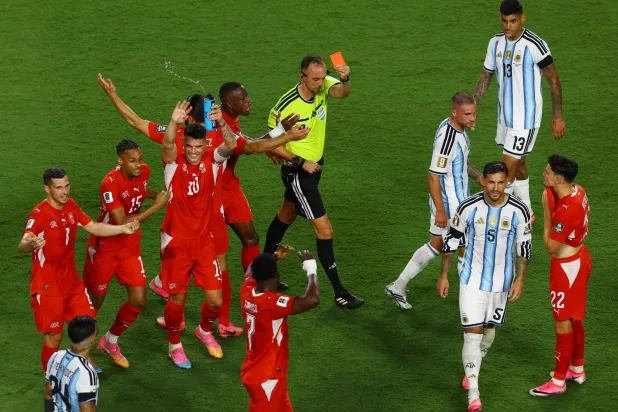
Swiss striker Breel Embolo received a red card in the second half of his country's match against Argentina in the quarter-finals of the FIFA World Cup.
Norway bid farewell to the 2026 World Cup with a 2-1 loss to England in the quarter-finals, but their exit was not without controversy, as their players believed that Jude Bellingham's equalizer should have been disallowed for an unusual reason.
According to the British BBC, the Norwegian team believed that the ball hit one of the camera wires suspended above the pitch in Miami during the build-up to Bellingham's goal. According to the laws of the game, if it was proven that the ball touched the wire, the goal should have been disallowed and play resumed with a dropped ball.
Norway and Fulham midfielder Sander Berge said: 'What happened with the wire is unbelievable. The 2-1 scoreline proves that the margins were very small, and we know well which way they went.'
For his part, Norway captain Martin Ødegaard expressed his discontent with some refereeing decisions, saying: 'I didn't see the incident myself, but the small details were not in our favor today. Perhaps you need such luck in matches like these.'
Tuchel said that there is an electronic chip inside the ball that can tell you if it touched it even a hair (AFP)
This was not the only incident that angered the Norwegians, as the referee disallowed a goal scored by Torbjørn Heggem in the second half after a VAR review, due to Erling Haaland pushing English player Elliot Anderson during a corner kick.
Berge said: 'Having immense physical strength is an advantage for Haaland, but you get punished if you hold an opponent.'
England were trailing to a goal by Andreas Schjelderup when the controversy occurred in first-half stoppage time. Replays showed that a goal kick from goalkeeper Ørjan Nyland passed near the suspended camera wire, before the ball fell in front of Elliot Anderson, who passed it to Anthony Gordon, who then set it up for Bellingham to calmly score the equalizer.
Several Norwegian players quickly surrounded French referee Clément Turpin, demanding the goal be disallowed, while coach Ståle Solbakken was seen discussing with the referee at halftime.
Solbakken said: 'The referee told me he did not see the incident himself and did not receive any signal confirming it. That is a logical explanation, and if FIFA says the ball did not touch the wire and no signal came from the electronic chip inside the ball, then the referee cannot do anything.'
He added: 'But the ball suddenly dropped from the sky in front of the substitutes' bench, so I believe it touched the wire. Many on the bench noticed it immediately, although I was not one of them.'
For his part, former England striker Wayne Rooney said on BBC: 'It looks like the ball's trajectory changed and then dropped quickly, as if something altered its direction.'
Later, FIFA announced that there is 'no evidence' of the ball touching the wire.
FIFA clarified via its media account that the electronic sensor inside the ball did not record any change in signal while it was in the air, which means there was no evidence of it hitting the wire or changing its trajectory because of it.
FIFA explained that the electronic sensor inside the ball did not record any change in signal while it was in the air (AFP)
Nevertheless, Solbakken stuck to his opinion, saying: 'If the chip did not send any signal, I cannot argue with that, but everyone, including the goalkeeper and the player who was waiting for the ball, saw that it suddenly fell from the sky. For me, it was clear, and it was a very strange incident.'
This incident comes just days after a similar controversy in the tournament, when 'SNICKO' technology was used to help disallow a goal for Croatia against Portugal in the round of 32, after the electronic chip detected a slight touch by Igor Matanović, who was in an offside position.
As for England coach Thomas Tuchel, he said: 'There is an electronic chip inside the ball that can tell you if it touched it even a hair, as happened in the Croatia-Portugal match, so it should be able to determine whether it touched the wire here. I personally did not see the incident.'
Tuchel, on the other hand, admitted that luck was on his team's side in some key moments, saying: 'I'm not saying we won thanks to luck, but we were lucky in the decisive moments.'
Original source: Asharq Al-Awsat


Comments (0)
Be the first to comment.