Infantino's Proposal Offers Hope to India and China for World Cup Participation
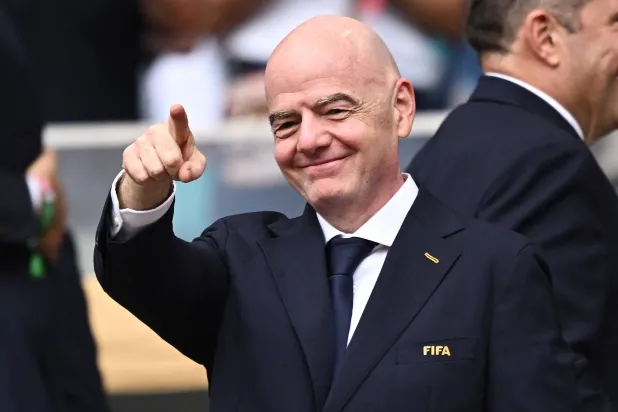
France, Argentina, Spain, and England have advanced to the World Cup semifinals, while FIFA President Gianni Infantino explores expanding the tournament to 64 teams, offering hope to populous nations like India and China.
France, Argentina, Spain, and England, which hold the top four spots in the FIFA world rankings, have qualified for the semifinals of the 2026 World Cup; however, many of the world's most populous nations have yet to qualify for the tournament.
With the possibility of increasing the number of participating teams in the World Cup to 64, other large nations may be able to dream of participating in future versions of the tournament.
India and China are the most populous countries in the world, and many of their 2.89 billion combined citizens are football enthusiasts. Yet, their national teams are notably absent from the World Cup, which now includes 48 teams for the first time in the current edition held in the United States, Mexico, and Canada.
Meanwhile, the current edition features the four highest-ranked teams in the semifinals, with France playing Spain later today, Tuesday, and Argentina facing England tomorrow, Wednesday.
China has qualified for the World Cup only once, during the 2002 edition in South Korea and Japan, where it exited early from the group stage after losing all three of its matches without scoring a goal.
Despite significant investments in football development, the Chinese league has failed to make any notable progress.
As for India, which is passionate about cricket and hockey, it has never qualified for the men's World Cup.
Population size does not necessarily translate to football success, but FIFA President Gianni Infantino has offered some hope for qualification in the 2030 or 2034 editions, suggesting that an increase to 64 teams should be considered.
Infantino told the Swiss website 'Blick Sport' last Saturday: 'The whole world must be allowed to dream of the World Cup, not just Europe and South America.'
The World Cup was recently expanded to include 48 teams in this edition, but the fact that Cape Verde—participating for the first time—reached the knockout stages and threatened defending champion Argentina, in addition to the impressive performance of the Democratic Republic of Congo in only their second World Cup appearance, helped refute claims that these additional teams are not competitive.
Excluding the United States and Brazil, 8 of the 10 most populous countries in the world are not participating in the World Cup, but they may join soon.
In India, the most populous country in the world, cricket is the undisputed number one sport. The success of the national team and the multi-billion-dollar Indian Premier League captures talent, money, and attention, which harms football.
Other major reasons cited for the lack of football success in India despite its popularity include poor infrastructure, insufficient talent development, and the harsh climate.
India is striving to catch up; since the launch of the Indian Super League in 2014, the country has sought to develop football professionally with the support of business and entertainment sector investments.
However, the road to the World Cup remains long. India was eliminated in the second round of the Asian qualifiers for the 2026 World Cup, finishing third in its group behind Qatar and Kuwait.
China failed once again to qualify for the World Cup, and the Chinese team is currently ranked 91st in the FIFA world rankings.
President Xi Jinping, like many other Chinese, is a football fan and has set his sights on making his country a leader in the sport. However, Chinese football has so far only made headlines for match-fixing and corruption scandals.
Observers see a structural problem, as clubs and leagues cannot develop independently in China, where the Communist Party has built a complex network of bureaucratic hurdles and controls over decades.
Nevertheless, hope remains, as the Chinese women's team performs better and is ranked 16th in the FIFA world rankings.
In the world's largest archipelago (with a population of at least 280 million), football is the most popular sport by far, but the country's only World Cup appearance dates back to 1938, when it was known as the Dutch East Indies.
Until the 1950s, Indonesia was among the leading football nations in Asia; however, political turmoil was followed by decades of mismanagement, corruption allegations, and a lack of youth talent development.
Furthermore, the country's geography, which includes more than 17,000 islands, hinders talent development. In 2015, FIFA decided to temporarily suspend the Football Association of Indonesia due to government interference in the management of the league.
But things have begun to improve; the association is investing more in youth and can now rely on professional players trained in Europe who have Indonesian roots, including Kevin Diks of Germany's Borussia Mönchengladbach and Maarten Paes of the Netherlands' Ajax Amsterdam.
Interest in football is notable in Pakistan (with a population of over 255 million), where many fans wear jerseys of Argentina's Lionel Messi, and the Lyari neighborhood in the port city of Karachi is nicknamed 'Little Brazil' due to their intense passion for the South American team.
However, the country's sports infrastructure is geared toward cricket, which was introduced during the British colonial period. Nevertheless, the state has long made strenuous efforts to create a professional football league in Pakistan.
Conflicts, a lack of funding for youth programs, and a shortage of good stadiums across the country are hindering development.
Pakistan has never participated in the World Cup, but this South Asian nation is represented in every match of this tournament, as the official match ball for this edition ('Tricolore') was manufactured for the German sportswear company Adidas in the industrial city of Sialkot.
Nigeria (with a population of about 242 million) is one of the most prominent African nations in football, despite its absence from the 2026 World Cup.
As in other West African countries, there are football academies fueling the hopes of many youths for a professional future, but after the 'Super Eagles' failed again, there was criticism regarding the neglect of talent development.
Bangladesh is the eighth most populous country in the world, with a population of nearly 180 million, but it has never qualified for the men's FIFA World Cup.
However, photos of thousands of fans in Bangladesh wearing Lionel Messi jerseys and cheering for Argentina have spread, showing how much they love football. Brazil matches have also paralyzed traffic on many streets in the capital, Dhaka.
But the Bangladesh men's team did not record a single win in its group during the 2026 World Cup Asian qualifiers; in six matches, it scored only one goal while conceding 20, which is attributed to mismanagement, lack of investment, and poor infrastructure.
Original source: Asharq Al-Awsat





Comments (0)
Be the first to comment.