Haaland: This Is What Salmon and Milk Did
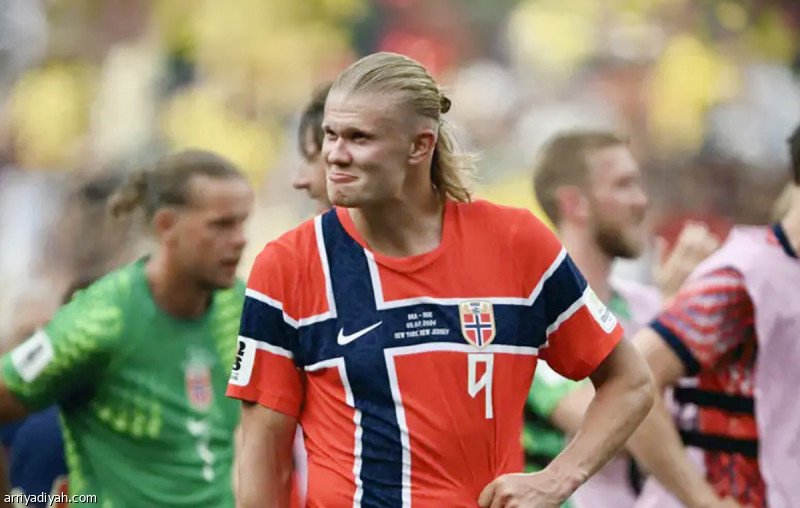
Born two years after Norway's last World Cup appearance, Erling Braut Haaland grew up in the shadow of his father's 1994 squad that exited in the group stage. In 2019, he stated his biggest dream was not individual glory but to lead Norway to the World Cup. After 32 years, with his father in tears, Haaland fulfilled that dream, guiding Norway to the 2026 World Cup with eight consecutive qualifying wins, scoring 37 goals and conceding 5, and later defeating Brazil to reach their first quarterfinal. A promotional ad four years earlier showed Haaland alone cutting grass while teammates packed for the tournament, but now the tables have turned.
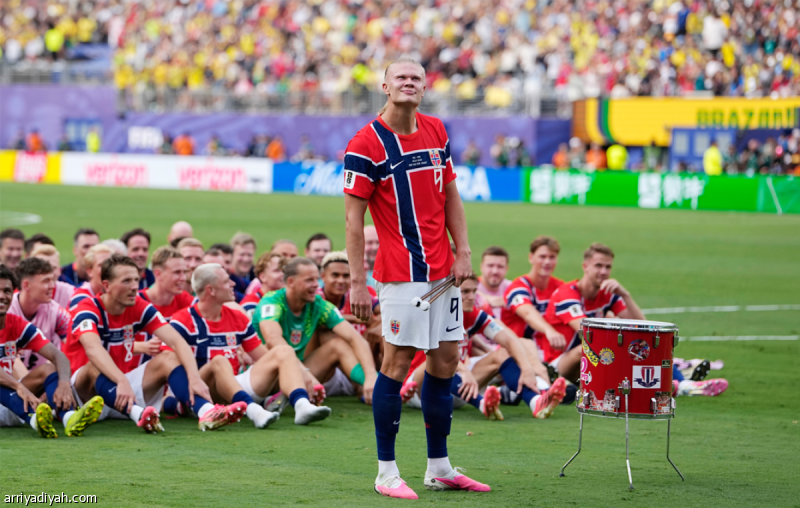
Erling Braut Haaland was born two years after the last time Norwegian feet touched World Cup soil, growing up in the shadow of a legacy hanging on a thread. His father, Alfie, was part of the 1994 squad that tasted the bitterness of group-stage elimination in the United States. The boy grew up in a cold nation that excels at producing brilliant strikers but was unable to reach the World Cup. In 2019, Haaland admitted that his biggest dream was not embracing gold or individual podiums, but simply to break the curse and lead Norway to the global stage to rewrite his country's history. After 32 years, on the same American pitches, his father sat in the stands with tears in his eyes, watching his son achieve his dream. Erling was no ordinary player; he became the leader of a brilliant battalion that turned an impossible dream into a strict routine. Norway crushed the qualifiers with eight consecutive victories without tasting defeat, taming Italy in two historic clashes, scoring 37 goals while conceding only five. Then came the cinematic scene that seemed predestined: in Norway's last appearance in 1998, the Vikings had beaten Brazil to advance to the knockout stages. Twenty-eight years later, Ragnar's descendants repeated the miracle, breaking Brazil's pride again to reach their first quarterfinal. This irony mocked those days just four years earlier, when a promotional ad showed Haaland alone and miserable at Manchester City's training ground, cutting grass and watching his teammates pack their bags for the tournament without him, as critics scoffed at the idea of Norwegian football maturing. But the verse has completely turned today: the world's stars are now the ones packing their bags and returning home, their dreams shattered by the Norwegian machine, while Haaland continues in the World Cup.
History Through the Wide Door
The grandson of the invader Ragnar Lothbrok would not settle for being an ordinary player; his grandfather was an extraordinary warrior. At age five, he set a world record in the standing long jump for his age group with a distance of 1.63 meters, a record still in his name today. Now, before the Norwegian striker turns 26, he has entered the history books through the noisiest door, smashing the wall of doubt that Turkish coach Sergen Yalçın tried to build when he publicly called him an untalented player. The response came in raw numbers that leave no room for interpretation: a stunning career spanning 418 matches, with 359 goals and 66 assists, proving that talent is not just flair but destructive efficiency that challenges the geography and difficulties of the game. When the world wondered if the English Premier League was the most demanding and punishing arena, Haaland answered with 112 goals and 24 assists in 132 matches. And when it was said that the Champions League was the pinnacle of club football, he left his mark with 57 goals in 58 appearances for Salzburg, Dortmund, and City. Even the international curse for his country, which lasted 28 years since the 1998 World Cup in France, was broken under the weight of 62 goals in 54 international matches. This numerical dominance culminated in his first World Cup with seven full goals in just four matches, light-years ahead of the legendary beginnings: Messi scored one goal in his first World Cup, Cristiano Ronaldo one, and Mbappé four. The 25-year-old has proven that he has already booked his place among the greatest to have ever touched the ball.
Tactical Philosophy
In a player's custom, he learned to plan his day before going to bed in the rural town of Bryne, his mother's hometown. Nothing is left to chance. He learned to plan his life according to a strict tactical philosophy that scorns random running and embraces the principle of Brazilian legend Romário, who always said that a striker does not run; he lets the ball and teammates run, and the striker's essence lies in smart positioning and complete rest while waiting for the moment of explosion. This is exactly what Haaland applies. The spectator sees him strolling on the pitch like a ghost, barely touching the ball, leading defenders to think it's not his day. Then, in a split second, his muscle mass suddenly expands and he explodes like a wild beast, terrifying goalkeepers with a deadly touch that ends the battle. His maturity surpasses the chaotic mindset of a player like Neymar, who prefers to create crises in the final minutes while his country seeks an equalizer.
Small Details
Original source: Arriyadiyah


Comments (0)
Be the first to comment.