Merino: The Most Successful Substitute in the World Cup
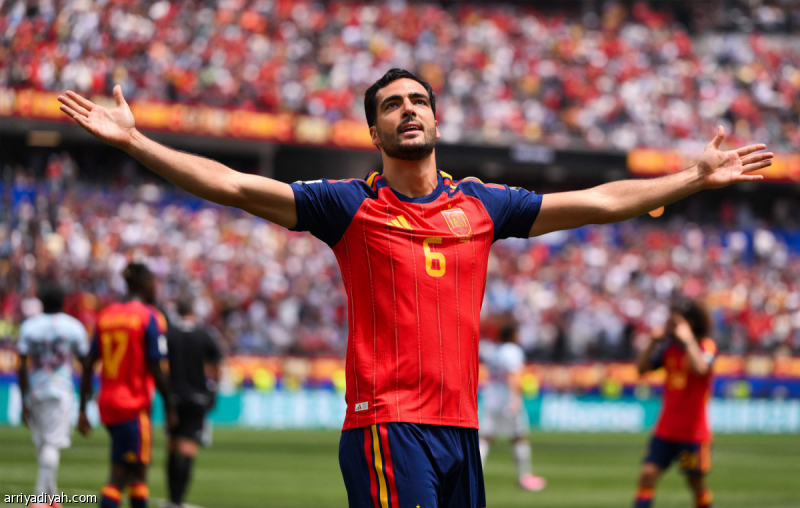
Spain's Mikel Merino has etched his name into World Cup history from the substitutes' bench, becoming a decisive factor that led his country's senior football team to qualification in two consecutive knockout matches at the 2026 World Cup. Merino did not need to be in the starting lineup to make his mark, coming on as a substitute against Portugal in the round of 16, before scoring the only goal of the match in stoppage time, securing Spain's passage to the quarter-finals. The Spanish midfielder repeated the feat against Belgium on Friday in the next round, entering from the bench and scoring the winning goal to send La Roja to the semi-finals, achieving an unprecedented feat in World Cup matches. Although World Cup history has seen several substitutes score decisive qualification goals, including Uruguay's Víctor Espárrago in 1970, Cameroon's Roger Milla and England's David Platt in 1990, Turkey's İlhan Mansız in 2002, and Belgium's Nacer Chadli in 2018, Merino uniquely scored qualification goals twice in a single edition, in two consecutive knockout matches. The tournament's history now includes 14 goals scored by substitutes that directly secured their teams' advancement to the next round, achieved by 13 players, with Merino becoming the only one to repeat the feat. Adding to these cases is Germany's Mario Götze in the 2014 final, who came on as a substitute and scored the winning goal against Argentina to give his country the world title. The 2026 World Cup alone saw four instances of a substitute scoring a qualification goal: Brazil's Gabriel Martinelli, Portugal's Gonçalo Ramos, and Mikel Merino on two occasions, making substitutes one of the most notable features of the tournament's knockout stages. While historic names have been associated with decisive moments after coming off the bench, Merino wrote a different chapter, transforming over two consecutive matches from a reserve option to the scorer of the deciding goal.
Spain's Mikel Merino has etched his name into World Cup history from the substitutes' bench, becoming a decisive factor that led his country's senior football team to qualification in two consecutive knockout matches at the 2026 World Cup. Merino did not need to be in the starting lineup to make his mark, coming on as a substitute against Portugal in the round of 16, before scoring the only goal of the match in stoppage time, securing Spain's passage to the quarter-finals. The Spanish midfielder repeated the feat against Belgium on Friday in the next round, entering from the bench and scoring the winning goal to send La Roja to the semi-finals, achieving an unprecedented feat in World Cup matches. Although World Cup history has seen several substitutes score decisive qualification goals, including Uruguay's Víctor Espárrago in 1970, Cameroon's Roger Milla and England's David Platt in 1990, Turkey's İlhan Mansız in 2002, and Belgium's Nacer Chadli in 2018, Merino uniquely scored qualification goals twice in a single edition, in two consecutive knockout matches. The tournament's history now includes 14 goals scored by substitutes that directly secured their teams' advancement to the next round, achieved by 13 players, with Merino becoming the only one to repeat the feat. Adding to these cases is Germany's Mario Götze in the 2014 final, who came on as a substitute and scored the winning goal against Argentina to give his country the world title. The 2026 World Cup alone saw four instances of a substitute scoring a qualification goal: Brazil's Gabriel Martinelli, Portugal's Gonçalo Ramos, and Mikel Merino on two occasions, making substitutes one of the most notable features of the tournament's knockout stages. While historic names have been associated with decisive moments after coming off the bench, Merino wrote a different chapter, transforming over two consecutive matches from a reserve option to the scorer of the deciding goal.
Original source: Arriyadiyah




Comments (0)
Be the first to comment.