Official FIFA Statement Settles Controversy Over Validity of Bellingham Goal
.jpg)
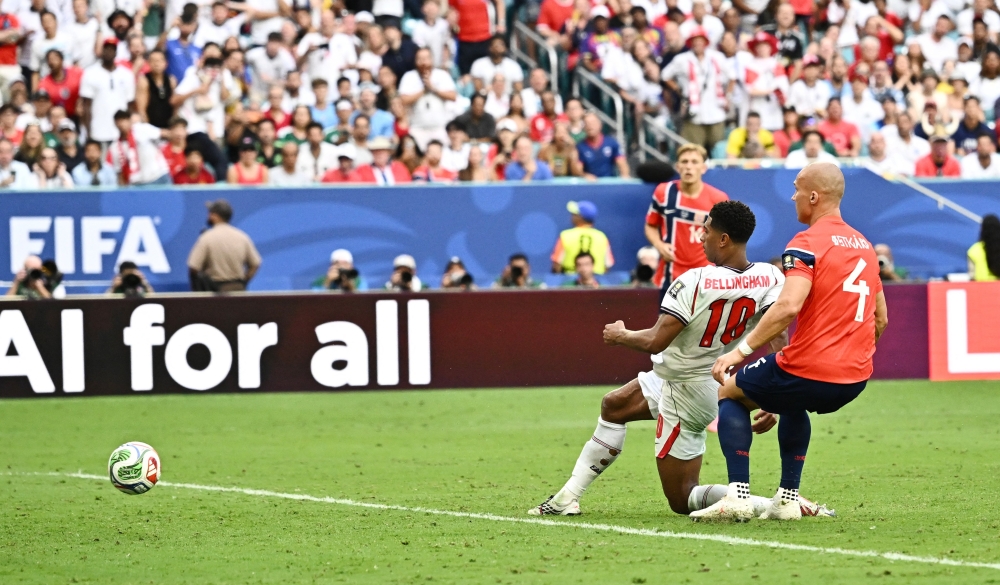
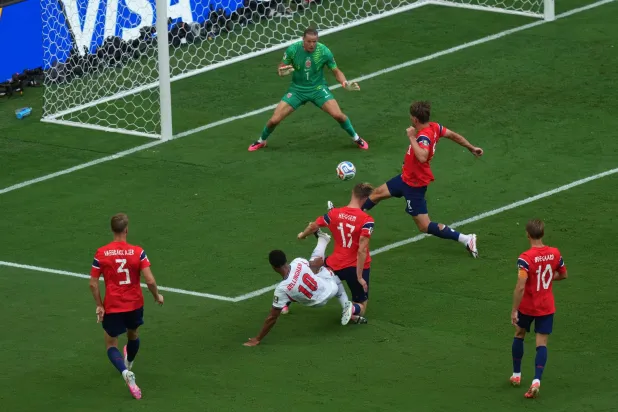
The International Federation of Association Football (FIFA) has settled the controversy raised by Norway over England's equalizer in the quarter-finals of the 2026 World Cup, confirming that the ball did not touch the camera wire hanging from the roof of Hard Rock Stadium in Miami before Jude Bellingham's goal, after examining data from the smart chip embedded in the ball.
Fox Sports reported that the incident occurred when Norwegian goalkeeper Nyland sent a long ball from his area towards his forwards; the ball suddenly dropped and was controlled by Englishman Elliot Anderson, who launched a quick attack that ended with the equalizer 1-1 scored by Bellingham in stoppage time of the first half.
Nyland immediately went to French referee Clément Turpin to tell him that the ball had hit the cable and that the goal should not count, but the referee ignored his protests, as well as those of Erling Haaland and coach Ståle Solbakken, who strongly complained about the play continuing.
Technology Settles the Controversy
FIFA officially ended the debate by announcing that the smart chip embedded in the ball, which detects any contact or sudden change in the ball's trajectory, did not register any touch of the cable, stating in an official statement: "We have examined the data, and it shows that there is no sudden rise in the graph of the sensor connected to the ball."
Former international referee Pérez Burrull, an analyst on the 'Marca' radio program 'Marcador', confirmed the correctness of the decision, saying: "Thanks to this technology, if the ball had touched the camera cable, the goal would have been disallowed; but if there is a slight touch to the camera cable, there is no reason to disallow the goal."
This incident is one of the most prominent refereeing controversies in the tournament, as video assistant referee (VAR) technology and modern technologies face increasing criticism regarding their application and double standards, but FIFA's swift intervention with technical data decisively ended this controversy, confirming the validity of Bellingham's goal that helped England qualify for the semi-finals after a 2-1 victory in extra time.
Original source: Kooora



Comments (0)
Be the first to comment.