Salah and Egypt seize their chance

Salah and Egypt seize their chance
Egypt’s coach Hossam Hassan fielded repeated questions about Australia’s physical advantages and Mohamed Salah’s fitness. (AFP)
Short Url
https://arab.news/gepc2
Updated 04 July 2026 10:53
Gary Meenaghan
July 04, 2026 10:50
DALLAS: After a week in which Egypt’s coach Hossam Hassan fielded repeated questions about Australia’s physical advantages and Mohamed Salah’s fitness, it felt fitting that the Pharaohs’ biggest match on the world stage since 1934 began with the two captains — 175 cm Salah and the Socceroos’ 2-meter tower Harry Souttar — standing together in the center circle.
Yet as it turned out, neither storyline mattered quite as much as anticipated. Salah, declared fit enough to start despite concerns over a tight hamstring, drifted through much of the contest without imposing himself, while Australia’s much-discussed aerial superiority proved equally overstated.
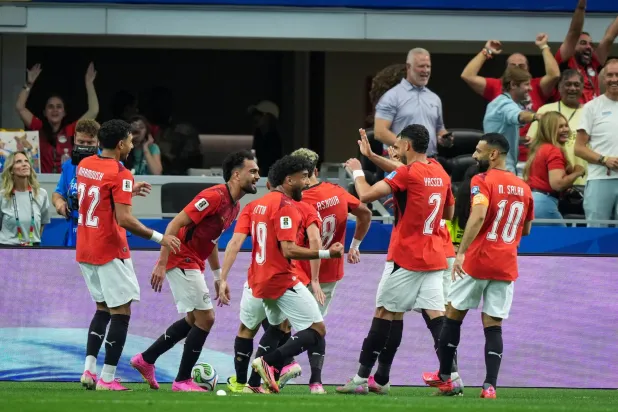
Eman Ashour proved height matters little if you leave players unmarked inside your own penalty area as the Al-Ahly midfielder headed Egypt into the lead in their first World Cup knockout match. Australia eventually equalised from a set piece, yet it was not Souttar or even an Australian but Egypt’s own Mohamed Hany who diverted the ball into his own net.
By the time penalties arrived, Souttar had handed his captain’s armband to substitute keeper Mathew Ryan ensuring that, in a twist of irony, Egypt went into the shootout with the taller man between the posts. Australia missed twice; Egypt were faultless. Yet none of those details will ultimately define what this Texan afternoon will come to represent in Egyptian football.
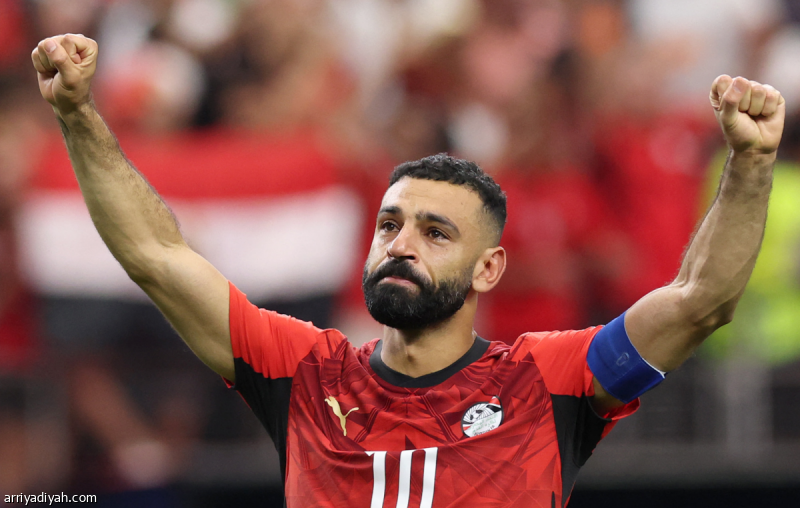
Instead, it may be better remembered for the way Salah described it afterwards. “It feels like I’m writing a beautiful story for the people of Egypt,” he told reporters. “To me, that’s better than any other achievement I could talk about.”
After some 15 years with the Pharaohs, countless individual records, and a career that has transformed him into the greatest Arab footballer of his generation, Salah deflected talk of his legacy and instead turned the focus on his team and his country, on bad memories and future hopes.
“I’ve always said that I try to give people hope and inspire them,” he said “There have been generations of players who won the Africa Cup of Nations multiple times, but were never fortunate enough to play in a FIFA World Cup. So I told our boys, ‘Realise that the moment you’re living right now may never happen again. This is the biggest stage a footballer can ever play on, so enjoy it. Don’t let the pressure take this moment away from you because you may never get another chance’.”
If the players felt the pressure inside the Dallas Stadium, they did not show it from the spot, despite being watched by 70,244 spectators. Souttar sent the first penalty flying high and the otherwise impressive Lucas Herrington hit the bar, while Mahmoud Saber, UAE-based Ramy Rabia, and Hossam Abdelmaguid all netted. As did Salah, who struck a Panenka down the middle and broke down in tears amid the celebrations.
“If somebody was going to do it, it would be me,” he said, laughing. “I am more experienced than the others and I wanted to give them confidence. I decided last minute, I had to do it … I’m happy that we wrote history today.”
Rabia, whose 94th-minute header from a Salah cross was brilliantly saved, admitted he had not struck his penalty as cleanly as intended. He was, however, full of praise for his fellow defenders, who fought for every ball throughout a well-balanced 120 minutes. Fortunate not to pick up at least a yellow card for a challenge that forced Jordy Bos out of the game, Rabia took a whack himself early in the second half.
“Honestly, I wouldn’t say it was overly physical,” said the 33-year-old. “That’s just football — there are challenges and aerial duels. The Australian players were very respectful, and we treated them with respect as well. If someone made a hard challenge, he’d help the other player back up afterward. Nobody was trying to injure anyone. As for the aerial balls, when they had a tall player, we’d either mark him tightly one-on-one or try to block his run, so he couldn’t jump freely. We handled it well, and, to be fair, our players were outstanding.”
In his pre-match news conference, Egypt coach Hassan dismissed the notion that taller is always a benefit, citing a couple of diminutive players who have done rather well at World Cups. “Maradona wasn’t the tallest of players,” said Hassan. “And Messi isn’t that tall either.”
Egypt will now get the chance to see just how big Messi is — be it in stature or status — on Tuesday when they face Argentina in Atlanta for a place in the World Cup quarterfinals.
“This generation wasn’t fortunate enough to win the Africa Cup of Nations,” Salah said. “We lost two finals and fell short on several other occasions, but God compensated us by allowing us to reach this stage and give people something to remember us by.”
With that achieved, Salah and his teammates can stand tall whatever happens next. They have taken Egypt to a place no previous Pharaohs side have gone before: A last-16 World Cup knockout tie.
Topics:FIFA World Cup 2026
Original source: Arab News

Comments (0)
Be the first to comment.