World Cup Steals Miura's Timeless Moments
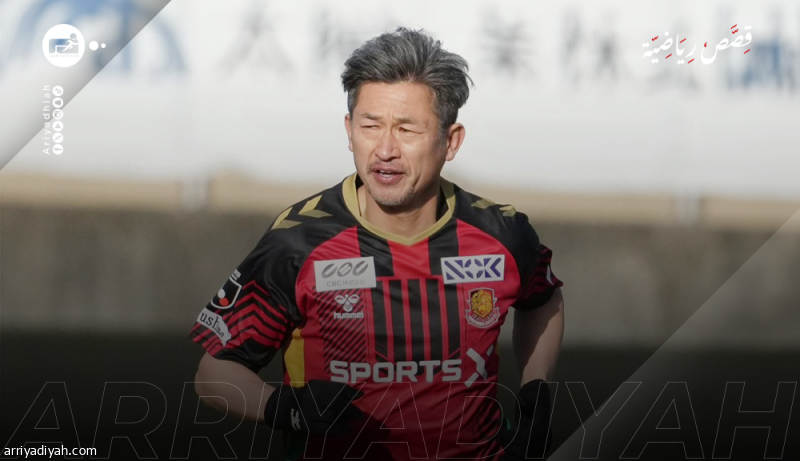
The buzz around the 2026 World Cup stole attention from the news that Japanese club Fukushima United renewed the contract of its legendary player Kazuyoshi Miura until June 2027, causing the news to go largely unnoticed as millions of fans worldwide focused on the West rather than the East. This renewal means that the oldest player in professional football history will enter his 60th year still running on the pitch, embarking on his 42nd season in a miraculous career that recently broke a new Guinness World Record as the oldest player to feature in an official match at the age of...
The buzz surrounding the 2026 World Cup stole the spotlight from the news that Japanese club Fukushima United renewed the contract of its legendary player Kazuyoshi Miura until June 2027, causing the announcement to go largely unnoticed as millions of fans around the world had their eyes fixed on the West rather than the East. This renewal means that the oldest player in the history of professional football will enter his 60th year still running on the pitch, embarking on his 42nd season in a miraculous career that recently shattered a new Guinness World Record as the oldest player to appear in an official match at the age of 59 years, 3 months, and 12 days. The historical irony is that "King Kazu," who is renewing his contract amid World Cup fever, has never once set foot on the pitch in any World Cup tournament throughout his life, a career that began its artistic chapters in the early 1980s when Japan was in total football isolation without any professional league. During that period, specifically in 1981, Japanese author Yoichi Takahashi launched the famous anime series "Captain Tsubasa," known in Arabic as "Captain Majid." The following year, young Miura made a life-changing decision: he dropped out of high school at just 15 years old and traveled alone to Brazil, turning fantasy into tangible reality. Many believe that the story of Captain Majid was inspired by Miura's career, but the opposite is true: Miura drew his future from the famous manga, and in later chapters, he became the hero of his favorite story. In 1990, his unique story directly inspired the author of "Captain Majid," who blended Miura's reality into the anime by sending "Majid Kamel" to play professionally in Brazil, joining São Paulo FC in later installments. There was no professional league in Japan at the time, and he knew his dream would only come true in the land of samba. He lived in shared housing, endured homesickness, language barriers, and the hardships of life. Miura began his rigorous technical training at the Clube Atlético Juventus academy in São Paulo to learn Brazilian dribbling skills. Thanks to his high discipline, he succeeded in signing his first professional contract in 1986 with the famous Brazilian club Santos, the home of legend Pelé. Due to the difficulty of securing a starting spot in Santos' star-studded lineup, he went on a series of well-planned loan moves to gain real playing minutes and develop his physicality and tackling ability. He moved between Palmeiras, Matsubara, and CRB, until he reached his true breakthrough with Coritiba in 1989, winning the Campeonato Paranaense with them. Afterwards, he returned to Santos as a regular starter. Japanese football authorities decided to bring back their star to build their project of launching a professional league in 1993. Miura returned to dominate the sporting and marketing scene, leading his club Verdy Kawasaki to the league title and winning the Asian Footballer of the Year award in 1993. From there, he made history as the first Japanese and Asian player to play in Italy's Serie A with Genoa in 1994, later playing for Croatia's Dinamo Zagreb and winning the league with them. The excitement peaked during the 1998 World Cup qualifiers, where Miura effectively led the attack, scoring 14 goals by himself in the qualifiers to give Japan its first-ever World Cup qualification. However, in the final training camp in Switzerland, head coach Takeshi Okada dropped a shocking bombshell by excluding Miura entirely from the World Cup squad. Okada wanted to send a strong message that the team was more important than the individual, and to strip Miura of his "sole star" authority and overwhelming influence in the dressing room to enforce his strict discipline. Miura immediately left the national team camp and returned to Japan. The sports world was stunned; media interrupted their programs to cover the news, and thousands of fans gathered at the airport chanting his name. The team traveled to France without their top scorer, resulting in a disastrous exit with three crushing defeats and elimination from the group stage. Years later, Miura admitted he did not understand the decision at the time, even returning to France to watch matches as a fan wearing a Japan jersey in the stands. Yet he did not retire or attack the national team management; instead, he stated that this exclusion gave him the moral fuel to continue on the pitch and prove his enduring ability. That shock, which could have ended any player's career, became for Miura an open challenge against time. After retiring from international football in 2000, he devoted himself entirely to defying the laws of nature and aging through a strict scientific lifestyle, imposing a precise diet that kept his body fat at only nine percent. Kazuyoshi Miura's success in continuing to play professionally until age 59 was not just luck, but the result of fundamental pillars that allowed him to challenge sports biology. These include a complete ban on fried foods, processed sugars, and saturated fats, relying on lean proteins; he only drinks a specific type of imported mineral-rich water to speed up muscle recovery; and he regularly undergoes blood tests to detect vitamin deficiencies and immediately corrects them. Miura spends more time preparing for matches and training than any young player on the team: he wakes up at 5 a.m. every day without exception, and travels with a personal staff consisting of a fitness coach, a physiotherapist, and a private chef, paying their salaries out of his own pocket to ensure the highest quality care. Before every training session, his staff measures blood oxygen levels, muscle flexibility, and blood pressure, and based on these, they determine the intensity of physical exertion to avoid injuries. As age advances, the biggest problem becomes the body's ability to recover after exertion, so he uses the latest sports medicine technologies such as hyperbaric oxygen chambers and cryotherapy. This discipline allowed him to play for Yokohama for over 15 years, then embark on a professional stint in Portugal with Oliveirense in 2023, leading to his current stop at Fukushima United. When asked about the secret of his longevity and why he has not retired yet, he replied simply: "I don't know what I would do with my life if I didn't wake up in the morning to train and play football. My passion for it is what keeps me alive." Despite that, Miura knows that at this age he will not play full matches; he accepts the role of a substitute who comes on in the final minutes, using his experience to guide younger players. Now, while the world passionately follows the current World Cup battles, Miura adheres to his strict morning training in Japan with a youthful spirit, drawing a clear line between past disappointment and present continuity, proving to everyone that the World Cup may come and go, its champions may change, but the inspirations in fiction and reality never pass and never retire.
Original source: Arriyadiyah


Comments (0)
Be the first to comment.