Growing Discord in the United States Over Data Center Projects
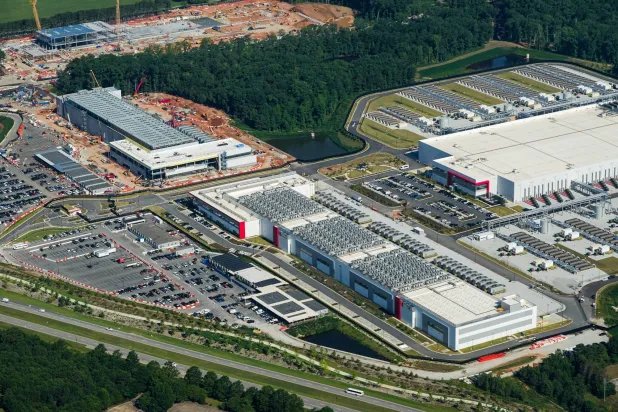
Opponents of the rapid expansion of data centers plan to hold protests today, Saturday, at at least 125 locations across the United States.
The contrast between Vice President J.D. Vance and Secretary of State Marco Rubio in their approach to Israel and Iran is no longer just a disagreement within President Donald Trump's administration. As the midterm elections approach and early calculations for 2028 begin, the two men are gradually becoming representatives of two competing factions vying to inherit the Republican movement: the war-averse 'America First' ideology embodied by Vance, and the traditional conservative ideology that is strongly pro-Israel and more hawkish toward Iran, represented by Rubio.
Pro-Israel Hawks Against Vance
Although the White House has denied the existence of a rift within the administration regarding the relationship with Israel, Reuters has observed a clear divergence between the positions of Vance and Rubio.
This divergence has become particularly evident through the role Vance played in reaching a memorandum of understanding with Iran, his criticism of Israeli officials who objected to its content, and his characterization of certain Israeli operations in Lebanon as an obstacle to American de-escalation efforts.
In contrast, Rubio has defended Israel’s right to respond to Hezbollah’s attacks, asserting that while Washington seeks an agreement with Tehran, it should not be 'at any cost'.
Trump delivers a speech in the Oval Office in the presence of Vice President J.D. Vance and Secretary of State Marco Rubio at the White House on April 23 (Reuters).
This disagreement has allowed pro-Israel conservative influencers at the 'Road to Majority' conference, organized by the Faith and Freedom Coalition in Washington two weeks ago, to hold Vance responsible for the agreement. Prominent influencers, such as Ben Shapiro and Mark Levin, portrayed the U.S. Vice President as someone prepared to make concessions to Iran and restrict Israel’s military freedom.
The campaign is not limited to foreign policy debate; it carries a clear political objective: to prevent Vance from turning his position as Vice President into an automatic right to inherit Trump, and to clear the path for Rubio or another candidate more aligned with the Republican hawkish wing, such as Florida Governor Ron DeSantis or Texas Governor Greg Abbott.
Thus, Israel has become a sorting tool within the Right: Vance’s supporters believe that supporting Israel does not mean entering open-ended wars or subjugating American interests to the calculations of Benjamin Netanyahu’s government, while his opponents argue that abandoning maximum pressure on Iran threatens both Israel and the United States.
Evangelicals Have Not Taken Sides
The Washington Post stated that the 'Road to Majority' conference revealed a gap between the intensity of media rhetoric and the mood of the attendees.
U.S. Secretary of State Marco Rubio speaks during a ministerial meeting on political violence on July 16, 2026 (Reuters).
Despite strong support for Israel and the war on Iran, many participants remained open to Vance’s candidacy; they even praised his effectiveness, loyalty to Trump, and his prior service in the Marine Corps. These positions do not represent a scientific poll, but they reveal that Israel, despite its religious and political importance to Evangelicals, is not the only criterion for choosing a candidate. This base is also concerned with issues of abortion, religious freedom, immigration, the courts, education, and the ability to confront the Democrats.
Trump's own experience proved that the Evangelical voter might overlook personal or ideological reservations when convinced that a candidate will fight for their priorities. Vance benefits from his closeness to Trump, his conservative cultural rhetoric, and his frequent talk of faith and family. As for Rubio, he presents himself as having more international experience, being clearer in his defense of Israel, and more reassuring to traditional Republican institutions and conservative donors. Although both are Catholic, they use religious language that resonates with Evangelicals.
Early Sorting
The electoral mobilization process has begun early, but it is still in the preliminary stages and remains open to all options. An Emerson poll in May showed a very close contest, with Vance receiving 36 percent and Rubio 35 percent among Republican primary voters.
Rubio was stronger among those over fifty, while Vance led among the younger demographic. Conversely, a Conservative Political Action Conference (CPAC) poll gave Vance a clearer lead, reflecting his strength within the heart of the MAGA movement.
Vance and Rubio arrive to watch President Trump's address to the nation at the White House on the evening of July 16 (Reuters).
Generational differences explain an important part of the battle. Older Republicans and traditional Evangelicals are more tied to Israel and interventionist foreign policy, while the younger conservative generation has become more skeptical of wars and costly alliances. The Pew Research Center has shown that a majority of Republicans under fifty now view Israel negatively, while support remains strong among older Republicans and white Evangelicals.
Therefore, the competition has not yet turned into a simple choice between a candidate who is 'with Israel' and one who is 'against it.' It is likely that Rubio will attempt to use hawkishness toward Iran and commitment to Israel as proof of readiness for the country’s highest office, while Vance will present himself as a guardian of 'Trumpism' that does not want 'endless wars.' The deciding factor will remain Trump’s own position and the outcome of the agreement with Iran: its success gives Vance the credit of a peacemaker, while its collapse and a return to war—the more likely scenario today—strengthen the argument for Rubio and the hawks.
Original source: Asharq Al-Awsat


Comments (0)
Be the first to comment.