Communications Authority Launches Third Edition of Global Research Competition (Non-Terrestrial Networks for 6G)

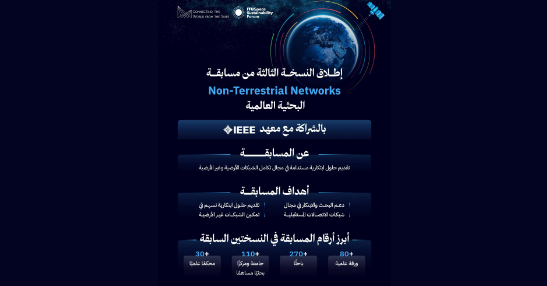
The Communications, Space and Technology Commission announced the launch of the third edition of the global research competition (Non-Terrestrial Networks 2026), organized in partnership with the Institute of Electrical and Electronics Engineers (IEEE). The competition aims to attract researchers and academics from around the world to present innovative ideas and solutions in the field of non-terrestrial networks, contributing to the development of next-generation wireless communication and enhancing the integration of terrestrial and non-terrestrial networks.
The results of the competition will be announced next October, alongside the global event for communication and space sustainability organized by the commission in Riyadh. The competition targets researchers, graduate students, and recent Ph.D. graduates, who will submit scientific papers covering concepts and technologies of non-terrestrial networks and their role in supporting sustainability and expanding future communication solutions. The papers will be evaluated by a judging panel comprising a select group of scientists and experts from around the world in the field of non-terrestrial networks.
The commission clarified that the deadline for submissions via the EDAS platform is August 10, 2026. The top ten entries will be selected, and their presenters will be hosted during the event to showcase their work in a specialized scientific session, competing for three cash prizes: $15,000 for the first winner, $10,000 for the second, and $5,000 for the third.
The competition in its previous two editions achieved broad international participation, attracting over 80 scientific papers submitted by more than 270 researchers from 47 countries, with the involvement of 114 universities and research centers. The evaluation was overseen by 33 scientific reviewers from experts and specialists, reflecting the growing global interest in research and innovation in non-terrestrial network technologies.
The competition is part of the commission's efforts to support research and innovation in future communication technologies and to enhance the participation of global research talents in developing technical solutions that contribute to building a more integrated and sustainable communication ecosystem, in line with international trends in the communications and space sector.
Original source: Al-Riyadh


Comments (0)
Be the first to comment.