Everything you need to know about Starlink ... Space internet for everyone!
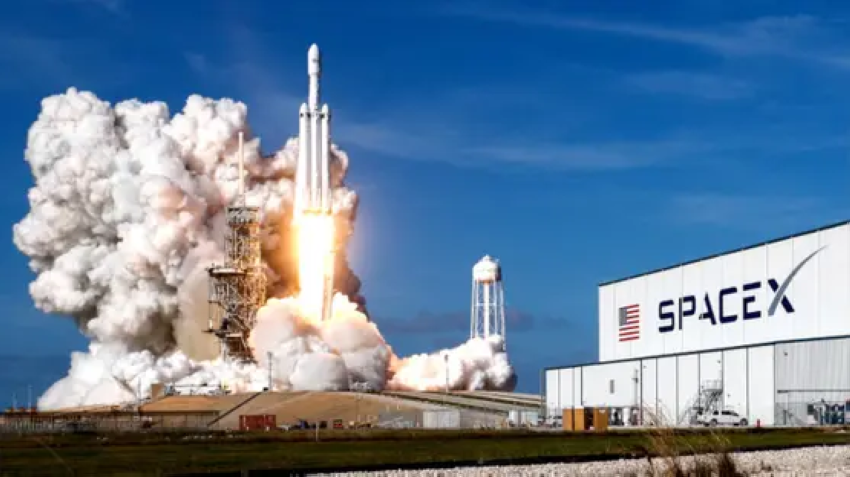
Starlink | SpaceX, owned by Elon Musk, launched a Falcon rocket on May 23, 2019, with an unusual payload: 60 satellites.
SpaceX, owned by Elon Musk, launched a Falcon rocket on May 23, 2019, with an unusual payload: 60 satellites. This is the first step towards launching about 12,000 satellites into low Earth orbit over the next few years, aiming to provide a new type of internet service that enables space-based internet connectivity to every corner of the Earth, especially places that usually lack internet service or have poor service through traditional means, not to mention serving nearly 3.5 billion people on the planet who lack access to stable and fast internet.
By: Anas Maarawi
Space internet connectivity is not a new technology, so what's new about Starlink?
The new aspect is that the project will cover the globe with higher quality connectivity than traditional satellite internet, relying on smaller and cheaper receiving devices. The reason is that Starlink satellites will orbit in low Earth orbits, meaning signals will arrive with greater strength to more specific areas compared to traditional communications satellites. This implies, in addition to stronger signals: significantly reduced latency, reduced power consumption in receivers, and reduced size and cost.
To achieve this, the company will launch thousands of satellites to cover the globe. It is possible to cover the Earth with a limited number of satellites placed in very high orbits (about 36,000 km, as traditional technology works), known as geostationary satellites; because the satellite is at a specific altitude that allows it to rotate at the same speed as the Earth's rotation (appearing stationary from Earth), but this means lower signal quality and high latency, along with the need for large, high-power consumption equipment to receive the signal, leading to high cost and difficulty of use.
As for Starlink satellites, they will fly in two groups in low orbits, starting with about 4,400 satellites at altitudes between 550 and 1,300 km, and the second group consists of about 7,500 satellites flying at altitudes between 335 and 346 km.
How can the signal be received on Earth?
Unfortunately, we currently lack precise details, as SpaceX has not disclosed much about the ground receiving stations. However, what we know is that at least the first generation, used in the current experimental phase, will be fixed receiving antennas. Elon Musk previously stated that the size of the receiving dish will be about the size of a pizza box. He added that the dish does not need to be precisely aimed in a specific direction, as with traditional receiving dishes; it is sufficient to point it at any angle towards the sky.
According to experts, Starlink can provide its services through a mix of the following options:
The company can sell or lease its receiving devices to homes and businesses. These devices are much smaller and cheaper compared to traditional satellite internet receiving equipment, making this service affordable for homes and small to medium-sized businesses.
Existing cellular network operators can lease bandwidth from Starlink, place its receiving devices on traditional communication towers, and then provide it to subscribers via mobile networks. Of course, this will not provide coverage for remote areas that lack communication towers altogether, but it will offer higher connection speeds over mobile phones.
It is possible, at low cost, to set up receiving stations in places that usually have no internet or have poor quality (such as travel routes), and relay the signal so that cars can receive it.
Technical Challenges
Flying in low orbits means that receiving antennas cannot lock onto a single satellite for more than a few minutes, because the satellites are constantly moving at high speed. Therefore, antennas have been designed to seamlessly switch between incoming signals, and this requires satellites to hand off information quickly between each other to ensure uninterrupted browsing or phone calls.
The antennas also need to accurately track satellite signals. The traditional method is mechanical tracking, where the antenna consists of movable parts, but this is not feasible if we want to reduce antenna size, cost, and complexity. Therefore, SpaceX developed high-tech, low-cost antennas that use electronic tracking, allowing signal tracking without any physical movement.
One of the main concerns with such a large number of satellites is them colliding with each other or with other satellites, especially since other competing companies will launch similar projects in the future consisting of thousands of satellites. To avoid this problem, SpaceX equipped its satellites with a collision avoidance system that allows the satellite to adjust its course to avoid a potential collision. Additionally, Starlink satellites contain an internal database with information on the locations of all other satellites orbiting Earth.
Commercial Launch of the Service
No information is available on the exact date for the commercial launch of the service, but according to the company, the service will be gradually available to users before the complete number of planned satellites is launched. According to Elon Musk, satellites will be launched in batches, each containing 60 satellites, with the goal of launching 1,000 to 2,000 satellites per year. When the service becomes available, it will not be offered in all geographic areas, but if things go well, the company set mid-2021 as the date for full global coverage with Starlink service.
It is still too early to talk about the subscription cost for the average consumer. However, since Elon Musk has said more than once that the biggest beneficiaries of the service are residents of poor areas who lack good internet access, this means prices will be affordable for everyone. Musk hinted that prices may vary from country to country, with poorer countries receiving the lowest prices.
Benefits of Starlink
High connection speed: Starlink will offer connection speeds exceeding the highest speeds currently available, because the satellites transmit information between each other via laser, as light travels faster in a vacuum than through any other medium (such as the glass used in current fiber optic cables).
Original source: AIT News


Comments (0)
Be the first to comment.