Why Are Chip Stocks Retreating Despite the AI Boom?
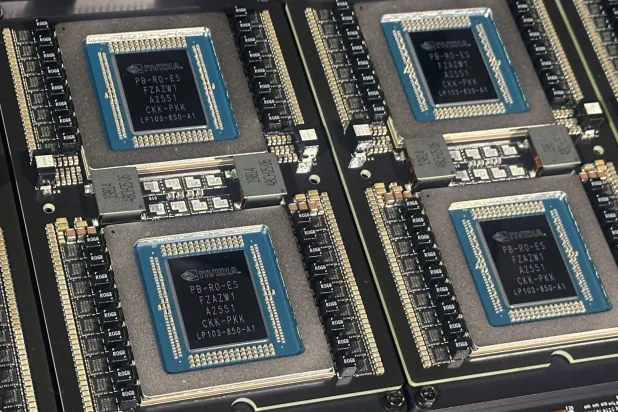
After more than a year of record gains driven by the AI revolution, the semiconductor sector has entered a new phase of sharp volatility, despite major companies continuing to post strong financial results. When ASML, the Dutch global leader in semiconductor manufacturing equipment, announced its sales forecast, chip stocks in Asia and the United States were hit by a broad sell-off. This raised questions among investors as to whether the current boom has peaked, or if this is merely a natural correction phase following an extraordinary rally.
Analysts do not view these events as a decline in demand for AI technologies. Instead, they see it as a shift in investor perspective—moving from a focus on current profits to evaluating the ability of companies to maintain similar growth rates over the coming years, amid high market valuations and shifting supply and demand dynamics in certain sectors, particularly memory chips.
TSMC logo during its second-quarter earnings conference (AFP).
From supply shortage crisis to overproduction fears.
Over the past two years, memory chip manufacturers have benefited from severe supply shortages coinciding with a massive surge in demand for data centers and AI applications. This pushed chip prices to unprecedented levels, directly impacting the profits of companies such as Micron, SK Hynix, and Samsung.
However, this equation began to change after ASML announced that its new Extreme Ultraviolet (EUV) lithography equipment is improving the efficiency of existing production lines, allowing factories to produce more chips without the need to build new facilities.
Although this development is positive for the industry in the long term, it has sparked investor fears that increased production could end the period of supply shortages that supported prices and profits over the past two years, causing memory chip stocks to retreat immediately upon these indications.
ASML logo displayed at the company's booth at the 8th China International Import Expo in Shanghai (Reuters).
Why has good news become a reason for stock drops?
It may seem paradoxical, but financial markets do not react to today’s results as much as they price in tomorrow’s expectations. When Taiwan’s TSMC announced record earnings with a 77 percent increase, the markets had already digested these results, as stock prices had reflected optimistic expectations for months. But when ASML signaled improvements in production efficiency, investors began to recalculate the future of chip prices and profit margins, considering that any increase in supply could put pressure on prices in the future.
Consequently, news that appears positive from an industry perspective can turn into a source of pressure on stocks if investors believe it will shrink future profits.
Profit-taking after a historic rally.
Many analysts believe that a large part of the recent declines is also due to profit-taking following the extraordinary gains recorded by the sector since the beginning of the year. The Philadelphia Semiconductor Index had achieved gains exceeding 80 percent before the recent correction began, while funds specializing in chip stocks witnessed the largest outflow of funds in years, shortly after recording record inflows.
These movements indicate that investors are not leaving the sector entirely but are reallocating their investment portfolios following the significant gains achieved over the past months.
SK Hynix logo during its IPO on the Nasdaq exchange (Reuters).
Are doubts starting to surround the AI boom?
Despite the sell-off, most research firms still expect huge spending on AI to continue in the coming years. Estimates suggest that global spending on data centers and AI infrastructure could approach $1.5 trillion by 2027, supported by investments from major tech companies such as Nvidia, Microsoft, Amazon, Alphabet, and Meta.
However, investors are now asking a different question. Instead of questioning whether spending will continue, the focus has shifted to whether chip stock prices truly reflect all these optimistic expectations, and whether future growth will be sufficient to justify current valuations.
Geopolitical tensions exacerbate pressures.
At the same time, geopolitical developments have increased investor caution, as the escalation of war in the Middle East led to another rise in oil prices, reviving fears of returning inflationary pressures and delayed global interest rate cuts.
For tech stocks, whose valuations rely heavily on future earnings forecasts, high interest rates represent an additional negative factor, alongside concerns related to supply chains and production costs.
South Korea intervenes to contain volatility.
Sharp movements have led South Korean authorities to tighten oversight of leveraged ETFs linked to chip stocks, after concluding that these tools were amplifying price movements in both directions.
Authorities raised the minimum investment for these funds and tightened requirements for investor risk awareness. They also recommended that brokerage firms refrain from launching new products of this type for the time being, in an attempt to limit the volatility that has begun to affect the entire Korean market.
Flags of China and the United States appear on a printed circuit board equipped with semiconductor chips (Reuters).
Correction or the start of a new phase?
So far, fundamental indicators do not suggest the end of the AI boom or a decline in demand for advanced chips, but the coming phase appears different from previous years.
Whereas markets previously rewarded almost all companies in the sector, investors have become more selective, with a greater focus on each company's ability to maintain profit margins, manage the balance between supply and demand, and convert massive AI investments into sustainable profits.
Thus, the semiconductor sector appears to be moving from a phase of collective growth driven by enthusiasm to a more mature phase, where operational performance and production efficiency will be the deciding factors in determining winners and losers.
Original source: Asharq Al-Awsat



Comments (0)
Be the first to comment.