Summer Triangle adorns northern border sky amid exceptional clarity

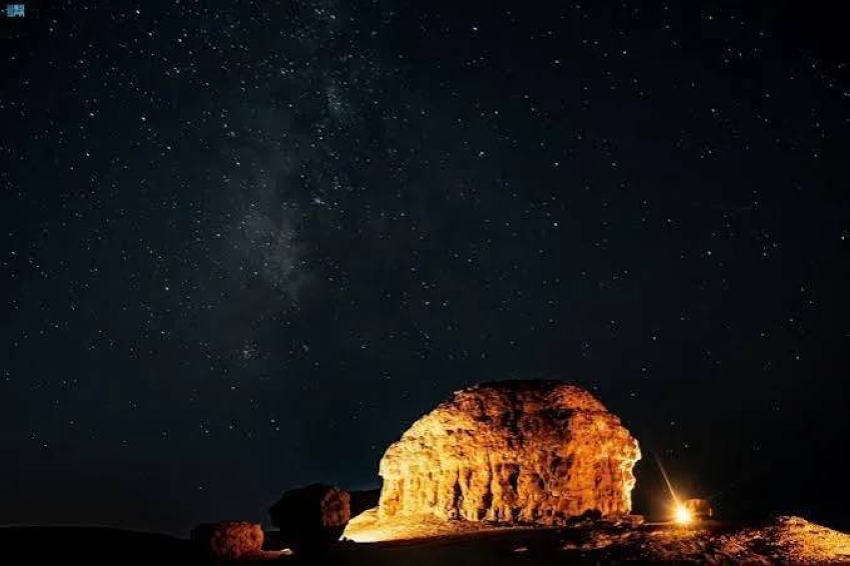
The 'Summer Triangle' phenomenon is currently visible in the sky of the Northern Border Region, presenting a spectacular astronomical scene that attracts stargazers and astrophotographers, benefiting from the clear skies and low light pollution in the region's wilderness areas.
Adnan Khalifa, a member of the Astronomy and Space Club, explained that the Summer Triangle is not a constellation in the strict astronomical sense, but rather a celestial formation consisting of three of the brightest stars in the sky: Vega in the constellation Lyra, Altair in Aquila, and Deneb in Cygnus, noting that these stars appear spaced apart to form a large triangle easily distinguishable with the naked eye after nightfall.
Khalifa pointed out that the Summer Triangle is one of the most prominent astronomical markers of summer nights, and has been used since ancient times for direction finding and seasonal determination, as well as guiding observers to identify several constellations and bright stars surrounding it.
He added that the region provides an ideal environment for observing this phenomenon due to its vast open areas and clear skies, noting the possibility of seeing the bright band of the Milky Way stretching near the triangle in locations away from artificial lighting, offering observers an exceptional visual experience during summer nights.
The Summer Triangle remains clearly visible throughout the summer months, forming a prominent celestial landmark easily recognized without the need for specialized observation equipment, making it a favorite destination for amateur and professional astronomers alike.
Original source: Sabq



Comments (0)
Be the first to comment.