5 Arab States Condemn Iranian Attacks, Call for De-escalation
In phone calls by Saudi Foreign Minister with his counterparts in Qatar, Oman, Bahrain, and Jordan
Istanbul / Anadolu
On Sunday, the foreign ministers of Saudi Arabia, Qatar, Bahrain, Oman, and Jordan condemned 'repeated Iranian aggressions against countries in the region,' calling for de-escalation and ensuring freedom of navigation in the Strait of Hormuz.
This came during phone calls made by Saudi Foreign Minister Prince Faisal bin Farhan with his Qatari counterpart Mohammed bin Abdulrahman Al Thani, Omani counterpart Badr al-Busaidi, Bahraini counterpart Abdullatif Al Zayani, and Jordanian counterpart Ayman Safadi, according to the Saudi Foreign Ministry.
According to the statement, the calls involved 'reviewing developments in the region, reaffirming condemnation of repeated Iranian aggressions against countries in the region, and rejecting anything that could undermine states' sovereignty or threaten the region's security and stability.'
They also exchanged views on a number of topics, 'foremost among them efforts to restore security, de-escalate tensions, and ensure freedom of navigation in the Strait of Hormuz.'
In a second statement, the Saudi Foreign Ministry reported that Faisal bin Farhan received a phone call from his Ukrainian counterpart Andriy Sybiha.
During the call, they 'reviewed bilateral relations, discussed regional developments, the latest in the Ukrainian crisis, as well as a number of topics of mutual interest.'
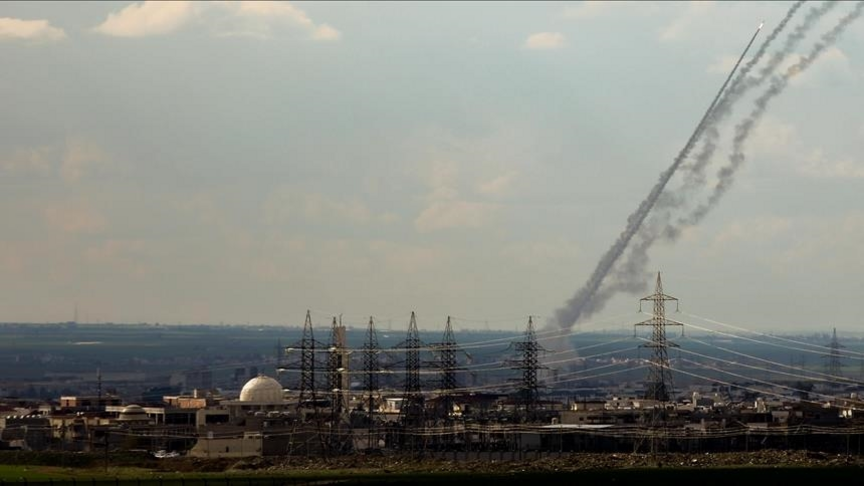
On Sunday, five Gulf states and Jordan witnessed attacks—the broadest targeting of Arab countries since the de-escalation between Washington and Tehran last April—while some of those states said Iran was behind the attacks.
According to Anadolu's monitoring of official positions, those countries included Qatar, the UAE, Kuwait, Bahrain, Oman, and Jordan.
On the night of Saturday to Sunday, Washington and Tehran exchanged strikes, while Iran's Revolutionary Guards announced the closure of the Strait of Hormuz to maritime navigation until further notice.
Also on Sunday, the Revolutionary Guards announced in a statement that they had targeted two ships in the Strait of Hormuz, which they said 'violated transit rules' imposed by Iran.
For its part, the U.S. Central Command (CENTCOM) announced on Sunday via the American platform X that it had launched a new wave of attacks on Iran in response to Iran's targeting of commercial ships in the Strait of Hormuz.
CENTCOM noted that its attacks overnight hit approximately 140 military targets, including missile and drone sites, naval capabilities, ammunition depots, communications networks, and coastal surveillance facilities.
In response to these attacks, Iran announced it had targeted U.S. military positions in Kuwait, Bahrain, Qatar, and Jordan with missiles.
Washington and Tehran had signed a memorandum of understanding on June 18 following negotiations mediated by Qatar and Pakistan, paving the way for a final agreement, before Trump declared that the memorandum with Iran had 'ended' amid the recent escalation.
Original source: Anadolu Agency






Comments (0)
Be the first to comment.