Vance Talks of 'Pragmatists'... But in Tehran, Decision Lies with the Supreme Leader's Network
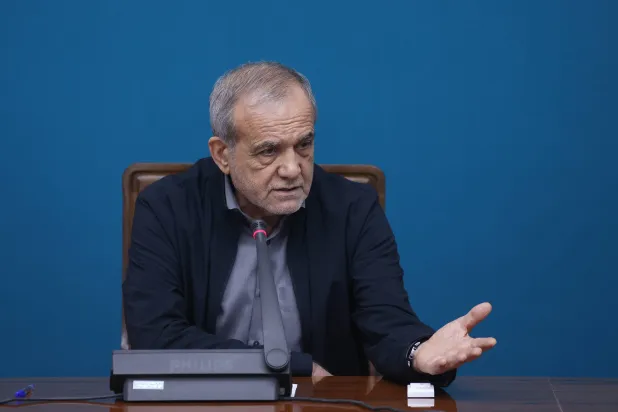
The picture in Tehran appears more complex than U.S. Vice President J.D. Vance's description of the conflict within the Iranian system.
J.D. Vance, the U.S. Vice President, described the relationship with Tehran as a 'delicate diplomatic dance' based on economic pressure and a 'carrot and stick' policy. This came as President Donald Trump said Wednesday that Iran 'strongly desires' to reach a settlement with the United States, and that Washington will decide whether to respond.
In an interview, Vance offered an explanation of the conflict within the Iranian system based on two wings: 'pragmatists' who want to continue negotiations and reach an agreement with Washington, and 'hardliners' who seek to thwart this path, considering that the memorandum of understanding is still moving in a positive direction despite the escalation of mutual strikes.
But the picture within Iran's state institutions, especially after the killing of Supreme Leader Ali Khamenei and a number of senior officials, appears more complex. Differences do exist, but they are not between reformists and conservatives in the traditional sense, nor can decision-making be reduced to the stance of a government or a political current, as security, military, and political institutions led by the Iranian Supreme Leader overlap in its formulation, while the Revolutionary Guard retains a decisive weight within this system.
Vance stands alongside Witkoff and Kushner in Switzerland on June 21, 2026 (AP)
Formulating the Negotiation Decision
Since the start of the war on February 28, questions have increased about decision-making in Iran, chief among them the return to the negotiating table and signing a memorandum of understanding with the United States. President Masoud Pezeshkian provided the clearest account so far of how the negotiation decision was made when he responded in June to criticism of the memorandum of understanding, saying that all military and security leaders participating in the meetings of the Supreme National Security Council supported this path.
After his office denied several times that he had resigned due to being sidelined from the negotiation path, Pezeshkian said that the commander of joint operations of the General Staff, the commanders of the army and the Revolutionary Guard, and the security agencies 'were all present, spoke with one voice, and all signed the decision.'
Iranian lawmakers later confirmed that the army and Guard commanders participate in council meetings and have the right to vote, while government officials spoke of 12 out of 13 members approving the memorandum of understanding with the United States.
This information contradicts the prevailing impression that the negotiations were a government project that faced opposition from the military establishment. The decision, according to the official narrative itself, was issued after consensus within the country's highest security institution, which includes political leaders and heads of military and security agencies together.
Pezeshkian also revealed that his government allocated twenty million barrels of oil to the missile unit of the Revolutionary Guard during the war, in addition to foreign currency resources, in an attempt to affirm that the government and armed forces operated within a single decision-making room, not at odds.
Head of the Judiciary Gholam Hossein Mohseni Ejei whispers in Qalibaf's ear on the sidelines of a memorial ceremony for former Supreme Leader Ali Khamenei on Tuesday evening (Iranian Parliament)
The Final Word of the Supreme Leader
Despite the pivotal role played by the Supreme National Security Council, its powers do not negate the decisive position of the Iranian Supreme Leader.
According to the Iranian constitution, council decisions become effective after approval by the Supreme Leader, who also holds the position of Commander-in-Chief of the Armed Forces and retains the final say on matters of war, peace, and national security.
The Supreme Defense Committee, linked to the Supreme National Security Council, manages major military files and recommends decisions related to operations and war, within a structure ultimately subject to the authority of the Supreme Leader. The committee, or Supreme Defense Council, was reactivated after the June 2025 war by orders of the former Supreme Leader.
Pezeshkian confirmed this equation when he said that the new Supreme Leader, Mojtaba Khamenei, granted the government permission to pursue negotiations, adding that the negotiations 'would have stopped immediately if an order had been issued not to conduct them.'
However, the way the Supreme Leader's approval was phrased opened the door to divergent interpretations. The statement in which the son Khamenei expressed support for the negotiations included a reference that he had 'in principle another opinion' before allowing the agreement to proceed, which opponents of the negotiations cited to argue that the leadership agreed reluctantly, while the government emphasized that the final authorization governs official policy.
Since his appointment as Supreme Leader, the Supreme Leader's absence from direct appearances has increased the difficulty of settling this debate. Statements attributed to him have become an open space for conflicting interpretations and exegesis, while each side tried to present itself as closest to the leadership's will.
The Revolutionary Guard... A Single Bloc?
Recent developments also reveal that the Revolutionary Guard is not a homogeneous political bloc. Within it, there are currents that differ in assessing the cost of war, the limits of escalation, and the feasibility of negotiations, even though they all operate within the general framework drawn by the Supreme Leader.
Parliament Speaker Mohammad Bagher Qalibaf stands out as an example of this complexity. Qalibaf came from the Revolutionary Guard and held military and security positions before entering politics, and is considered one of the most prominent figures of the conservative current. Yet, after the war, he turned into one of the most vocal defenders of the memorandum of understanding and the continuation of negotiations.
His positions, along with Pezeshkian's statements, indicate that pragmatism within the Iranian system does not mean belonging to the reformist current, but rather often reflects a different assessment of the balance of power and how to manage the conflict with the United States.
In contrast, the strongest opposition was concentrated within the 'Paydari' front, some influential political figures, and parliamentary, religious, and media voices who considered that the agreement made major concessions and went so far as to accuse the government and the parliament speaker of sidelining other institutions in the decision-making process.
0 seconds of 0 secondsVolume 90%
Press shift question mark to access a list of keyboard shortcuts
00:00
00:00
00:00
Limited Powers
Despite Pezeshkian's affirmation that the negotiation decision was made by consensus of the security and military institutions, he found himself at the forefront of political and media confrontation, given his limited powers compared to those of the Supreme Leader.
Pezeshkian and his team were repeatedly forced to defend the legitimacy of the negotiations and stress that they came with a mandate from the Supreme Leader and the backing of the Supreme National Security Council. He also raised the level of criticism when he blamed the state television this week for what he described as an attempt to suggest a division between the government and the armed forces.
He said that portraying the army and the Revolutionary Guard on one side and the government on the other serves Iran's adversaries, while stressing that he considers himself part of the institution that manages the military confrontation, not a separate party from it.
Earlier, Qalibaf faced a similar campaign, the most prominent episode of which was the cutting of a recorded television interview in which he was defending the memorandum of understanding, before it was later rebroadcast in full after widespread controversy.
These facts reflect that the disagreement is widening within Iranian agencies over the interpretation of the decision that was made, who has the right to speak on its behalf, and who represents the leadership's will more accurately.
Original source: Asharq Al-Awsat




Comments (0)
Be the first to comment.