Broader US Strikes on Iran Shake Fragile Understanding
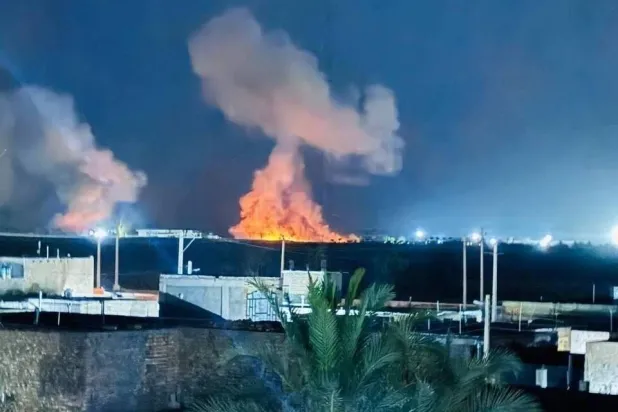
The United States expanded its strikes on Iran early Thursday in a second round that US Central Command (CENTCOM) said targeted about 90 military sites, a day after bombing about 80 other targets, bringing the total number of US targets in 24 hours to about 170, in an escalation that pushed the interim memorandum of understanding between Washington and Tehran to the brink of collapse.
The new strikes came hours after US President Donald Trump said the recent Iranian attacks on ships in the Strait of Hormuz signaled the end of the fragile ceasefire, warning that any new attacks on commercial shipping would lead to 'much worse' strikes.
Iran's Health Ministry said Thursday that the US airstrikes over the past two days had killed at least 14 people and wounded 78 others, the first overall casualty toll announced by the Iranian government since the start of the new round of attacks. State media said most of the dead were members of the armed forces.
Hossein Kermanpour, the Health Ministry spokesman, announced the toll on social media. State media reported at least three people killed in Ahvaz province in southwestern Iran, while authorities in Iranshahr in Balochistan province, bordering Pakistan, said a strike killed a firefighter at an airport. These deaths came after at least nine members of the Iranian armed forces were killed in Wednesday's strikes, according to state media.
170 targets in a day
CENTCOM said Wednesday that US forces struck about 90 targets in Iran as part of an additional effort to weaken Tehran's ability to attack commercial ships and civilian sailors in the Strait of Hormuz.
The US command added that the strikes hit air defense systems, coastal surveillance assets, missile and drone storage sites, naval capabilities, and military logistics infrastructure along the Iranian coast.
This round came a day after US forces conducted what CENTCOM described as 'offensive' strikes inside Iran, targeting about 80 military sites, including air defense systems, command and control networks, coastal radar sites, anti-ship missile capabilities, and more than 60 small boats belonging to the Revolutionary Guard in and near the Strait of Hormuz.
CENTCOM said in a post on platform X, accompanied by a video of airstrikes, that the goal was to 'further weaken Iran’s ability to attack commercial ships and innocent civilian sailors in the Strait of Hormuz.' It also said the United States is 'holding Iran accountable' for what it described as 'unprovoked aggression' against commercial shipping and civilian crews in a vital international waterway.
The first US strikes came after three oil tankers were hit by shells in the Strait of Hormuz. Concurrently with that round, Washington revoked a license that had allowed Tehran to sell oil, a move Iran considered part of a breach of the memorandum of understanding.
A US Marine Corps F-35C stealth fighter prepares to take off from the aircraft carrier USS Abraham Lincoln in the Arabian Sea (CENTCOM)
From Coast to Interior
The new US round began with strikes on military sites linked to the Strait of Hormuz, where coastal radars, anti-ship missile platforms, fast boats, and surveillance centers are concentrated. Then the scope of targeting expanded to include sites in the interior of Iran, including bridges and railway lines on routes of economic and logistical importance.
Iranian state television reported explosions heard in several cities after the United States announced the start of a second night of strikes. The Revolutionary Guard-affiliated Fars agency said explosions were recorded in the ports of Chabahar and Konarak east of the Strait of Hormuz, as well as in Bushehr on the Persian Gulf.
The semi-official Mehr agency reported several explosions heard in Bushehr province, which houses Iran's only commercial nuclear power plant.
Bushehr is also near Kharg Island, the center of Iranian oil exports. State media also reported explosions heard in the coastal city of Bandar Abbas opposite the Strait of Hormuz in southern Iran late Wednesday evening local time, without their source being clear.
0 seconds of 0 secondsVolume 90%
Press shift question mark to access a list of keyboard shortcuts
00:00
00:00
The strikes moved from the coast to the interior after the Revolutionary Guard-affiliated Fars agency reported that a US attack overnight targeted a railway bridge in Golestan province in northeastern Iran, on the Tehran-Mashhad line.
The agency said the attack damaged a land trade route connecting Iran to China and Russia via Turkmenistan and Kazakhstan, noting that this route had grown in importance during the US blockade of Iranian ports in the Persian Gulf. It added that Russia has been using the same route to transport goods to Iran since late 2025.
Iranian state television announced the suspension of train services between Tehran and Mashhad, while the railway operator said repair teams were sent to the site and authorities are working to provide ground alternatives for stranded passengers.
Iran's Foreign Ministry condemned the US strikes, saying they targeted 'several points' in southern coastal provinces early Thursday, in addition to two bridges in eastern provinces on the railway line to Mashhad.
It described the attacks as 'aggressive' and a 'grave war crime,' affirming Iran's determination to defend its territorial integrity, sovereignty, and national security.
Damage on the Tehran-Mashhad railway in northeastern Iran (Telegram)
The ministry said the US strikes over the past 48 hours came under the pretext of responding to what it called 'alleged incidents' involving 'violating' passing ships in the Strait of Hormuz.
It considered the attacks a violation of Article 2, paragraph 4 of the UN Charter and an 'egregious breach' of clauses 1 and 5 of the war-ending memorandum of understanding. It added that Washington is using these strikes, in its words, as a pretext to justify its 'continued non-compliance' with the memorandum.
Foreign Ministry spokesman Esmaeil Baqaei said clause 5 of the memorandum affirms Iran's responsibility for determining safe passage arrangements for ships through the Strait of Hormuz, an argument rejected by the United States. He added that Washington defied this clause and violated the agreement's structure through unilateral measures and military strikes.
The Iranian Joint Staff Operations had earlier threatened a 'crushing response' after the first round of strikes, accusing Washington of blatant aggression and warning that Tehran would not allow US intervention in the management of the Strait of Hormuz.
0 seconds of 0 secondsVolume 90%
Press shift question mark to access a list of keyboard shortcuts
00:00
00:00
Iranian attacks
The Iranian army said it used drones to target a Patriot system in Kuwait, an early warning system in Qatar, and fuel depots in Bahrain, in what state media described as a continuation of attacks against US bases in the region. Residents in Qatar received a brief security alert on their phones, followed by a message saying the threat had been cleared.
Original source: Asharq Al-Awsat



Comments (0)
Be the first to comment.