Ahmadinejad's office denies ties with Israel, publishes photos of his movements in Tehran
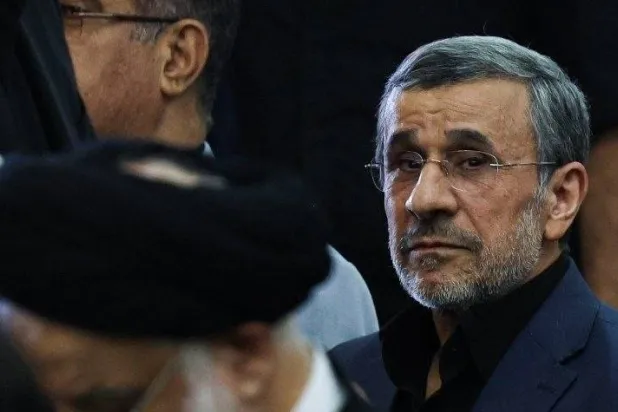
The office of former Iranian President Mahmoud Ahmadinejad on Tuesday denied a US newspaper report about contacts between him and Israeli intelligence and his being under house arrest.
The office of former Iranian President Mahmoud Ahmadinejad on Tuesday denied a report by an American newspaper about contacts between him and Israeli intelligence and his being under house arrest, before official media outlets and his website published photos documenting his participation in a memorial ceremony for former Iranian Supreme Leader Ali Khamenei and his holding meetings at his office in Tehran.
The response came a day after The New York Times published a detailed report saying that Israel worked for years to prepare Ahmadinejad to be part of a plan to change the regime in Iran, and that operatives from the Mossad moved him to a safe house after targeting his residence in the early days of the war.
Ahmadinejad's office said what the newspaper published was a "complete lie," describing it as containing "Hollywood claims" and a "ridiculous scenario," in an attempt to "create confusion and wage psychological warfare" on Iranians.
A statement published on Ahmadinejad's website 'Dolat-e Bahar' said that the former president continues his "ongoing affairs" and works in the service of citizens, categorically denying that he is under house arrest or that he has ties to Israel.
The statement said the office had refrained from responding to a previous report by the newspaper published 55 days ago, due to what it described as "the flimsiness and lack of credibility of the scenario," but decided to respond this time "in view of political considerations and the sensitive circumstances the country is going through, and to thwart the sedition of the enemies."
The statement accused the newspaper of being "ready, in exchange for money, to publish fake articles and news originating from disreputable elements," using harsh language in attacking the newspaper and those who worked on the report.
A photo published by the official IRNA news agency of Ahmadinejad offering condolences to Khamenei's sons Mostafa and Masoud, with Deputy Secretary of the Supreme National Security Council Ali Bagheri Kani seen giving a statement to state television in Tehran on Monday.
Repeated public appearances
It was notable that the controversial Ahmadinejad participated in the memorial ceremony for Khamenei at the Tehran prayer hall, attended by a number of Iranian officials, hours after his office published its response to the newspaper.
The official IRNA news agency published a photo of Ahmadinejad offering condolences to Khamenei's sons, Mostafa and Masoud, in his first documented appearance after his office denied what was reported in The New York Times report about him being under house arrest.
That was his second public appearance in days, after he briefly participated on July 6 in Khamenei's funeral procession. Recordings from the ceremony showed Ahmadinejad with his head bowed, surrounded by security personnel, in his first appearance since his residence in Tehran was targeted on February 28.
On the same day, the 'Dolat-e Bahar' website published photos of Ahmadinejad during a meeting he held in his office with a group of friends, colleagues, and advisers.
The website said the meeting discussed current developments in the country, and that attendees offered condolences for the death of a number of Ahmadinejad's guards who were killed in the US-Israeli strike that targeted his workplace and residence at '72 Narmak' square in Tehran.
A photo published by 'Dolat-e Bahar' website from a meeting of Ahmadinejad and a number of his advisers on Monday.
It added that the site was hit by two guided missiles on February 28, killing five security personnel and injuring two others.
At the same time, the office also revealed that Ahmadinejad participated on Saturday in a meeting of the Economic Committee of the Expediency Discernment Council, which was dedicated to discussing ways to deal with the current economic situation.
'Dolat-e Bahar' said that during the meeting, Ahmadinejad presented his expertise and viewpoints to the council members, a step that showed his continued participation in one of the institutions linked to decision-making centers in Iran.
Report on an Israeli plan
The New York Times report, published on Monday, said that Ahmadinejad's visit to Budapest in 2024, and another visit the following year, were part of a years-long Israeli effort to prepare him to become an "intelligence asset" who could be installed as leader of Iran if the regime changed.
The newspaper quoted former US officials as saying that former Mossad chief David Barnea traveled to Budapest in 2024 to meet Ahmadinejad in person, and that the agency later informed the US Central Intelligence Agency of its contacts with him.
The report said that in recent years, Israel paid money to cover Ahmadinejad's housing and travel expenses, and that Israeli operatives met him abroad on several occasions.
It added that the operation reached its peak in the early days of the war, when an Israeli strike targeted Ahmadinejad's compound, his guards' building, and his armored vehicle.
Ahmadinejad speaks to people during the memorial ceremony for the former Supreme Leader, attended by senior Iranian officials in Tehran on Tuesday (Dolat-e Bahar).
According to four senior Iranian officials who spoke to the newspaper, following the strike, a black Peugeot car arrived and quickly moved Ahmadinejad from the site. US and Iranian officials familiar with the operation said the car was driven by Mossad operatives, and he was taken to a safe house inside Iran.
The newspaper reported that Ahmadinejad appeared unhappy with the extraction process, and that he later left the safe house under unclear circumstances, before Iranian authorities placed him under house arrest after discovering part of his contacts with Israel.
It also said that Ahmadinejad was part of a broader plan to change the regime, which included arming and training Iranian Kurdish opponents in northern Iraq, aimed at entering western Iran and taking control of areas before advancing toward Tehran, but the plan was not implemented.
Israeli officials did not publicly comment on the report, and Mossad officials did not respond to the newspaper's requests for comment.
Previous report
The New York Times had published a previous report on the same file in May, saying that the strike targeting Ahmadinejad's residence at the beginning of the war was part of an attempt to remove him from security surveillance and launch a plan to install him in a post-regime era.
According to the two reports, US and Israeli officials believed at one point that Ahmadinejad might be able to play a role in running the country after a joint military attack on Iran.
Ahmadinejad during his participation in the memorial ceremony for former Supreme Leader Ali Khamenei in Tehran on Monday (Dolat-e Bahar).
The new report provided details about possible meetings between Ahmadinejad and Israeli officials abroad, particularly in Hungary, and about the widening of his differences with the ruling establishment after he was barred from running for president three times.
A former adviser told the newspaper that Ahmadinejad was seeking a return to power, and that he presented himself to his circle as a figure capable of leading a transitional period and reshaping Iran's foreign relations.
However, Ahmadinejad's office did not respond in detail to each point raised in the report, limiting itself to a comprehensive denial of what it described as "false claims," while publishing photos of his movements and meetings, and appearing at an official ceremony hours after the statement was issued.
Read also
Original source: Asharq Al-Awsat


Comments (0)
Be the first to comment.