Gaza Tailor Turns War Rubble into Wedding Dresses
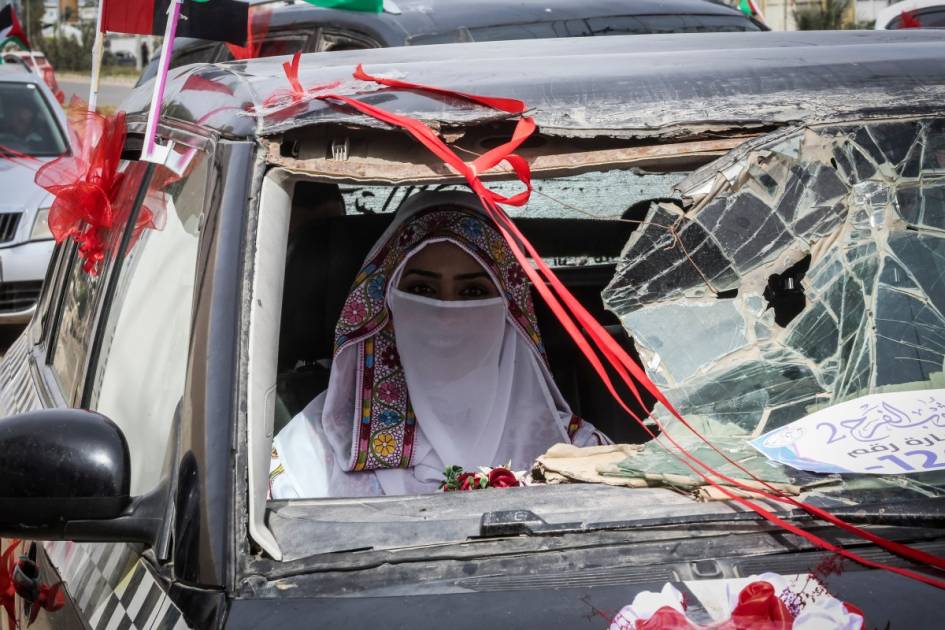
A Gaza tailor, Amir al-Rantisi, turns fabric remnants from war rubble into wedding dresses, using a bicycle-powered sewing machine to overcome power cuts, helping brides find joy amid destruction.
Summary: Every white stitch piercing this fabric extracted from under the rubble is met by a drop of sweat flowing from Amir's forehead, and every up-and-down movement of the needle is a muscular battle to sew a pure white wedding dress with which he mends the brokenness of the Strip's girls.
From the darkness of a shop whose facade was bombed in Khan Younis, a monotonous sound emanates: the rattle of metal gears and the friction of an old bicycle chain forced to spin in place to power the sewing machine.
The surroundings are submerged in the destruction caused by the military fighting between Hamas and Israel, but amid this rubble, tailor Amir al-Rantisi prepares a pure white wedding dress with layers of tulle, proudly hanging it on a protruding iron rod extending from a concrete pillar still standing amidst the destruction.
The elegant dress, in all its splendor, is not made from new imported fabrics, but is entirely woven from remnants of partially burned clothes and dresses, extracted from under the rubble of homes destroyed by the war.
On an old wooden table, young Amir's hands are busy directing the fabric remnants with utmost precision, millimeter by millimeter, under the needle of the fast sewing machine.
Amir's movement with the sewing machine is linked to the harsh muscular effort exerted by his brother Youssef to move the gears of a bicycle chain in order to move the needle and thread, instead of running the machine on electricity, which has been cut off from Gaza for three consecutive years.
Every white stitch piercing this fabric extracted from under the rubble is met by a drop of sweat flowing from Amir's forehead, and every up-and-down movement of the needle is a muscular battle to sew a pure white wedding dress with which he mends the brokenness of the Strip's girls.
The idea when it occurred and ignited
The war imposed a tight blockade on Gaza, closed crossings, froze markets, and sent clothing prices skyrocketing to astronomical sums, making it impossible for girls to obtain a wedding dress.
Hence, the idea of alternative sewing of fabrics damaged by shrapnel and burns to make women's wedding dresses dawned on Amir's mind, in a social and humanitarian rescue attempt. He says, 'The dress I made in my workshop is not just a passing cosmetic piece, but rather a confirmation that the will to celebrate is stronger than the daily attempts to crush and erase.'
Amir makes fully elegant wedding and evening dresses, using exclusively clothing remnants he extracts from under the rubble of destroyed homes and shops in the Gaza Strip, trying to help women recover their wedding trousseau that missiles buried under the rubble.
The elegant dress, in all its splendor, is not made from new imported fabrics, but is entirely woven from remnants of partially burned clothes and dresses (AFP)
At the threshold of the workshop in Khan Younis, concepts of 'fashion' collapse, as the place is not bounded by four walls, and a break in the western wall caused by a shell makes the wall a stage giving passersby a chance to watch the stages of sewing a wedding dress.
There are no shiny glass facades or bright lighting in Amir's workshop, as the walls are covered with powders of ash and smell of war, and instead of the missing plastic mannequins, Amir adapted the harsh surroundings to alternative display methods.
The young man bent the iron rods protruding from the collapsed pillars, and fixed above the scattered concrete blocks dresses of tulle, silk, and satin, so that on the iron they appear like bright flowers sprouting miraculously from the heart of destruction.
The complete power outage in Gaza was enough to end any designer's dream, but Amir dismantled an old bicycle and manually connected the gears of its iron chains to the motor and pulley of the traditional sewing machine, and assigned young Youssef solely to operate it.
Gaza deprived of the needle
The child sits on the floor near the machine, gripping the bicycle pedal with his small hands and turning it with strength and determination, so the gears spin to generate energy. At that moment, Amir bends with full concentration to guide the fabrics with extreme precision under the fast needle.
Amir says, 'The skill of sewing has turned into continuous pressure on the joints that we all share to produce one dress, the work on which takes days.' Amir pauses for a moment, wipes his forehead with his shirt, and speaks in a calm tone: 'The war closed everything in our faces, even the thread and needle were denied to us. When the machine needle broke to the exact size for the first time, I felt my project was over, as the markets are completely empty due to the blockade and closure of crossings.'
Read more
Gaza's worn-out fabrics, dresses of its little princesses
Gaza's laboratories without reagents for life-saving medical tests
9 Palestinians killed in several areas of Gaza by Israeli fire
Artificial eyes reconcile the faces of Gaza's wounded with the mirror
He continues his talk: 'We spent long days searching among the rubble, trying to repair old needles with sandpaper until they became fit for piercing and embroidery and completing the promised dress. We are not only sewing fabric, but we are sewing our time and nerves to give people a chance for joy.'
Amir contemplates the thread extending in the machine, then continues: 'Look at these colors, the white thread spools have become scarce and their prices jumped fivefold, a cost that displaced families cannot bear. When I fail to find a pure white thread matching the wedding dress, I do not give up; I use light gray or beige threads available to me, and sew them with entirely hidden circular stitches inside the layers of tulle and thick linings of the dress.'
Amir reveals: 'From the outside, the eye sees a pure white dress, but the inside of the garment carries a complete geography of alternative colors imposed on us by the scarcity of war and limited options.'
A bride behind this danger
Amir did not find fabrics in the markets, so he crawled towards the destroyed areas to begin the journey with fear, walking long kilometers through potholed roads next to tilting buildings resembling skeletons that could fall at any time.
He approaches the rubble of a destroyed house, bends down and crawls on his knees into dark tunnels and narrow concrete cavities, under cracked ceilings from which cut iron nets hang.
The air inside is almost nonexistent, saturated with humidity, suffocating gases, and the smell of death emanating from deep within the rubble. He uses a small phone flashlight and a small axe to break concrete blocks weighing tons. And when he finds a roll of fabric or an old wedding dress, he does not pull it easily, but is forced to extract it from among the building blocks. He says: 'The cloth roll, which was 50 meters long, comes out like a corpse, half charred by fire, and parts of it melted from the heat of explosions, and what survives needs effort to rescue.'
Amir dusts off the clinging dust from his shirt, and small scratches and wounds appear on his hands. He whispers: 'Every step under the rubble is an adventure from which I may not return. I was crawling towards a wardrobe under a hanging ceiling to extract a wedding dress, when suddenly I heard a ticking sound and a slight drop of cement above my head. The blood froze in my veins, and I held my breath for seconds. I pulled the dress frantically and crawled out on my stomach, and within one minute the passage collapsed. I enter into death and wrestle it to get a meter of white satin, because I know that behind this danger there is a bride preparing in her tent for joy.'
A rose in the place of the shrapnel
Amir's journey does not end with bringing the fabric; after that comes the sorting stage. He holds a piece of white satin, water still unable to remove a black charred spot on its edges. He says: 'Digging in the rubble is not just collecting materials. When I retrieve a torn dress, I feel its edges and wonder: Who is the bride who wore it? Did she survive or leave?'
Original source: Independent Arabia




Comments (0)
Be the first to comment.