Peace Council Plans to Establish Experimental Humanitarian Zone in Southern Gaza

A senior official in the Peace Council, established by US President Donald Trump, confirmed plans to establish an experimental humanitarian zone in southern Gaza aimed at accommodating tens of thousands of Palestinian civilians who will undergo security screening procedures.
The official explained that this zone could serve as a 'launching pad' for the Palestinian technocratic committee that is set to manage daily life affairs in the Gaza Strip during the transitional post-war phase, under Trump's 20-point plan.
The official added, 'There is a pilot project we are specifically studying, which may provide the National Committee for Gaza Management with a launching pad, and could allow tens of thousands to voluntarily relocate to this area if they wish, and then begin granting them a space to exercise actual governance, with the committee taking over administrative affairs.'
According to the official, multinational forces under the International Stabilization Force (ISF), an emerging body operating under the Peace Council, will secure the area that the Council is considering establishing in Rafah in the southern Gaza Strip.
As for the National Committee for Gaza Management, a group of Palestinian technocrats established by the Peace Council, it will handle security screening and regulate entry into the area, with support from the International Stabilization Force.
The official, speaking on condition of anonymity, said that 'entry and exit from the area will remain freely available to all unarmed civilians.'
Efforts to advance the US-backed ceasefire plan in Gaza have stalled for months, and the National Committee for Gaza Management remains in Cairo, unable to enter the Strip so far.
Since the truce between Israel and Hamas took effect last October, Israeli forces have expanded their deployment inside the Gaza Strip and now control more than 60 percent of its territory.
Disallowing armed individuals.
The idea of creating closed humanitarian zones, which has been discussed in various forms over the past months, has raised reservations.
Diplomats and officials from NGOs working in Gaza, speaking to AFP on condition of anonymity, said this mechanism seems to them incompatible with international humanitarian law.
They explained that concentrating civilians in specific areas with entry and exit controls could amount to forced displacement, restrict Palestinian freedom of movement, and undermine the principle of humanitarian neutrality.
Although the Council is studying the project in Rafah, according to the official, the exact location has not yet been determined, and he noted that construction has not started.
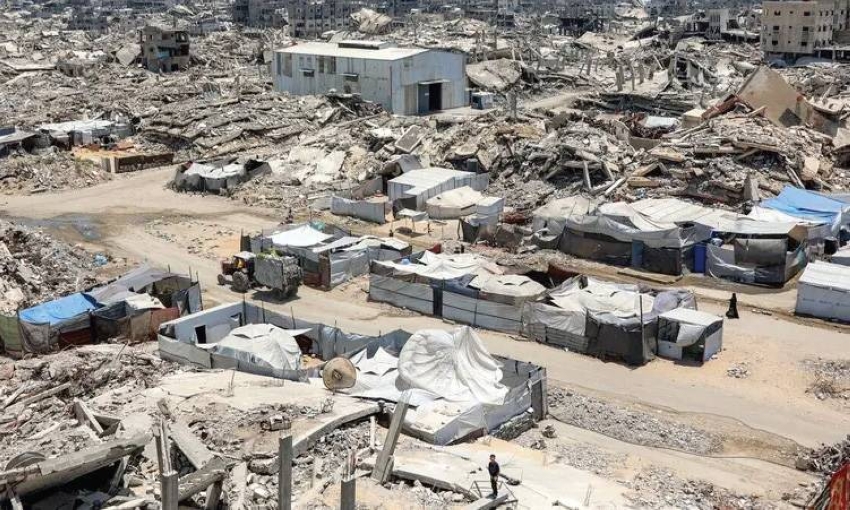
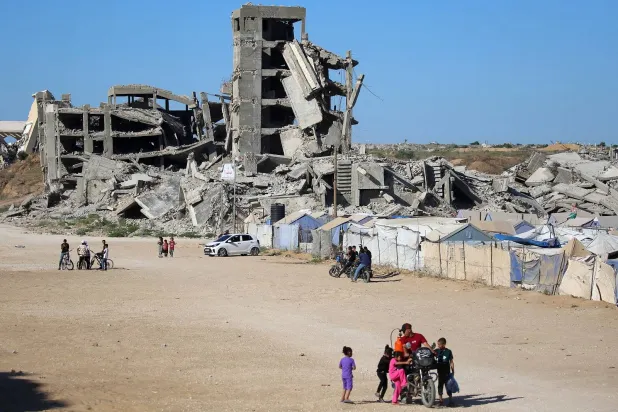
Rafah is located in the far south of the Gaza Strip and has suffered extensive destruction during the war due to Israeli shelling, and the area is now largely under Israeli military control.
The official added that the deployment site of the International Stabilization Force will serve as a 'buffer zone' separating Palestinian residents from Israeli forces.
He explained, 'A security screening mechanism will ensure that armed individuals or fighters do not enter these safe humanitarian zones.'
The official noted, 'The Israeli military will not carry out this task, will have no contact with the civilian population, and will have no role in isolating these areas from the rest of the Gaza Strip.'
The Peace Council was officially announced earlier this year as part of the US-backed Gaza ceasefire plan, which was approved by the UN Security Council.
The Council aims to end Hamas's administration of the Strip, support civil governance, and restore basic services.
Demands for Immediate Release of Dr. Abu Safiya
Independent UN experts demanded that Israel immediately release Palestinian doctor Hussam Abu Safiya, who was arrested by Israeli forces in December 2024 during its war on the Gaza Strip, pointing to reports that he suffered severe torture and life-threatening injuries.
Abu Safiya, a pediatric specialist and director of Kamal Adwan Hospital in Gaza, came to prominence in 2024 after disseminating information about the deteriorating conditions at the besieged hospital in Beit Lahiya during the Israeli attack on it.
On December 27, 2024, Israeli forces launched a large-scale raid on the only remaining functioning health facility in the northern Strip, arresting dozens of its staff, including Abu Safiya, under the pretext that the hospital was a 'terrorist center' affiliated with Hamas.
Four independent UN experts said in a statement that 'the continued arbitrary detention of Dr. Abu Safiya without charges or trial reflects Israel's systematic targeting of Palestinian health workers.'
The experts accused Israel of aiming, through 'the ongoing destruction of the healthcare system in Gaza,' to 'impose conditions leading to the physical and psychological destruction of Palestinians,' noting that the experts are mandated by the UN Human Rights Council but do not speak officially on behalf of the international organization.
They noted that they had previously expressed concerns to Israel regarding the 'Unlawful Combatants' law and its legality.
Based on reports that Abu Safiya suffered 'severe and continuous torture' and that his injuries 'could lead to imminent death,' the experts stressed that Israel must ensure he receives 'immediate and appropriate medical care.'
Among the signatories of the statement was Francesca Albanese, the UN Special Rapporteur on the situation of human rights in the occupied Palestinian territories, who accuses Israel of committing 'genocide' in the Gaza Strip.
The experts said that Israel's war on Gaza 'has turned the practice of medicine into a crime, and made health workers targets of harassment, intimidation, arrest, torture, and killing.'
Irish Parliament Bans Israeli Imports
The Irish Parliament passed a bill banning the import of goods from Israeli settlements in the occupied Palestinian territories, as Dublin moves forward with adopting one of the toughest European trade measures in this regard.
The legislation stipulates a ban on importing goods from 'specified Israeli settlements' located outside Israel's internationally recognized borders, covering all items related to housing, agriculture, and trade.
While Ireland is the first EU member state to proceed with this ban, Spain began implementing a package of restrictions on imports from Israeli settlements as of October.
The center-right coalition government said the drafting of the legislation it prepared was based on the 2024 advisory opinion of the International Court of Justice, which deemed Israel's occupation of the West Bank, East Jerusalem, and the Gaza Strip illegal under international law.
Ireland has been at the forefront of criticism of Israel's war on the Gaza Strip, and recognized the State of Palestine in 2024. At that time, Israeli Foreign Minister Gideon Sa'ar ordered the closure of his country's embassy in Dublin, accusing it of pursuing 'extreme anti-Israel policies.'
Last month, Dublin barred Israeli National Security Minister Itamar Ben Gvir and Finance Minister Bezalel Smotrich from entering its territory, over their conduct towards activists of the 'Global Resilience Flotilla'.
Ireland has long called for a review of the EU-Israel Association Agreement signed in 1995, which forms the basis of trade relations between the two sides.
Original source: Al-Riyadh


Comments (0)
Be the first to comment.