Khalil al-Hayya... What Do We Know About the New Hamas Leader?
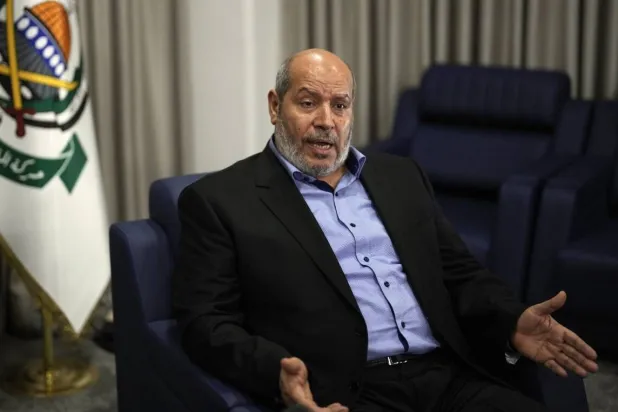
The elections for the head of the political bureau of the Hamas movement resulted in Khalil al-Hayya winning, becoming the leader of the movement for a temporary transitional period that will establish a new phase within the movement, which has suffered a series of assassinations targeting its leaders after the October 7, 2023 attack.
Al-Hayya competed with Khaled Meshaal for the leadership of Hamas's political bureau. This is the first time al-Hayya has assumed the leadership of the movement, noting that during the October 7 attack, he was the deputy of Yahya Sinwar, the head of Hamas in the Gaza Strip. After Israel assassinated former political bureau chief Ismail Haniyeh in late July 2024 while he was in Tehran, Sinwar became the leader of the movement, before he too was killed in October of the same year.
Throughout that period, al-Hayya remained the head of the movement in Gaza, the head of its negotiating delegation for a ceasefire in the Strip, and a member of the leadership council temporarily formed from regional leaders, which included alongside himself and Meshaal: Zaher Jabarin, the movement's leader in the West Bank; Nizar Awadallah as secretary; and Mohammed Darwish, head of the Shura Council.
Al-Hayya was born in the Gaza Strip in 1960, and has been a member of the Hamas movement since its founding in 1987. In the early 1980s, he joined the Muslim Brotherhood, the movement from which Hamas emerged.
Al-Hayya was the target of an assassination attempt aimed at him and Hamas leaders in the Qatari capital Doha in September 2025, which resulted in the killing of his son Hammam and three other companions. Al-Hayya also lost his fourth son, Azzam, in a raid that targeted him along with a field activist in the al-Qassam Brigades, the movement's armed wing, more than a week ago in Gaza.
In 2007, an Israeli airstrike hit his family home in the Shujaiya neighborhood of Gaza City, killing a number of his relatives.
During the 2014 war between Hamas and Israel, the home of his eldest son Osama was bombed, killing him, his wife, and their three children.
During the 2006 legislative elections, in which Hamas competed with Fatah, al-Hayya's name began to shine. He appeared in press conferences opposing the policies of the Palestinian Authority as illegitimate after Hamas's victory in the elections.
(From right) Members of Hamas's leadership council: Mohammed Darwish, Nizar Awadallah, and Khalil al-Hayya during a meeting with the late Iranian Supreme Leader Ali Khamenei in February 2025 (Khamenei.ir - AFP)
With Hamas's takeover of the Gaza Strip in 2007, al-Hayya's name became even more prominent.
As a leader in the movement, al-Hayya moved from local leadership positions within Gaza City to become a sector-wide leader, then a general leader. He consistently received support from leaders of the movement's military wing in Gaza, such as Ahmed al-Jaabari and Izz al-Din al-Haddad. Moreover, the repeated attempts on his life and the killing of several of his sons all contributed to raising his profile within the movement as a leadership figure.
Al-Hayya, like many members of the political bureau in Gaza, was asked by Sinwar before the October 7, 2023 attack to leave Gaza to follow up on certain files. But no one knew the reality of what Sinwar was planning, especially since those asked to leave had tasks related to their external work.
Sources from Hamas told Asharq Al-Awsat that al-Hayya was more informed than many political bureau members about some details of what Sinwar was preparing, but his information was neither complete nor accurate, as only Sinwar and leaders in the military wing knew specific details of the October 7 attack.
During the war, al-Hayya said in an interview published by the Palestinian Information Center, affiliated with Hamas: 'The October 7 attacks, which ignited the Gaza war, were intended to be a limited operation carried out by Hamas to capture a number of soldiers for exchange with Palestinian prisoners,' adding, 'The Gaza Division of the Zionist army completely collapsed,' referring to the Israeli army.
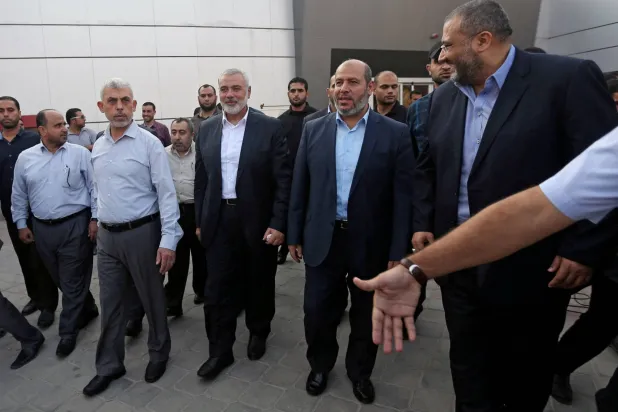
Hamas leaders... from right: Rawhi Mushtaha, Saleh al-Arouri, Ismail Haniyeh (all assassinated), Khaled Meshaal, and Khalil al-Hayya (Archive - Hamas Media)
Throughout the war, al-Hayya remained domestically and externally a defender of Sinwar's decision and the al-Qassam leaders, until he became, alongside Nizar Awadallah (currently the movement's secretary), one of the most prominent figures making fateful decisions in the current negotiations. He also played a role in the 2014 war negotiations and the negotiations of the 'Sword of Jerusalem' battle in 2021.
Al-Hayya is known to be one of those who supported Sinwar's shift toward re-establishing relations with Iran and strengthening ties with Lebanese Hezbollah, to the point that he now has good relations with both sides and leads Hamas's meetings alongside Saleh al-Arouri with the Lebanese party's leadership and Iranian officials. He also represented his movement in a meeting with ousted Syrian President Bashar al-Assad in 2022, steps that were not completed to restore relations between the two sides.
It is expected that al-Hayya will continue the same approach he follows, in connection with what is known as the 'axis of resistance,' which has suffered severe Israeli blows in the period following Hamas's major attack on October 7, 2023.
Al-Hayya is surrounded by many figures who are close to Sinwar and adopt the same approach. Most of these are freed prisoners who were released in the Gilad Shalit deal in 2011.
Facts
Al-Hayya lost several of his sons in Israeli attacks
Al-Hayya was the target of an assassination attempt aimed at him and Hamas leaders in the Qatari capital in September 2025, resulting in the killing of his son Hammam. Al-Hayya also lost his fourth son, Azzam, in an Israeli raid on Gaza City in May of this year.
In 2007, an Israeli raid hit his family home in the Shujaiya neighborhood of Gaza City, killing a number of his relatives.
During the 2014 war between Hamas and Israel, the home of his eldest son Osama was bombed, killing him, his wife, and their three children.
Original source: Asharq Al-Awsat



Comments (0)
Be the first to comment.