Dbeibeh Faces 'Difficult Choices' to Pass 'American Initiative' on Libya
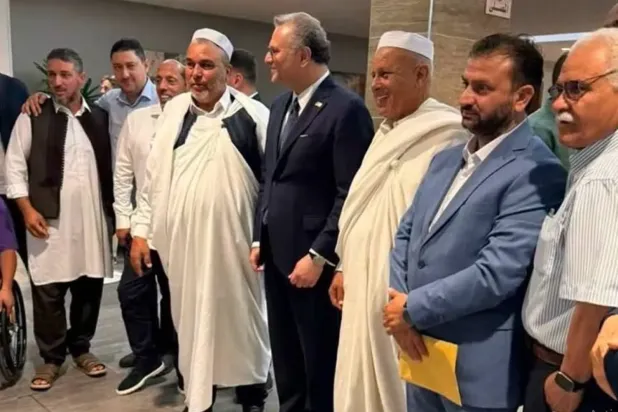
Abdul Hamid Dbeibeh, head of Libya's interim Government of National Unity, finds himself caught between bowing to the demands of those rejecting the 'American Initiative' and clashing with Washington's directives.
The escalating rejection of the 'American Initiative' in cities in western Libya—led by US presidential adviser Massad Boulos to resolve the Libyan crisis under Abdul Hamid Dbeibeh—has placed the head of the interim Government of National Unity in a complex political predicament.
Dbeibeh finds himself facing difficult choices: either yield to the demands of these cities, which constitute his popular and military base, or clash with Washington's directives. The rejection of the initiative centers on granting any political role to Saddam Haftar, deputy commander-in-chief of the 'National Army'.
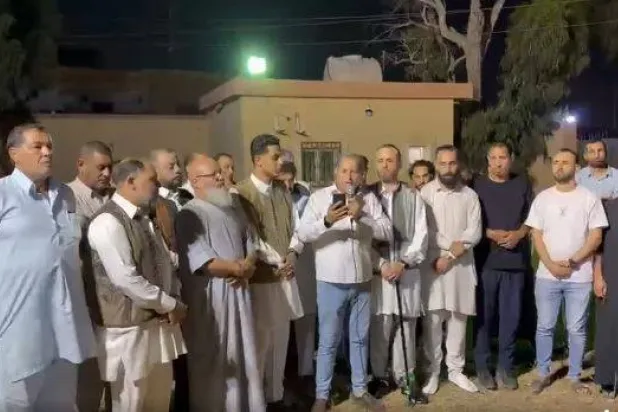
According to observers, Dbeibeh faces a major challenge, especially after military forces in Misrata, Dbeibeh's hometown, maintained their rejection of the initiative, describing it as a 'suspicious deal'.
The American Initiative stipulates keeping Abdul Hamid Dbeibeh as head of a unified government (Unity).
Mohammed Maazab, a member of the High Council of State, believes that the growing rejection in western Libya stems from 'legitimate concerns.' In a statement to Asharq Al-Awsat, he described the initiative as 'a power-sharing deal under American sponsorship between Haftar and Dbeibeh, without popular or electoral mandate, which constitutes an insult to Libyans who reject turning their country into a booty.'
Maazab considered the initiative 'an extension of the transitional period and an entrenchment of division without addressing its roots; most dangerously, it consolidates the legitimacy of the status quo by locking in the figures currently dominating the scene, who may not pave the way for elections or address the roots of division.'
Libya is experiencing a sharp political and administrative division between two competing governments: the first is the Government of National Unity in Tripoli, and the other is headed by Osama Hammad, appointed by Parliament, which administers the east and some southern cities with the support of Khalifa Haftar, commander-in-chief of the 'National Army'.
Field Marshal Khalifa Haftar, commander of the National Army (National Army Command)
According to Boulos's statements in mid-last month, the initiative is based on a political settlement between eastern and western forces, unification of institutions—especially military—and the formation of a unified executive authority to oversee preparations for elections. Political circles speculate that the initiative keeps Dbeibeh as head of a unified government.
Maazab addressed the concerns raised by elevating Saddam Haftar, as a military figure, to a sovereign position, citing 'fears of reproducing military rule in the country.' He also pointed to a 'categorical rejection' of this approach by those affected by the war that the 'National Army' waged on Tripoli in 2019.
Saddam Haftar (AFP)
Libyan political analyst Mohamed Mahfoud ruled out the possibility of the initiative being passed, noting that 'the ambiguity surrounding it gives Boulos and Dbeibeh room to maneuver and sends reassuring messages to the rejecting parties.'
Mahfoud told Asharq Al-Awsat that 'any concessions or guarantees offered to western Libya will immediately raise concerns in the eastern camp and prompt it to demand counter-guarantees,' attributing this to 'the lack of trust between the two camps.'
For his part, a leader of Operation 'Volcano of Rage'—the military operation formed to counter the 'National Army's advance toward the capital—spoke of 'the western region's rejection of any settlement that grants Haftar and his sons any position under the initiative.'
The former military official, who declined to be named, downplayed 'the possibility that Boulos's visit to Misrata in mid-week would change that conviction.'
Interpretations vary regarding Dbeibeh's silence on the initiative, in contrast to the welcome by the General Command of the 'National Army' in the east. While some say he 'implicitly rejects it and prefers to maintain the status quo, leaving the confrontation to the street,' others express 'fear that Saddam Haftar's assumption of the presidency of the Presidential Council would lead to the removal of his government.'
Mohamed al-Menfi outside the calculations of the American Initiative (Reuters)
Libyan political analyst Houssam al-Abdali believes that the movement rejecting the initiative indicates 'Dbeibeh's lack of absolute control over the political and military scenes in western Libya through his close relations with key figures and armed factions there.'
Al-Abdali told Asharq Al-Awsat that this rejection 'will weaken Dbeibeh's negotiating position with domestic and international parties, and may later prompt Washington to consider replacing him.'
Despite rising rejection from military formations and influential social entities in Tripoli and Misrata, and the opposition of the Mufti of western Libya, Sadiq al-Ghariani, al-Abdali believes there is 'another significant segment in the region that welcomes any settlement that unifies the country and its institutions.'
Al-Abdali opined that 'revealing more details of the initiative, or including points such as the date for elections, drafting a permanent constitution, and setting the term of the Presidential Council and the anticipated government, could broaden the circle of support for it.'
Al-Abdali concluded that 'expanding the initiative by including political figures and bodies might give it hope for acceptance, but that does not guarantee its long-term success.'
Boulos had made a visit to Libya last Tuesday, beginning it with a meeting with military leaders, notables, elders, and civil society institutions in Misrata. The meeting ended with those forces rejecting what they called 'the militarization of Libya' or 'pushing dishonest figures, whose involvement in corruption cases or human rights violations has been proven by international reports.'
Original source: Asharq Al-Awsat
Comments (0)
Be the first to comment.