Politics and Sports (Two Sides of the Same Coin) - Prof. Dr. Othman bin Saleh Al-Amer
Football is no longer just ninety minutes where twenty-two players compete on the green rectangle; it has become one of the most important soft power platforms in the world. World Cup matches, for example, have turned into a stage where politics meets sports, where presidents and kings appear as stars on the field and fans in the stands, and the sports scene throughout the tournament days has become a political message par excellence.
In this World Cup (the 2026 World Cup, which concluded last Sunday evening), this overlapping scene appeared more clearly than ever. US President Donald Trump attended the forefront of the event, and his presence in the tournament became part of media and political discussion, at a time when his relationship with the leadership of the International Federation of Association Football (FIFA) sparked widespread debate about the boundaries between politics and sports, especially after the controversy surrounding the suspension of American player Folarin Balogun.
On the Spanish side, the presence of King Felipe VI was not just a royal protocol, but a message of support for a team representing the identity of the entire nation. When the king stands alongside the young star Lamine Yamal, the image transcends the boundaries of sports celebration to become an announcement of sport's ability to create new national symbols around which fans rally.
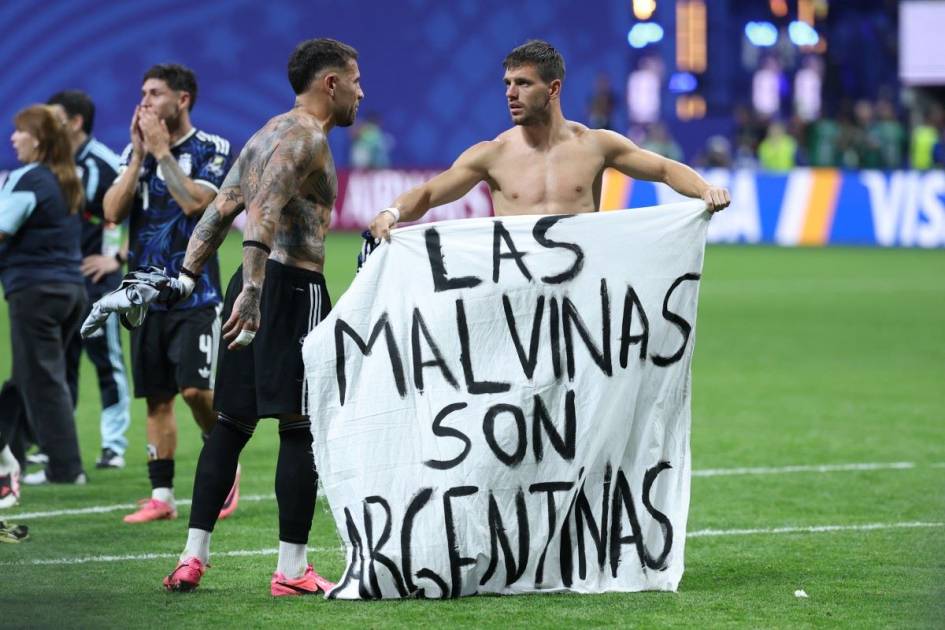
In Argentina, presidents have become accustomed to investing the overwhelming popularity of football as an element of national identity. Pictures of politicians with players or with balls are not just spontaneous shots, but carefully crafted messages addressing the sentiments of the people; for football there is not just a sport but part of national history and collective memory.
Speaking of which, the diplomatic arena previously witnessed a sharp exchange between Spain and the Israeli enemy, where Israeli Defense Minister Israel Katz strongly criticized player Lamine Yamal for raising the Palestinian flag during Barcelona's celebrations, demanding that the club's management disassociate itself from him. In response, Spanish Prime Minister Pedro Sánchez defended Yamal, considering that his raising of the flag expresses the feelings of solidarity with Palestine felt by millions of Spaniards.
In the past few days, Israeli Prime Minister Benjamin Netanyahu heads a football while receiving the Argentine Ambassador to Israel, Shimon Axel Wahnish, to affirm the Israeli enemy's support for the Argentine national team!?
The symbolic images showing some leaders engaging with football as a common language with citizens, even if in the form of a funny shot or a reception carrying popular connotations, strongly express the real overlap between the two poles: the political on one side and the sports on the other.
The politician realizes that audiences may differ over economic programs or partisan positions, but they often unite around national teams. This is why football has become an effective means to enhance the state's image, ease tensions, highlight national cohesion, and sometimes even convey diplomatic messages that official speeches cannot deliver to the same extent.
However, this overlap imposes a great responsibility; sports lose some of their spirit if they become a tool for political conflict, and politics loses a lot if it directly exploits sports emotions. For this reason, international sports charters emphasize the principle of independence of sports, although reality proves that complete separation between them is almost impossible.
The World Cup has proven that football is no longer just a game kicked with feet, but a global language spoken by nations, and a means reflecting influence, identity, and belonging.
For when a king appears next to a player, or a president on the podium, or a leader celebrates a football as he celebrates the emblem of his homeland, the message transcends the green rectangle to a broader space, titled: politics and sports, no matter how much they try to distance themselves, remain two facets of influence on public opinion and the making of mental image of nations. Stay well, until we meet again, and peace.
Original source: Al-Jazirah



Comments (0)
Be the first to comment.