Artificial Intelligence Transforms Humanitarian Work: Smart Vehicles and New Tools to Save Lives
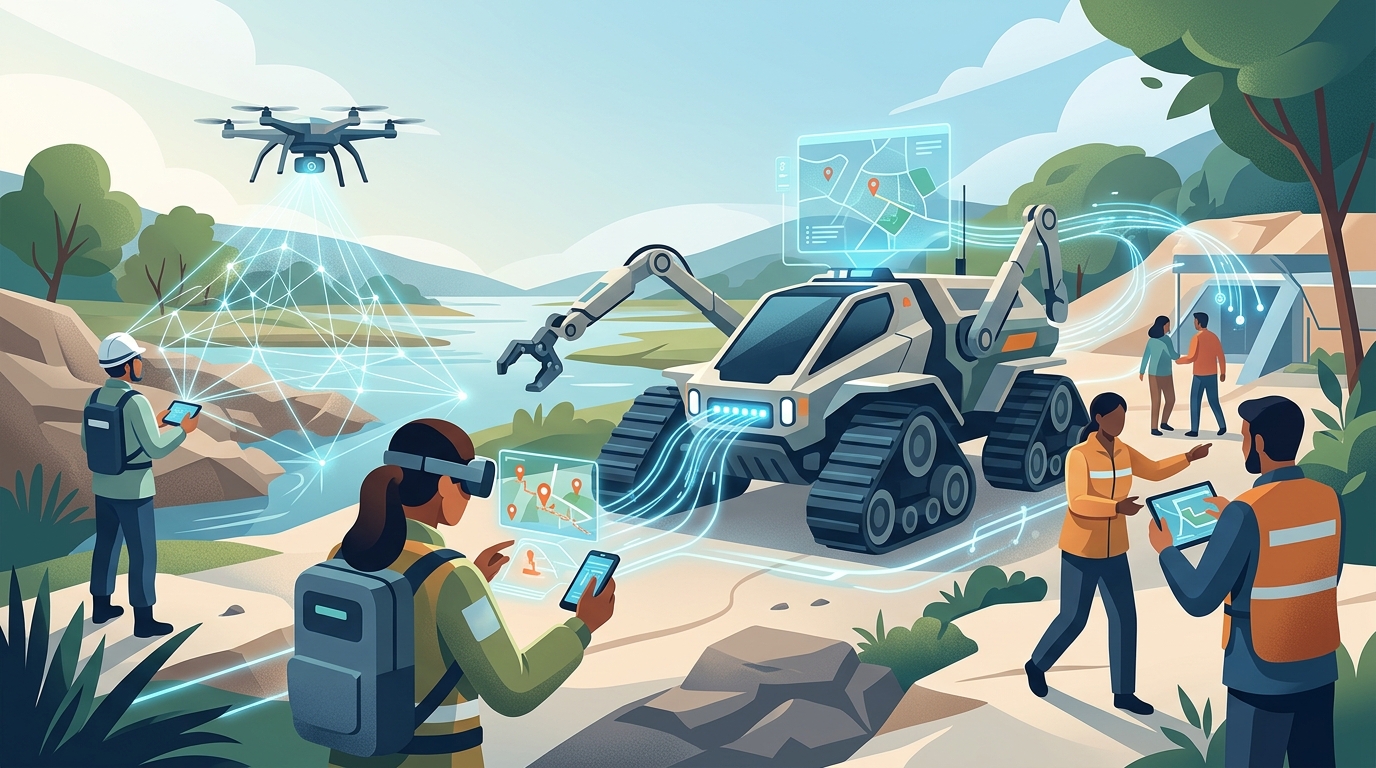
Humanitarian organizations are leveraging AI to enhance operations, including remote-controlled vehicles for rugged terrain and data analysis tools to track population movements, while also addressing risks like data protection and misinformation.
Humanitarian organizations are seeking to harness the potential of artificial intelligence to improve their operations, such as adopting remotely controlled vehicles to reach rugged areas and data analysis tools to monitor population movements.
There are numerous warnings about the risks posed by artificial intelligence to humanitarian organizations, which must protect highly sensitive data and counter the spread of misinformation about their activities and the people they assist.
But at the 'AI for Good' summit, held this week in Geneva, the pavilions dedicated to humanitarian work focused primarily on AI's potential to bring about a qualitative leap in this sector, according to AFP.
Parked in the vast hall of the Palexpo conference center was a huge white vehicle resembling a giant Mars rover, equipped with cameras, sensors, and a drone landing platform on its roof.
The World Food Programme is preparing to launch field trials of an AI-powered version of this vehicle that can be driven remotely over the most difficult and dangerous terrains.
In an interview with AFP, Bernhard Kowatsch, head of the World Food Programme's global Innovation Acceleration Programme, said, 'This technology will allow us to reach people who would otherwise be unreachable.'
The WFP already uses SHERP amphibious vehicles, designed in Ukraine for harsh environments, to deliver aid in Sudan, South Sudan, and Uganda.
But after losing several drivers, the program asked the German Aerospace Center to equip these vehicles with AI and other technologies for remote control in high-risk areas.
Armin Wedler, coordinator of the AHEAD (Autonomous Humanitarian Emergency Aid Devices) project at the German Aerospace Center, said tests have been conducted in Germany, with practical trials scheduled in Uganda in 2028.
Explaining to AFP while standing next to the 2.8-meter-high vehicle, he said the team used 'techniques based on mathematics and classical research' in addition to AI.
He acknowledged the possibility of making the vehicle fully autonomous, but 'the human element must remain present' in complex humanitarian situations.
He said, 'We're not talking about driving on well-marked roads with clear lanes. There are no roads at all,' also noting cases where trucks are suddenly surrounded by hungry crowds.
He added, 'No autonomous AI algorithm will be able to handle this safely.'
Among the more than 200 participants at the summit, showcasing technologies ranging from humanoid robots to electronic prosthetics, there were other initiatives from humanitarian actors that were more cautious but no less important.
The UN High Commissioner for Refugees (UNHCR) presented a new AI-powered virtual legal assistant for lawyers and legal professionals representing refugees under various national legal frameworks.
Rebecca Moreno Jimenez, senior data specialist in UNHCR's innovation service, told AFP that preparing cases more quickly and efficiently could 'save the lives of many refugees.'
Another UN initiative called 'Disha' relies on partnerships with private companies like Google and McKinsey to provide humanitarian organizations with data and AI models designed to accelerate and improve disaster response.
One of its projects uses AI to analyze anonymized mobile phone data to track mass population movements during disasters, helping humanitarian workers identify needs and adapt their interventions.
Another project uses AI to analyze satellite images taken before and after disasters, such as the earthquake that struck Venezuela last month, to assess building damage.
Andreas Kortis, product manager at Disha, told AFP that 'the goal is to provide decision-makers with reliable information early enough to enable them to make better decisions.'
Ad material
Ad material
Original source: Al Arabiya





Comments (0)
Be the first to comment.