After 250 Years of Independence: What Does the Future Hold for the US as a Superpower?
After 250 Years of Independence: What Does the Future Hold for the US as a Superpower?
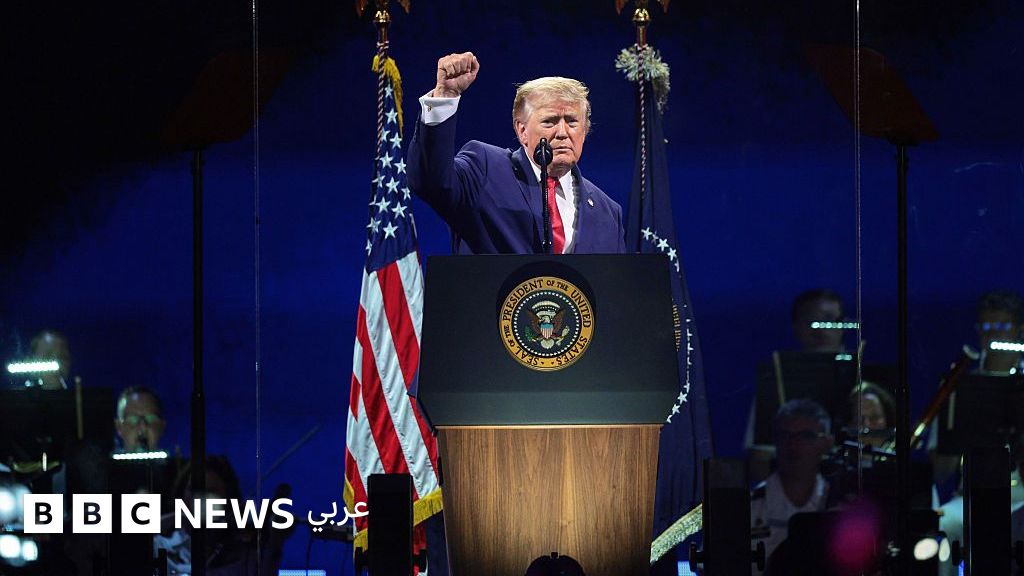
Image caption: US President Donald Trump pledged to make his country 'stronger, prouder, richer, and greater than ever before.'
Published 32 minutes ago
Reading time: 4 minutes
The United States, on July 4, 2026, marked the 250th anniversary of the adoption of the Declaration of Independence, with widespread celebrations across several American states, an event that combined reflection on the nation's journey since 1776 with questions about America's ability to maintain its status as a superpower in the coming decades.
The celebrations included air and sea shows, fireworks, musical and community events, along with official ceremonies held at historic landmarks, most notably the Lincoln Memorial in Washington, D.C., and Mount Rushmore in South Dakota, which features the carved faces of four former U.S. presidents.
At the same time, 150 people from 50 different countries took the oath of citizenship at the home of the first U.S. president, George Washington, in a scene reflecting the role immigration has played in shaping American society.
In his address, U.S. President Donald Trump called on American citizens to commemorate the founding in a manner befitting the nation's history.
Trump added: 'We celebrate, as one American people, and continue to carry the spirit ignited by the nation's founders.' He pledged to make the United States 'stronger, prouder, richer, and greater than ever before.'
From colonies to a global power
The anniversary marks a historic milestone for a nation that began as a union of 13 colonies declaring independence from Britain, before expanding geographically, demographically, and economically, and transforming during the 20th century into the most influential power in the international system, especially after World War II and the end of the Cold War.
U.S. power currently rests on a combination of economic, military, financial, and technological elements.
The International Monetary Fund estimates U.S. GDP in 2026 at $32.38 trillion, keeping the United States the world's largest economy by nominal value.
Skip Most Read and continue reading
Do you really need to avoid gluten?
'The bloodiest in years'... Dozens killed and wounded among Yemeni government forces in Houthi attack
How did Khamenei's funeral turn into a 'propaganda spectacle'? - Article in The Telegraph
Squirrel inspires scientists to spark a medical revolution in treating critical conditions – what's the story?
On the military front, the United States remained the world's largest defense spender, with spending of about $954 billion in 2025, equivalent to 33 percent of global military expenditure, compared to $336 billion for China, according to the Stockholm International Peace Research Institute.
The U.S. dollar continues to play a pivotal role in the global economy, accounting for about 57.13 percent of officially declared foreign exchange reserves in the first quarter of 2026, despite moves by several countries to diversify their currency reserves and reduce reliance on the U.S. currency.
The United States also maintains a notable lead in the field of artificial intelligence. According to a Stanford University report, U.S. private investment in this sector reached $285.9 billion in 2025, more than 23 times the private investment recorded in China, and the U.S. led in the number of new AI companies that received funding.
These factors give the United States significant ability to influence the global economy, trade, technology, and international security.
Damage to America's image in recent years
Skip Podcast and continue reading
Worth paying attention to
In-depth explanation of key events and topics, to help you understand the most important changes around you and their impact on your life
Episodes
Podcast end
In recent decades, the United States has faced widespread criticism for its repeated foreign military interventions, particularly the 2003 invasion of Iraq, which was carried out without a mandate from the Security Council and whose legal basis remained a subject of international criticism.
The legal and political debate was renewed with the American war on Iran in 2026, as war critics said the U.S. strikes were launched without Security Council authorization and questioned whether the conditions for self-defense applied, while Washington insisted its operations aimed to protect its security and prevent Iran from acquiring a nuclear weapon.
Twenty years spent by U.S. forces in Afghanistan, with its human losses, violations, and lack of stable political outcomes, contributed to weakening America's image and credibility.
According to critics, these wars and foreign interventions have weakened American soft power and highlighted a gap between Washington's proclaimed defense of the rules-based international order and its occasional resort to military force outside a broad international consensus.
In the context of its relations with allies, U.S. relations with a number of its traditional European allies have been clearly damaged since the return of President Trump to power, against the backdrop of his administration's repeated criticisms of its Western allies regarding their military spending or handling of domestic issues such as immigration and freedom of speech.
International competition and domestic challenges
In its 250th year, the United States faces increasing strategic competition from China, which has become an economic, technological, and military rival, with a massive industrial base and extensive commercial influence. Russia and other regional powers also attempt to challenge U.S. influence and reshape the balance of power in various regions.
But the future of American power may largely depend on its ability to address its domestic problems. These include rising public debt, widening political polarization, declining trust in institutions, economic inequality, and disputes over immigration and the limits of executive authority.
The Congressional Budget Office expects the publicly held federal debt to rise from about 101 percent of GDP in 2026 to 120 percent in 2036, as a result of persistent budget deficits, rising interest costs, and spending on retirement and health care programs.
Political polarization stands out as another challenge to America's image and external influence. A Pew Research Center survey found that 68 percent of Americans believe that 'their country's democracy was once a model to be emulated, but has not been so in recent years,' while only 24 percent said it 'remains a good model.'
These divisions were reflected in the atmosphere of the celebration itself, with critics saying some events took on a partisan tone, while supporters considered the occasion an opportunity to strengthen national pride and pride in American history.
In your opinion,
What does the future hold for the United States 250 years after its independence?
Have the repeated U.S. wars over the past decades affected its image as a superpower?
What are the most important challenges facing the United States in the coming years?
Is American society experiencing internal division, as some see?
Why have U.S. relations with traditional Western allies deteriorated?
Original source: BBC Arabic



Comments (0)
Be the first to comment.