Burnham on the Test of the 'Special Relationship' with America
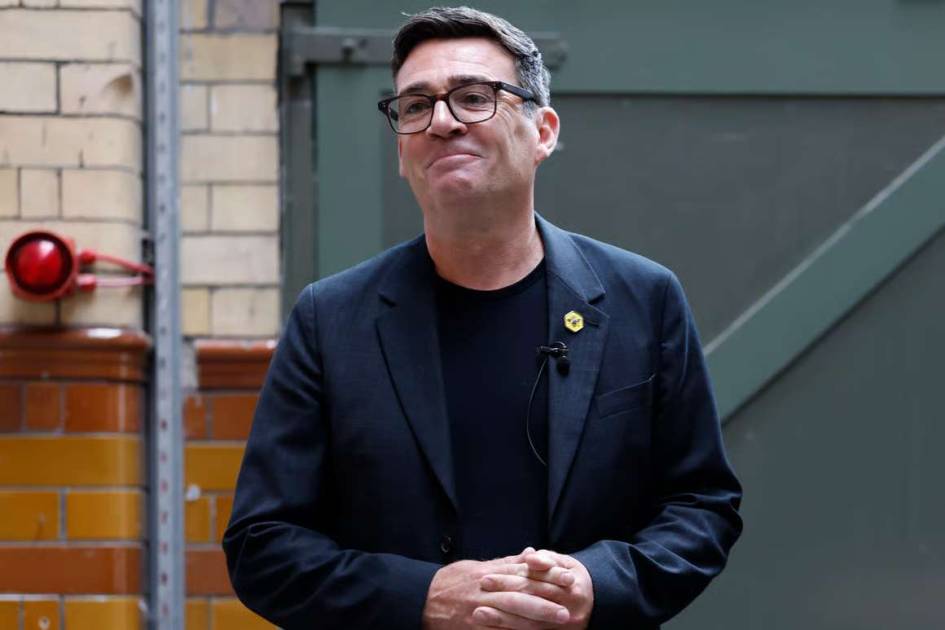
Summary: Andy Burnham arrives at the British premiership at a moment of unusual tension with Washington, after the White House sided with the Argentine players in the prominent case of the Falkland Islands flag they raised following their victory over England in the World Cup semi-final, preceded by the US President Donald Trump describing the new prime minister as an 'extreme liberal'. These facts open the door to serious questions about the future of the 'special relationship' between London and Washington, between the pressures of mutual interests and the possibilities of personal and political clash between the two men.
Hardly had Andy Burnham secured the leadership of the ruling Labour Party in Britain last Friday, paving the way for him to officially assume the premiership on Monday, succeeding Keir Starmer, when he found himself facing his first diplomatic test with the United States, a test that did not come from trade or defense files as usual, but from a football field in the American city of Atlanta, and from previous statements by President Donald Trump that did not hide his cold reception of the seventh British prime minister in a decade of political turmoil in the United Kingdom.
The spark of the latest crisis began last Wednesday evening, when the Argentine national team defeated the English team 2-1 in the semi-final of the World Cup held in the United States, as a number of Argentine players raised a banner written in Spanish 'Las Malvinas son argentinas' meaning 'The Malvinas Islands are Argentine', in reference to their country's claim of sovereignty over the British-administered Falkland Islands, before leaving the banner lying on the pitch.
The Falkland Islands archipelago in the South Atlantic is about 300 miles off the coast of Argentina and about 8,000 miles from Britain, which has administered it since 1833, and a war erupted over it in 1982 resulting in the deaths of 649 Argentine soldiers, 255 British, and three islanders.
The scene sparked widespread anger in Britain, with outgoing Prime Minister Keir Starmer supporting the call for an investigation by the International Football Federation (FIFA) into the incident, and the government's response also included 'The World Cup may not be British, but the Falkland Islands certainly are', while the Liberal Democrats party led by Ed Davey went further, contacting the Federation demanding the suspension of the players who raised the banner, considering what happened an insult to British war veterans and a direct violation of neutrality rules in stadiums.
Read more
Burnham faces energy test... Will he revive North Sea oil?
Trump reveals his advice to the next British prime minister
Challenges await Burnham when he enters 10 Downing Street
The surprise that turned the sports incident into a diplomatic problem came from the White House itself, as the Trump administration announced its support for the Argentine players' right to protest regarding the islands during World Cup matches, and rejected the calls led by the British government to punish them, with the US President's World Cup coordinator Andrew Giuliani saying the matter concerns freedom of speech guaranteed by the First Amendment of the US Constitution, a stance that London read as an explicit bias towards Buenos Aires in a matter affecting the sovereignty of British territory.
This US stance cannot be separated from the close rapprochement between Trump and Argentine President Javier Milei, a rapprochement that brought the islands file back to the forefront of political debate in Argentina, and was clearly expressed by Argentine Vice President Victoria Villarroel, daughter of a veteran of the 1982 war, who celebrated the banner and wrote that the islands are Argentine and that the players carry them in their blood and hearts despite the ban on bringing the banner into the stadium.
The banner issue was just the latest episode in an already tense relationship between Trump and Burnham. When the US President was asked in late June what he knew about the incoming British prime minister, he dismissively replied that he 'apparently was the mayor of a town, and heard he is an extreme liberal', concluding that he will not open the North Sea to expanded oil and gas drilling as Trump has been advising London for years. And when asked if he hoped Washington would be among Burnham's first foreign destinations, he denied, adding that the two men likely belong to two different convictions.
In contrast, Burnham has a long record of public criticism of Trump dating back to his first election in 2016, describing his speech then as 'very worrying', then escalating his rhetoric in recent years. In 2025, he compared the instability Trump brought to the United States and the world to that brought by Liz Truss to Britain, described several of his decisions, including his approach to the Russia-Ukraine war, as 'out of the ordinary', and warned during his recent election campaign that Britain, if not careful, is heading toward an American-style polarized and poisoned politics that loses societies the ability to work together. He also criticized the early stages of the joint US-Israel attack on Iran that killed former Iranian Supreme Leader Ali Khamenei, considering the idea of toppling a leader to unite peoples behind change a naive approach.
Argentine player raises banner reading 'Falkland Islands are Argentine' (Getty)
Burnham inherited a strained relationship between Downing Street and the White House. Despite the relative success achieved by Starmer in managing the US file, including hosting a state visit for Trump, the last months of his tenure saw growing chill against the backdrop of the repercussions of the Iran war and repeated US criticism of London's policies on energy, immigration, crime, and foreign policy. Hence came the advice of former British Prime Minister Theresa May to the new leader to focus on mutual interests between the two countries instead of slipping into personal or political clashes with Trump, reminding that transatlantic institutional relations can absorb differences between leaders.
Despite his critical record, Burnham is likely to seek to repair the relationship with Washington out of necessity, either by remaining silent about Trump or focusing on mutual interests. The British reliance on the American partnership in security, intelligence, nuclear deterrence, and within the North Atlantic Treaty Organization (NATO) leaves the new prime minister no luxury to break with Washington. Similarly, his declared domestic priorities, foremost the cost-of-living crisis and confronting the rise of the 'Reform' party, make him in no need of an open external battle with the White House.
The prospects for the relationship between Washington and London during Burnham's tenure swing between three possible paths: first, cold pragmatism that maintains institutional cooperation in defense, trade, and intelligence while freezing personal warmth between the two leaders, which is the most likely path in the near term; second, intermittent escalation fueled by controversial files ready to ignite, from the Falklands issue that showed Washington's readiness to stand on the opposite side of London, to energy and North Sea files, the stance on Iran and Ukraine, passing through the close alliance between Trump and Farage, Burnham's primary domestic opponent; and third, the least likely, the transformation of the special relationship into an ordinary relationship where London deals with Washington as a partner among partners, while deepening rapprochement with Europe.
Original source: Independent Arabia




Comments (0)
Be the first to comment.