Death of US Senator Lindsey Graham, a prominent supporter of Israel
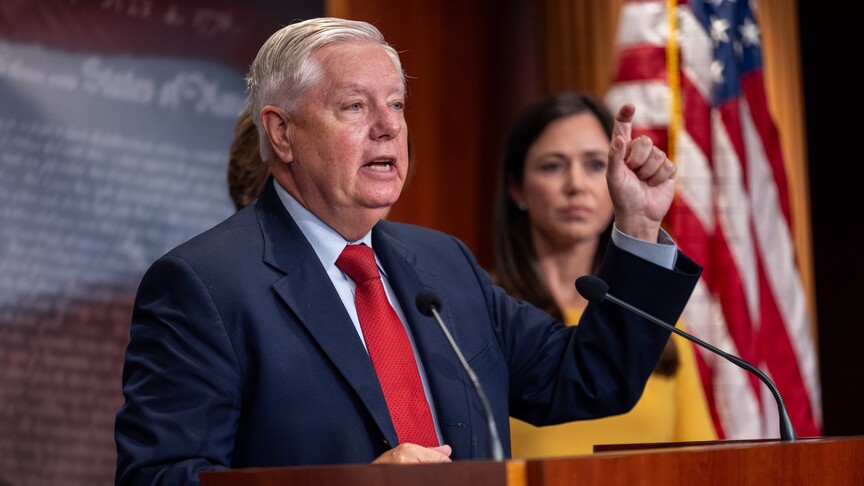
This came in a statement published by Graham's office on Sunday on the American platform "X," which said: "Senator Lindsey Graham died Saturday evening after a sudden and brief health setback."
Istanbul / Anatolia
- Aged 71, after a "sudden and brief health setback," according to a statement from his office
- He was among Trump's closest allies, known for his pro-Israel stance, insistence on imposing sanctions on Russia, and his threat of military action against Iran and Cuba
U.S. Republican Senator Lindsey Graham, one of President Donald Trump's closest allies and known for his pro-Israel positions, died Saturday evening at the age of 71 after a "sudden and brief health setback."
This was stated in a statement released by Graham's office on Sunday on the American platform "X," which said: "Senator Lindsey Graham died Saturday evening after a sudden and brief health setback."
The statement added: "The family of Senator Graham expresses its gratitude for the prayers and requests respect for its privacy during this difficult time."
Graham belonged to the Republican Party and represented South Carolina in the Senate since 2003, after being first elected in 2002, and re-elected in 2008, 2014, and 2020.
In recent years, he emerged as one of Trump's closest allies, and was known for his pro-Israel positions, his support for tightening pressure on Russia and Iran, as well as controversial stances on Cuba.
In May 2024, Graham criticized International Criminal Court Prosecutor Karim Khan's request to issue arrest warrants for Israeli Prime Minister Benjamin Netanyahu and then-Defense Minister Yoav Gallant, calling for sanctions on the court.
During a Senate Foreign Relations Committee session at the time, he said: "If you do this to Israel, we are next," arguing that targeting Israel could open the door to targeting the United States in the future.
In February 2026, he visited Israel, where he met with Netanyahu, President Isaac Herzog, and Foreign Minister Gideon Sa'ar, and said that "the United States has no better friend than Israel," while Herzog thanked him for his "steadfast support for Israel."
In May of the same year, the International Criminal Court prosecutor revealed in a media interview that Graham told him that "the International Criminal Court was created to deal with Africa and thugs like (Russian President Vladimir) Putin, not with democratic countries like Israel and the United States."
Graham's positions were not limited to supporting Israel; he was among the most prominent Republican voices calling for tightening pressure on Russia since the outbreak of the war in Ukraine.
In January of last year, Trump approved a bill to impose sanctions on countries that purchase "cheap Russian oil," stressing that the legislation gives the U.S. administration significant leverage to pressure countries like China, India, and Brazil to stop buying Russian oil.
Years ago, specifically in March 2022, the U.S. Senate unanimously passed a bill introduced by Graham condemning Putin as a "war criminal" and calling for an international investigation into "crimes committed by Russia in Ukraine."
His stances on Iran and Cuba also sparked wide controversy, as he hinted last January at the possibility of a U.S. military move against Cuba, considering that the "days" of the Cuban regime "are numbered," and indicating that he hopes this will happen during the current year.
Last February, he hinted at the possibility of a joint U.S.-Israeli attack on Iran, affirming that the Trump administration is considering both diplomatic and military paths, and that he does not mind giving diplomacy a chance, but at the same time stressed the need to keep the military option if necessary.
Over more than two decades in the Senate and three decades in his political career, Graham's name was associated with positions supporting U.S. interventionist policies in a number of international files, especially those related to Israel, Russia, and Iran, making him one of the most influential Republican figures in foreign policy and national security matters.
Original source: Anadolu Agency


Comments (0)
Be the first to comment.