Democratic Clergy Run for Congress in US Midterms
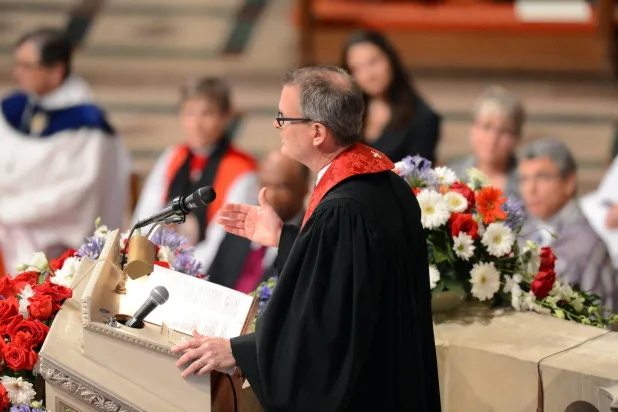
As the US midterm elections approach, Democratic clergymen seek to counter Republican religious rhetoric, believing it has been exploited for political purposes.
Ahead of the US midterm elections in November, a number of white Democratic clergy are seeking to counter the religious rhetoric adopted by Republicans, driven by the conviction that this rhetoric has been used for political purposes.
It is well known that the Republican Party dominates the votes of most white Christian voters in the United States, but many religious leaders now believe that the policies of President Donald Trump and his allies no longer reflect their views, especially on immigration issues. For this reason, several have decided to run for Congress as Democrats in November, believing they can thus influence some US administration decisions.
Adam Hamilton is a leading figure in this movement and could become the first Democrat from Kansas elected to the Senate since 1932. He said, 'The Christians we see (in political institutions) in Washington do not reflect the Jesus (Christ) of the Gospels,' as reported by AFP on Sunday.
Hamilton, 62, leads a massive Methodist church with 24,000 members in a highly conservative rural area of Kansas. Ostensibly, his ideas align with those of a Republican Christian, and while he advocates fiscal discipline and a strong military, he supports abortion rights and protections for LGBTQ+ people in his Senate campaign.
While he denounces the 'vulgarity' and 'banality' of Trump's presidency, as he puts it, he insists that the Republican president's policies 'do not align with the values' he has preached for 36 years. He adds, 'I want to stand up, be heard, and say: This is not acceptable.'
Recapturing Religious Rhetoric
Democrats have long involved clergy in politics, but this has been concentrated among Black Americans. Among them is Black Senator Raphael Warnock, who leads Ebenezer Baptist Church in Atlanta, where Martin Luther King Jr. was a pastor. But the last white Democratic clergy in Congress was Bob Edgar, a Methodist who represented Pennsylvania from 1975 to 1987.
Currently, at least seven white clergy are vying to represent the Democratic Party in Congress.
Democratic Senate candidate James Talarico speaks at a rally in San Antonio, Texas, on May 29, 2026 (AFP)
Most of these newcomers to politics come from Iowa, Texas, Alaska, Arkansas, Kansas, and Tennessee. Among them are three women, and they all share the same ambition: to reclaim the Christian rhetoric monopolized by Republicans and spread biblical teachings to advocate for policies more favorable to immigrants and low-income populations.
Perhaps the most prominent is James Talarico, a 37-year-old Protestant theology student running for a Texas Senate seat. In this conservative, Republican-led state, Talarico has made significant gains with speeches full of biblical quotes. In one, he said, 'Do you want to know what offends Jesus? Denying the sick health care while cutting taxes for billionaires.'
'A Void in the Religious Space'
One reason for the Republican dominance among white Christian voters is that Democrats have gradually shifted from being the party of the working class to a secular elite. Indira Doogherala, who co-chairs the Religious Council of the Democratic National Committee, acknowledges 'a void in the religious space in Democratic politics.'
She says the emergence of these religiously oriented candidates is 'not an unwelcome change,' stressing that it happened organically. She adds, 'It's okay to be a Democrat and religious,' while emphasizing that government should be secular.
Many also express displeasure over the prayer meetings organized by Defense Secretary Pete Hegseth at the Pentagon and the religious rhetoric used by the US administration to justify the war on Iran.
Rob Ryers, an evangelical pastor from Arkansas and a congressional candidate, asserts that 'Christian nationalism represents one of the biggest threats to American democracy.' Ryers and other clergy involved in the movement to counter Republican exploitation of Christian rhetoric say they firmly adhere to the separation of church and state. He adds, 'We need believers to stand up and say that the United States was founded on the principle of separation of church and state.'
Original source: Asharq Al-Awsat

Comments (0)
Be the first to comment.