Egypt demands from Europe 'regular channels' for migration... and addressing its root causes
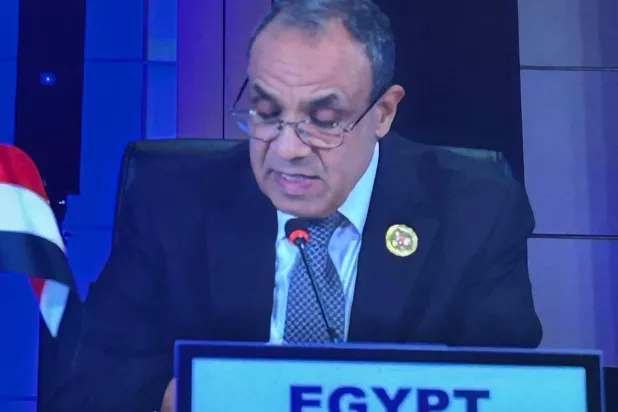
Egyptian Foreign Minister Badr Abdelatty spoke about 'his country's engagement with a number of European countries bilaterally to formulate agreements on the issue of migration.'
Egypt demanded from Europe 'regular channels' for migration, and addressing its root causes. Foreign Minister Badr Abdelatty spoke about his country's engagement with a number of European countries bilaterally to formulate agreements on the migration file, 'based on a long-term strategic vision that goes beyond short-term crisis management.'
Abdelatty's remarks came during talks with the European Union High Representative for Foreign Affairs and Security Policy Kaja Kallas on Thursday, on the sidelines of the ministerial meeting of the Association of Southeast Asian Nations (ASEAN) held in the Philippine capital, Manila.
According to a Foreign Ministry statement, Abdelatty pointed during the meeting to the existing cooperation with the European Union in the fields of migration and combating 'illegal migration,' and reviewed the economic burdens borne by the state as a result of hosting millions of foreigners, including refugees, migrants, and residents, stressing 'the pivotal role it plays in supporting security and stability in the Middle East region.'
Egypt hosts more than 10 million arrivals, led by Sudanese and Syrians, costing it more than $10 billion annually, according to official estimates.
In this context, Abdelatty stressed 'the importance of opening channels for regular migration, including circular and seasonal migration, and supporting development projects that address the root causes of migration, in addition to supporting refugee-hosting countries.'
Egypt renewed its demand for international support for hosting millions of refugees. The Foreign Minister said during his meeting with the Director General of the International Centre for Migration Policy Development (ICMPD) Susan Ropp last week that his country 'adopts a comprehensive approach to migration issues.'
Egypt and the European Union have multiple joint cooperation files, most notably efforts to confront 'illegal migration,' efforts to provide energy, combating terrorism, digital transformation, and areas of sustainable development and investments.
Refugees from different nationalities in Egypt (Refugee Commission)
During his meeting with Kallas, Abdelatty praised the momentum in relations between Egypt and the European Union, and the progress achieved by the strategic and comprehensive partnership between the two sides, which culminated in the holding of the 11th session of the 'Egypt-EU Association Council' in Luxembourg in mid-June last year. He pointed to the importance of continuing to enhance economic, investment, and trade cooperation between the two sides in various sectors.
In March 2024, Egypt and the European Union agreed to upgrade relations to the level of 'comprehensive strategic partnership.' At the conclusion of a summit held in Cairo, attended by Egyptian President Abdel Fattah El-Sisi, European Commission President Ursula von der Leyen, and the heads of state and government of Cyprus, Italy, Austria, and Greece, the two sides signed a 'joint declaration' on a comprehensive strategic partnership.
Sisi considered the visit of the European leaders to Cairo at the time as 'a reflection of the depth of the Egyptian-European relations extending through history, and the momentum that the relations have witnessed recently, at various political, economic, and cultural levels.'
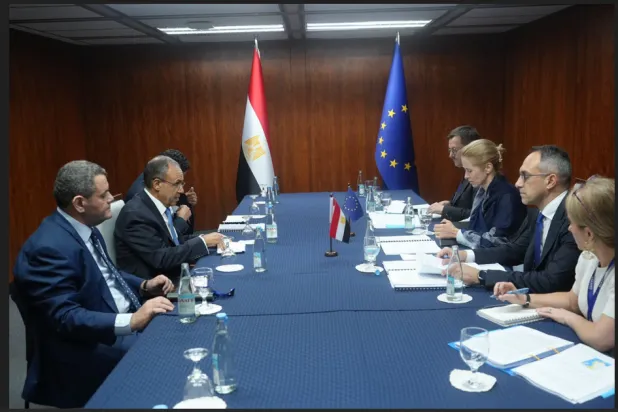
Meeting of Egyptian Foreign Minister Badr Abdelatty and EU Foreign Affairs Representative Kaja Kallas in Manila (Egyptian Foreign Ministry on 'Facebook')
According to the 'Egyptian Foreign Ministry,' the Foreign Minister briefed the European official on Egypt's intensive contacts and efforts aimed at de-escalation and reducing tensions in the Middle East. He affirmed 'Egypt's support for all efforts aimed at resolving the current crisis through dialogue and diplomatic means, contributing to lowering tensions, enhancing security and stability in the region, and avoiding the expansion of the conflict, given its repercussions on the region's security, international navigation security, global trade movement, and supply chains.'
The meeting also addressed developments in the Palestinian cause and the situation in the Gaza Strip, where Abdelatty stressed 'the importance of completing the implementation of the first phase requirements of US President Donald Trump's plan, ensuring full and rapid access for humanitarian aid, and preparing conditions for moving to subsequent phases, leading to early recovery and reconstruction.' He warned of 'the gravity of continued Israeli violations in the West Bank.'
Abdelatty and Kallas exchanged views and assessments on the situations in Sudan, Libya, and Syria, and affirmed 'support for efforts aimed at achieving security and stability, and preserving the unity, sovereignty, and territorial integrity of states.'
Meanwhile, the European official praised Egypt's role in supporting regional de-escalation efforts, affirming 'its aspiration to continue coordination and consultation in the coming period within the framework of the strategic partnership between Egypt and the European Union.'
"); googletag.cmd.push(function() { onDvtagReady(function () { googletag.display('div-gpt-ad-3341368-4'); }); }); }
Original source: Asharq Al-Awsat

Comments (0)
Be the first to comment.