France and Spain battle massive wildfires and evacuate tens of thousands
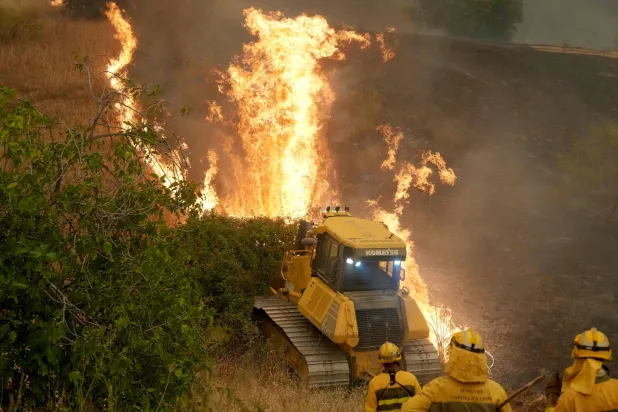
Massive wildfires burning in southwestern France and central Spain forced authorities on Friday to evacuate tens of thousands of people from their homes, as the fires raged out of control fueled by strong winds and high temperatures. Some residents in France were forced to flee by boat after the flames swept through the tourist Cap Ferret peninsula on the Atlantic coast. Authorities announced that dozens of firefighters had been injured during firefighting operations, according to the Associated Press.
Spreading Fires
In France, the flames, which broke out Wednesday near Cap Ferret, have consumed an area of nearly 125 square kilometers. The peninsula is located about 60 kilometers from the city of Bordeaux and is considered a premier tourist destination thanks to its sandy beaches, oyster-farming villages, and luxury resorts.
Additionally, some 67,000 people were forced to leave their homes after evacuation orders were issued for further areas to the south following the outbreak of another fire. Laurent Moretti, a resident of the French town of Arès, said, "The sight is both majestic and terrifying. We have never seen an evacuation on this scale, and all we hope for is that firefighters can bring the fire under control quickly."
Firefighters in the Gironde region on July 24 (Reuters)
More than 20,000 people had been evacuated on Thursday from towns and tourist resorts, while new batches of residents were transported by land, with boats allocated to move those who could not leave on their own.
Authorities in the Gironde department reported that 53 homes and campsites were destroyed by the flames, while 42 firefighters were injured. About 1,500 people who left the peninsula by sea arrived in the city of Arcachon, some aboard small water taxis and others on larger vessels.
European Support
France deployed hundreds of firefighters to the region and boosted its efforts with additional land and air resources, as another major fire broke out further south on the coast, consuming about 25 square kilometers and remaining out of control due to gale-force winds.
Authorities suspect that the two fires were accidental. The number of evacuees reached 44,000 in Gironde and 23,000 in the Landes department.
French President Emmanuel Macron announced that his country would receive European support including two Canadair firefighting planes from Croatia, two Air Tractor planes from Portugal, and two heavy-lift Black Hawk helicopters from the Czech Republic and Slovakia.
Spain Declares State of Emergency
In Spain, the government declared a national state of emergency over wildfires for the first time after blazes in Madrid and the neighboring Ávila region prompted the evacuation of about 20,000 people.
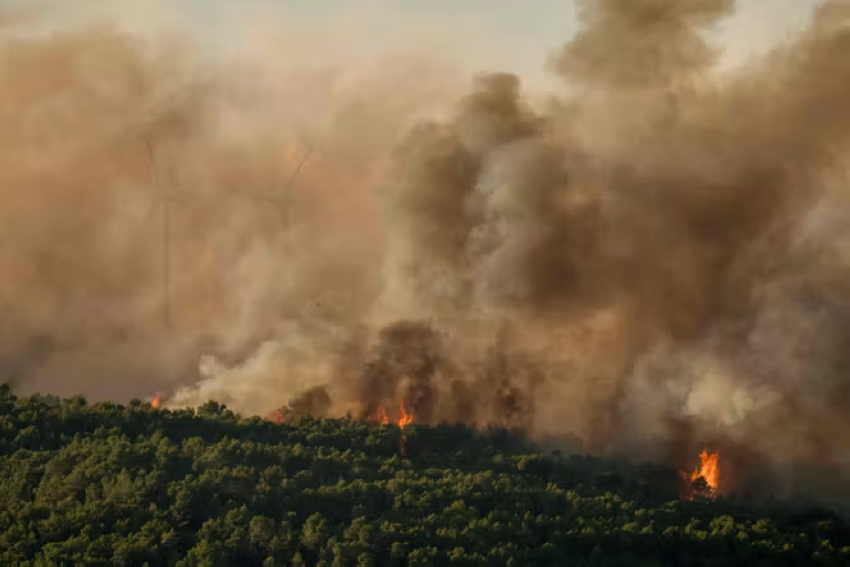
Dense smoke blankets the sky over Lacanau beach in southwestern France on July 24 (AFP)
A heat wave, with temperatures expected to exceed 39 degrees Celsius in parts of the country, is fueling the spread of the flames. Two large fires west of Madrid merged into a single blaze that rapidly spread over 30 square kilometers by Friday afternoon, with the President of the Community of Madrid, Isabel Díaz Ayuso, describing the fire as "the worst in Madrid's history."
Regional authorities said about 18,000 people were evacuated from villages and towns located west of the capital.
In Ávila, located northwest of Madrid, the flames devoured about 90 square kilometers, forcing an additional 1,500 people to leave their homes. Francisco Martínez, mayor of Burgohondo, said, "In sixty years I have never seen anything like this in my village. I have never witnessed fires of this magnitude before."
For his part, Spanish Interior Minister Fernando Grande-Marlaska said that Italy and Greece would send two Canadair planes each to participate in the firefighting efforts.
Footage broadcast by Spanish television showed walls of flame advancing through forests and brush amid thick columns of smoke, while rugged terrain and strong winds complicated firefighting operations.
Joaquín Espinosa, 33, who was evacuated from the village of Chapinería west of Madrid, said, "The whole town was surrounded by smoke and fire. I felt scared, and people were tense."
Unprecedented Fires
In just one week, the Madrid and Castilla-La Mancha regions recorded the worst fires in their modern history.
Firefighters are still battling to extinguish Spain's second-largest fire on record in Guadalajara province within the Castilla-La Mancha region, after it destroyed about 320 square kilometers over the past week.
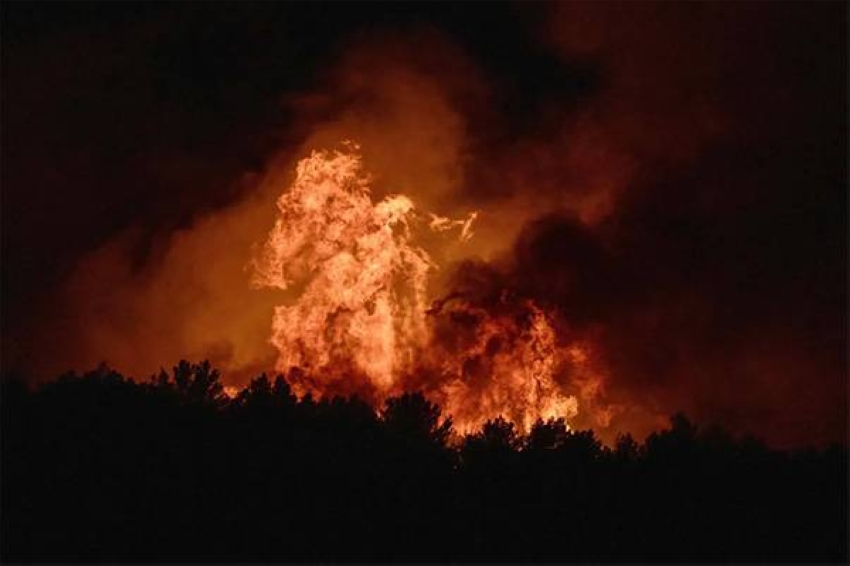
Dense smoke rises in Cap Ferret, southwestern France, on July 23 (AFP)
Thirteen people had died in a fire that broke out in southern Spain earlier this month, in the country's deadliest blaze in recent years.
Spanish Minister for Ecological Transition Sara Aagesen said that since the beginning of the year, fires have consumed about 1,140 square kilometers—more than five times the area burned during the same period in 2025—noting that 9 other large fires are still burning across different parts of the country.
Prime Minister Pedro Sánchez called for political consensus to address climate change, considering it an essential factor to adapt to a reality witnessing an increase in heat waves and wildfires.
Experts believe that climate change, alongside declining agricultural activity in rural areas, has contributed to increasing fire risks, as villages have lost the agricultural belts that once served as buffer zones, and trees and brush now extend right up to the edges of homes.
Wildfire analyst Raúl Kellyth said, "These combined factors create the perfect environment for such fires to break out."
Sicily Also Ablaze
In Italy, wildfires continued to ravage parts of the island of Sicily, particularly in the Agrigento province in the island's southwest, where temperatures exceeding 40 degrees Celsius, alongside low humidity and winds, contributed to the spread of the flames.
French authorities evacuated thousands of residents after fires expanded in the country's southwest on July 23 (AFP)
The fires led to sporadic evacuations and resulted in the death of a firefighter while he was helping to extinguish a fire in the city of Caltanissetta.
This comes at a time when 2025 was the third-hottest year on record, amid warnings from scientists that climate change is increasing the frequency and intensity of heat waves and droughts, particularly in southeastern Europe, making the region more vulnerable to wildfires and their health and environmental consequences.
Original source: Asharq Al-Awsat


Comments (0)
Be the first to comment.