Azawad Front in Mali: We Did Not Start the War and No Negotiation with the Coup Plotters
ISTANBUL/ Adel Al-Thabeti/ Anadolu
** Spokesperson for the Azawad Liberation Front Mohamed El-Mouloud Ramdane to Anadolu:
- There is no talk in the front about any initiative, dialogue, or peace and reconciliation process with the coup plotters in Bamako. We are in a war we did not start.
- We adhered to the Algiers Agreement, but the coup plotters tore it up when they seized power, went to Russia, brought mercenaries, and waged war on us.
- Russia has become an imperialist state interfering in Mali to loot its wealth, and it will fail as it failed in Afghanistan.
- Our problem is internal, and I do not think that the resumption of relations between Algeria and the coup plotters in Bamako will affect our path.
The spokesperson for the Azawad Liberation Front in Mali, Mohamed El-Mouloud Ramdane, stated that there is no initiative for negotiation with those he called "the coup plotters in Bamako."
In May 2021, General Assimi Goïta seized power in Mali, located in the Sahel region of Africa, and placed it under military rule.
Ramdane said in an interview with Anadolu: "There is no talk of any initiative, dialogue, or peace and reconciliation process with the coup plotters in Bamako. We are fighting a war we did not start."
He added: "We were committed to the Algiers Agreement, but the coup plotters tore it up when they seized power, went to Russia, brought mercenaries, and waged war on us."
In 2015, the Malian government and the Coordination of Azawad Movements signed a peace and reconciliation agreement, mediated by neighboring Algeria, but the military administration in Bamako announced its termination in January 2024.
The agreement aimed to calm the situation, with promises to grant northern Mali more autonomy and improve economic conditions.
Ramdane continued: "We did not start the war, but we will decide when and where it ends."
He added: "For us in the Azawad Liberation Front, there are no initiatives for negotiation with the government. We are in a war we did not start, and we must face the enemy."
He added: "We face an enemy that pursues a scorched earth policy against our people, committed crimes, and we must expel him from our lands and liberate all of Azawad."
The front demands autonomy or independence for the Azawad region (northeastern Mali), which constitutes about 60 percent of Mali's area, which gained independence from French colonization in 1960.
Ramdane continued: "And no one in the name of the Azawad Liberation Front can speak of a peace initiative or dialogue."
The Azawad is a multi-cultural ethnic group comprising a mix of Arabs, Fulani, Songhai, in addition to the Tuareg who form the majority of the group, distinguished by their Amazigh culture and Tamasheq language.
The area of the Azawad region is 822,000 square kilometers (Mali's area is 1.24 million square kilometers), bordered by Algeria to the north and northeast, Mauritania to the west, Niger to the east, and Mali and Burkina Faso to the south.
** Battle of Anfif
Ramdane's talk about the current rejection of any negotiation represents a change in the front's position, after its media official Boubacar Ould El-Taleb stated to Anadolu in May last year that they were open to political solutions to the crisis.
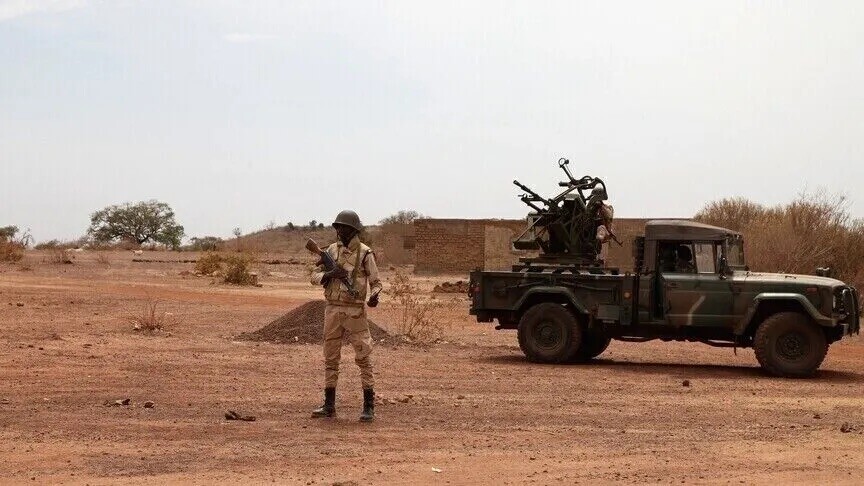
The reason behind this change may be the subsequent battles between the transitional government forces and the Azawad Liberation Front, founded in 2024, most notably what the city of Anfif witnessed between July 6 and 11 this month.
Anfif is a strategic city in the Azawad region, acting as the 'southern gateway' leading to the city of Kidal, giving it military importance.
At that time, the front stated in a statement that it dealt with 'the largest military mobilization organized by the Bamako authorities and their local militias, under the direct command of a full battalion of the Russian mercenary corps.'
It added that the Azawad fighters 'recorded the greatest loss of lives and equipment in the history of the invaders in the region.'
In contrast, the Malian army spoke of recapturing the city and the fall of a thousand dead among the front and its allies.
Regarding what happened in Anfif, Ramdane said: 'We are at war, and war is a series of battles.'
He added: 'We carried out a precise military operation on Anfif, especially on the Russian corps forces inside it and some Malian army forces.'
He continued: 'Complete control of the city was achieved, but some elements of the Russian corps took refuge inside a fortified military barracks along with the Malian army.'
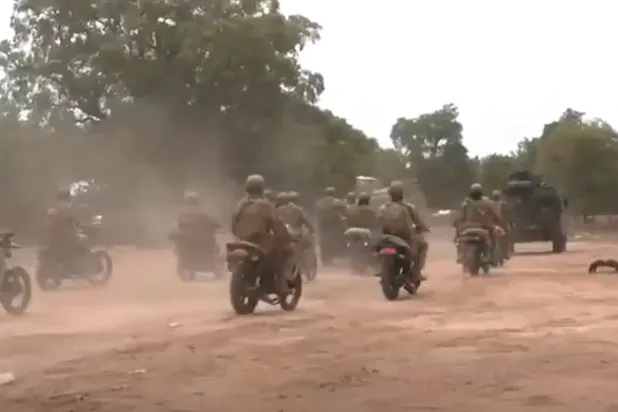
Ramdane added: 'Another convoy advanced from Gao city, also consisting of Russian forces and the Malian army under air cover to break the siege on them, and the convoy was destroyed and the remainder returned to Gao.'
He continued: 'On July 9, another convoy began arriving, I think from Russia, with air and ground forces, and we confronted them for a whole day.'
He added: 'After that, the Azawad fighters decided to withdraw outside the city to reorganize and devise another strategy.'
He continued: 'We set an ambush for the forces leaving Anfif towards Gao, destroyed many of their vehicles, killed many Malian army elements, and the rest fled to Gao. We are the ones controlling and taking the initiative on the ground.'
** Russia's "Ambitions"
Regarding the Russian role in Mali, Ramdane said: 'Russia and all countries do not intervene for the sake of any government in Africa.'
He added: 'All countries have interests, and Russia has interests in the region through looting resources and stealing gold. It has ambitions in the region's wealth because it is rich in resources.'
He added: 'No matter how strong Russia is, it cannot benefit from the earth's wealth in Azawad, because we will be on the lookout for it and it will be expelled as all invaders were expelled from our land.'
He continued: 'We defeated them in all confrontations, starting from the Wagner operation (Russian mercenary forces) in Azawad in 2024 to the Kidal and Tessalit operation where they requested safe exit, and in Anfif they will be defeated and expelled.'
And 'Our message to Russia is: if it wants to protect its interests in the region, it must deal with those on the ground, and not be an invading state waging war on the people, destroying cities, hospitals, and schools,' according to Ramdane.
He continued: 'Russia had a positive role and no one could have accused it of imperialism.'
He added: 'But today it plays the role the West played for 100 years. It is an imperialist state wanting to control the land by force, and that is impossible, so it will fail as it failed (during the Soviet Union) in Afghanistan (1979-1989).'
** Algeria and Bamako
On July 11 this month, Algeria and Mali announced the return of their ambassadors and the reopening of their airspace for flights between the two countries, ending a diplomatic crisis that erupted in April 2025.
At that time, Algeria closed its airspace to Malian aviation and recalled its ambassador to Bamako for consultations, following what it said was a 'repeated violation' of its airspace by Malian drones.
Regarding the resumption of these relations and whether they concern the Azawad Liberation Front, Ramdane said: 'This is a matter that does not concern us. Algeria is a sovereign state and has the right to establish relations with all countries.'
He concluded: 'Our problem is internal with the coup government. As for Algeria, it is a neighboring country and I do not think their relations will have any impact on our path.'
Original source: Anadolu Agency

Comments (0)
Be the first to comment.