Jordanian diplomatic movement to contain military escalation in the region
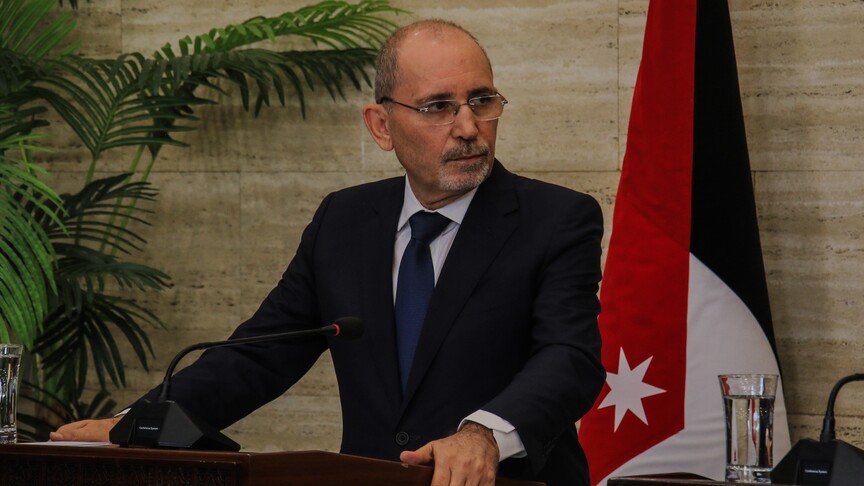
Through phone calls made by Foreign Minister Ayman Safadi with his counterparts in Turkey, Qatar, Saudi Arabia, Kuwait and Bahrain, according to statements by the Jordanian Foreign Ministry
AMMAN / Laith al-Junaidi / Anadolu
Jordanian Deputy Prime Minister and Foreign Minister Ayman Safadi on Sunday held a series of phone calls with his counterparts in Turkey, Qatar, Saudi Arabia, Kuwait and Bahrain, discussing ways to contain the military escalation in the region.
This came in statements by the Jordanian Foreign Ministry, published on its page on the American company X platform.
Jordan, along with other Arab countries, has recently been subjected to Iranian attacks that Tehran said targeted US military facilities, in response to daily attacks launched by the United States on its territory.
The Jordanian Foreign Ministry said in a statement that Safadi, during his call with Kuwaiti Foreign Minister Jarrah Jaber Al-Ahmad Al-Sabah, affirmed 'absolute solidarity in facing the Iranian attacks on the Kingdom, Kuwait and the sister Gulf Cooperation Council states.'
Safadi condemned these 'brutal attacks that represent a blatant violation of states' sovereignty and a threat to the security and stability of the region.'
The two ministers stressed 'the need to end the dangerous escalation in the region, implement the ceasefire agreement between the United States and Iran, and adopt dialogue and diplomacy as a way to end the crisis, restore calm, and achieve lasting security and stability.'
In a separate call, Safadi and Bahraini Foreign Minister Abdul Latif Al-Zayani affirmed their condemnation of 'Iranian attacks' on Jordan, Bahrain and Gulf Cooperation Council states, and absolute solidarity in facing them.
The two ministers warned of 'the danger of continued escalation and the threat it poses to regional and international peace and security,' according to the Jordanian Foreign Ministry.
They stressed the need to end the escalation and return to negotiations as a way to end the crisis and reach a comprehensive solution addressing all causes of tension.
Safadi and Al-Zayani affirmed the need to ensure freedom of navigation in the Strait of Hormuz in accordance with international law.
Safadi also discussed with Saudi Foreign Minister Faisal bin Farhan 'the dangerous escalation the region is witnessing and the efforts made to end it.'
The Jordanian Foreign Ministry stated that the two ministers affirmed 'condemnation of Iranian attacks on Jordan and Gulf Cooperation Council states, and absolute solidarity in facing them.'
Safadi and his Saudi counterpart stressed 'the need to end the escalation and implement the ceasefire agreement between the United States and Iran.'
They affirmed 'the need to resume negotiations and reach a comprehensive solution that addresses all causes of tension and guarantees freedom of navigation in the Strait of Hormuz.'
In another call, Safadi and Qatari Prime Minister and Foreign Minister Mohammed bin Abdulrahman called for joining efforts 'to end the dangerous escalation the region is witnessing and adopt dialogue as a way to resolve the crisis.'
According to the Jordanian Foreign Ministry, the two ministers stressed 'the need for a ceasefire, a return to negotiations to reach a comprehensive solution addressing all causes of tension and ensuring freedom of navigation in the Strait of Hormuz.'
They emphasized 'full solidarity in facing Iranian attacks,' while warning of the consequences of their continuation.
In the same context, Safadi discussed with Turkish Foreign Minister Hakan Fidan, during a separate call, the dangerous escalation in the region.
Safadi and Fidan affirmed the need to end this escalation, implement the ceasefire agreement between the United States and Iran, and return to negotiations to reach a comprehensive solution to the crisis that addresses all causes of tension, according to a statement by the Jordanian Foreign Ministry.
On Saturday, the US Central Command 'CENTCOM' announced the death of two US soldiers and the loss of a third in Jordan on Friday, while repelling Iranian attacks with ballistic missiles and drones.
The confrontation between Washington and Tehran entered its second week, as US President Donald Trump announced on July 8 that the ceasefire stipulated in the memorandum of understanding signed on June 18, 2026 had ended.
Trump's announcement came after Iran targeted three commercial ships in the Strait of Hormuz, as Tehran insists on imposing a mechanism to regulate the passage of ships through the strategic waterway, while Washington demands what it says is ensuring freedom and security of navigation in the strait.
The escalation has disrupted navigation through the Strait of Hormuz and threatened air traffic and energy supplies, amid intermittent closures of airspace and warnings of targeting US facilities and interests outside the Middle East.
Safadi and Fidan also discussed the situation in Gaza and the occupied West Bank, where they affirmed 'the need to implement all provisions of US President Donald Trump's plan on Gaza to stabilize the situation.'
They stressed 'the need for Israel to remove all restrictions on the entry of humanitarian aid to the Strip, which continues to suffer a humanitarian catastrophe,' according to a statement by the Jordanian Foreign Ministry.
Israel has reneged on various commitments stipulated in the ceasefire agreement in the Gaza Strip in effect since October 10, 2025, including the cessation of military operations such as bombing and incursions, opening crossings, and allowing the agreed quantities of food, relief, and medical aid.
The agreement was reached after two years of a genocidal war waged by Israel with US support, which left more than 73,000 dead, over 173,000 wounded, and massive destruction affecting 90 percent of civilian infrastructure, with a reconstruction cost estimated by the United Nations at about $70 billion.
The two ministers affirmed 'rejection of all illegal Israeli measures that entrench the occupation in the occupied West Bank and undermine the two-state solution, which is the only way to achieve a just peace.'
They pointed to 'the need for the international community to take effective and impactful steps to stop the illegal Israeli escalation measures that constitute a blatant violation of international law and Israel's obligations as an occupying power.'
They also warned of 'the consequences of Israel's continued measures aimed at changing the historical and legal status quo in the Islamic and Christian holy sites in occupied Jerusalem.'
They affirmed that 'the Holy Sanctuary / Al-Aqsa Mosque in its entirety is a pure place of worship for Muslims.'
The two ministers condemned 'these measures that threaten to explode the situation in the occupied West Bank and threaten to fuel the conflict.'
The West Bank has witnessed since October 2023 an escalation in attacks by the Israeli army and settlers, resulting in the killing of 1,181 Palestinians and the injury of about 13,000, in addition to the arrest of nearly 24,000 Palestinians.
Original source: Anadolu Agency






Comments (0)
Be the first to comment.