Intense anticipation in the Syrian street for the upcoming verdicts against Assad regime officials
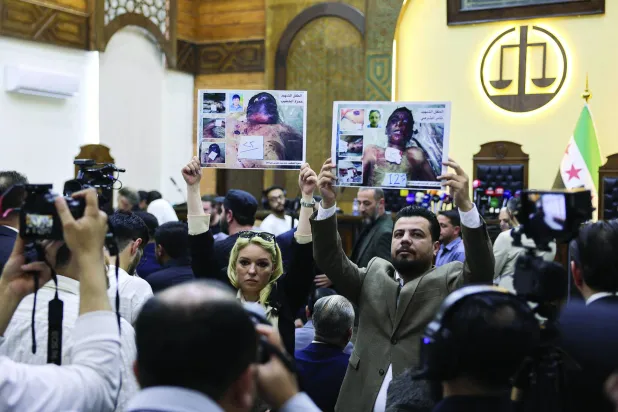
A state of intense anticipation prevails among the families of victims and those subjected to torture in Syria for the verdicts to be issued against them, amid demands for the death penalty.
Amid the accelerated public trial sessions for former Syrian regime officials, families of victims and survivors of torture are in a state of intense anticipation for the expected verdicts, with increasing calls for the death penalty.
These trials come after the fall of the Assad regime in December 2024, as part of transitional justice efforts.
The Fourth Criminal Court in Damascus is witnessing an acceleration in the holding of sessions, as a trial in absentia for Bashar al-Assad, his brother Maher, and others, including Atef Najib who appeared handcuffed in the courtroom, began on April 25.
Atef Najib inside the criminal court during his first trial session in April (EPA)
The number of trial sessions for Atef Najib reached six, while three sessions were held for Wasim al-Assad, and the Transitional Justice Authority is expected to issue a verdict against him on July 29.
Three consecutive trial sessions were also held for Syria's mufti under the former regime, Ahmed Hassoun, accused of inciting violence and justifying killings during the era of the fallen regime.
The state of anticipation intensifies in Daraa in the south of the country, where locals are closely following the course of Najib's trial, given that the governorate witnessed in February 2011 the arrest of more than 20 children in the city by the Political Security Branch he headed, on the basis of writings on school walls, including the phrase "Your turn has come, doctor," and the case became known as the "Children of Freedom" case, which sparked protests in the city on March 18 of that year.
A photo of Hamza al-Khatib and another child who died in Daraa in 2011 was raised during the trial of Atef Najib on April 26, 2026 (SANA)
Mohamed Abdul Rahman, a resident of Daraa whose son died in Sednaya prison after being arrested at the beginning of the revolution, asserts that the people of the governorate "demand the execution of all those whose hands are stained with the blood of hundreds of thousands of Syrians, not just Atef Najib."
He tells Asharq Al-Awsat: "There is no house in Daraa that has not paid the price, as some have lost a son or more by the bullets of the army and security services of the fallen regime, or in the regime's prisons, and those who have not lost a loved one are now living amid destruction... so the people want the execution of all of them."
Youssef Sweidan, who was among the children arrested in Daraa and is now a young man but cannot work due to the severe torture he endured during his detention, tells Asharq Al-Awsat: "We demand the execution of Atef Najib as a lesson, and execution is too little for him given the crimes he committed against the people of Daraa."
Relatives of torture victims during the trial session of Atef Najib at the Palace of Justice in Damascus on April 26, 2026 (Reuters)
It is noted in the previous trial sessions that the time interval between sessions is short, as the last trial session for Hassoun was held on July 23, and July 30 was set for the next session, while the last session for Wasim al-Assad was held on July 22 and July 29 was set for the next session. The public prosecution demanded the death penalty against him, based on evidence and testimonies proving his responsibility for crimes of premeditated murder, drug trafficking, and promotion, after the last session of Najib's trial was held on July 21, and July 28 was set for the next session.
Wasim al-Assad (Syrian Ministry of Justice)
Lawyer Noha al-Masri, a member of a committee of five lawyers acting as the prosecution team in the case currently before the Criminal Court for the trial of former regime pillars, including Najib, explained that "there is no haste in the process of trying former officials under the old regime."
Noha al-Masri told Asharq Al-Awsat that the cases reached public sessions "after the public prosecution had previously initiated them, then they were referred to the investigating judge, then to the referral judge, and then to the Criminal Court."
Noha al-Masri pointed out that the procedures preceding the public trial sessions "were not highlighted, and therefore some believe there is haste in conducting these trials," explaining that "the case against Najib began in February 2025, i.e., more than a year and a half ago."
Noha al-Masri indicated that what the next session of Najib's trial will include, during which the defendant's defense lawyer will be heard, will determine whether the following session will be for continuing procedures or for deliberation and verdict.
Ahmed Badreddin Hassoun, mufti of the Assad regime, during his first trial session last June in Damascus (SANA)
Regarding the possible verdicts the court might issue against Najib, Wasim al-Assad, and Hassoun, Noha al-Masri said: "According to the Code of Criminal Procedure, which considers that their crimes are not subject to statute of limitations because they represented a regime that existed until its fall, we demand that the court impose the death penalty on them. As for international and humanitarian law, which considers their crimes crimes against humanity, it does not set a maximum penalty and does not include the death penalty, so they could be sentenced to life imprisonment. But we do not want life imprisonment; we demand the death penalty, because those who participated in killing Syrians must be executed, and people's souls will not rest until they have taken revenge on them."
International and human rights organizations and civil society attended the fifth session of the trial of Atef Najib (Syrian Ministry of Justice)
She added: "We cannot pre-empt the results, but we hope that death sentences will be issued against these killers and criminals, and we have confidence in our judiciary and its justice."
The new Syrian authorities have pledged to establish justice and accountability for the atrocities committed under Assad's rule, while activists and the international community emphasize the importance of transitional justice in the war-torn country.
"); googletag.cmd.push(function() { onDvtagReady(function () { googletag.display('div-gpt-ad-3341368-4'); }); }); }
The trials represent a rare step toward accountability in Syria after decades of impunity. The charges focus on crimes against humanity. Activists see these verdicts as symbolic but important for appeasing the anger of victims. The continuation of trials may open the door to prosecuting more officials.
Original source: Asharq Al-Awsat




Comments (0)
Be the first to comment.