Iran-US ceasefire collapsed even before Trump declared its end... Why?
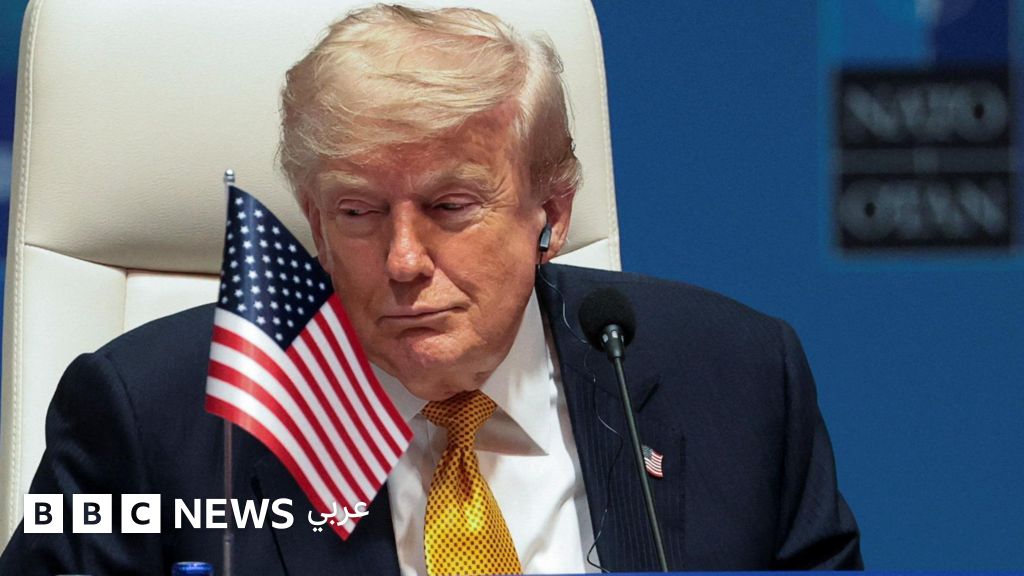
Washington and Tehran appear to be rapidly heading towards resuming the conflict on a large scale, as both refuse to give up their position of strength.
Iran-US ceasefire collapsed even before Trump declared its end... Why?
Image caption, US President Donald Trump says the ceasefire agreement with Iran is 'over'.
Article Information
Author, Saeed JafriRole, Political analyst
Published 5 hours ago
Reading time: 5 minutes
From a leather seat in Turkey, US President Donald Trump declared the end of the ceasefire between the United States and Iran, apparently closing the negotiation window he had opened just three weeks earlier.
Trump said on the sidelines of the NATO summit in Ankara: 'I think it's over. I don't want to deal with them anymore, they are scum.'
Although fighting had not completely stopped between the two sides, strikes have returned to a level not seen since the signing of the memorandum of understanding on June 17.
Washington and Tehran are rushing towards resuming full-scale war, with each side refusing to concede the other's superiority.
After 250 years of independence: What does the future of the US as a superpower look like?
Banners of revenge accompany Khamenei to his final resting place in a scene
Image caption, Washington and Tehran appear to be moving swiftly towards resuming full-scale war, as both refuse to give up their position of strength.
Robert Pape, professor of political science at the University of Chicago, says the problem is that Trump 'does not want to admit the strategic defeat he has suffered'.
Most of the factors that ignited the war remain, while the goals declared by the Trump administration—from regime change and reaching a nuclear deal to crippling Iran's ballistic missile program—have not been achieved, leaving many of these issues for future negotiations.
The war has strengthened Iran's influence, elevating the Islamic Republic to the level of a dominant regional player, and revealed its grip on the global economy through its control of the Strait of Hormuz and its ability to target navigation.
Pape says: 'Iran has become stronger as a result of this war, and the balance of power in the region has changed.'
Skip most read and continue reading
Trump agrees to continue talks with Iran, and Tehran threatens to bomb Israel in response to any attack on infrastructure
Bonnie Tyler... The husky voice that changed the power ballad
The volcanic eruption that produced the loudest sound in recorded history
Syrian authorities announce dismantling of Islamic State cells and arrest of a senior leader in the south
Skip podcast and continue reading
Worth paying attention to
In-depth explanation of key events and topics to help you understand the most important changes around you and their impact on your life
Episodes
Podcast end
Mojtaba Khamenei, 56, replaced his late father, the Supreme Leader who died at 86, and adopted a bolder approach. The Iranian leadership also abandoned the state of 'no war, no peace' and began bombing American bases and neighboring Gulf states.
After waves of Iranian drones and ballistic missiles undermined confidence in the US security umbrella protecting oil monarchies in the Gulf, reports indicated that Saudi Arabia is working to hold a reconciliation summit.
But this shift has not been reflected at the negotiating table, where US-Iran relations remain governed by the logic of coercion and resistance.
The 14-point memorandum of understanding was supposed to reopen the Strait of Hormuz and ease pressure on the global energy market, and launch negotiations on more complex issues, foremost among them Iran's nuclear program and Tehran's support for its regional proxies.
However, the interpretation of the memorandum turned, before reaching the nuclear issue, into an arena of competition between Tehran and Washington, each seeking to impose the terms of the post-war order.
This competition is evident in three main files: the Strait of Hormuz, Lebanon, and the proposed reconstruction fund to incentivize Iran to end the war.
Image caption, The Trump administration has not achieved its strategic goals in Iran.
The Strait of Hormuz is the clearest example of this competition.
Robert Pape says: 'Trump cannot accept Iran's control of the Strait of Hormuz,' noting that US officials began, after signing the memorandum, 'an attempt to weaken a number of the agreement's clauses.'
The United States, in cooperation with Oman, is seeking to create an alternative navigation route that relies less on coordination with Tehran.
In contrast, Iran insists on managing the strait.
Hamid Reza Azizi, visiting researcher at the German Institute for International and Security Affairs in Berlin, says: 'From Tehran's perspective, Iran's concession was limited to refraining from imposing transit fees during the 60-day period, and did not include giving up its role in determining the arrangements governing navigation.'
Washington may see its military buildup or the creation of an alternative route as mere measures to protect freedom of navigation. But for Tehran, the issue goes beyond transit fees, as the strait is a key pillar of its geopolitical influence.
Azizi added: 'The matter lies in recognizing Iran's leadership role in managing the strait, because creating an alternative route without Tehran's approval would be seen as a loss of a strategic card.'
Image caption, During his visit to the Gulf in June, US Secretary of State Marco Rubio made clear that investment in rebuilding Iran would be conditional.
The same conflict appears in the Lebanese file.
The memorandum does not address Iran's relations with its regional proxies, including Hezbollah, but it obliges all parties to cease military operations and ensure Lebanon's sovereignty. Its brief clauses did not stipulate the withdrawal of Israeli forces.
Many analysts saw the inclusion of Lebanon in the memorandum as one of Iran's biggest gains, reflecting recognition of the centrality of its role in settling broader geopolitical conflicts in the region.
Hamid Reza Azizi says: 'The United States interprets this clause more narrowly, as an affirmation of Lebanon's sovereignty and territorial integrity, without necessarily granting Tehran a special role in the country's future political process.'
At the same time, Washington sought to limit the significance of this gain by launching a parallel diplomatic track. Tehran may see the acceleration of US-sponsored talks between Lebanon and Israel as an attempt to marginalize it.
Image caption, The war with Iran has reshaped the regional order, after strikes undermined the Gulf states' sense of security.
Uncertainty still surrounds the scale of financial relief Iran might receive and the conditions attached, amid conflicting reports on the scope and timing of sanctions relief, and the release of frozen funds in exchange for reopening the Strait of Hormuz.
The announcement of a special reconstruction fund worth $300 billion (about £224 billion) was one of the most controversial clauses, raising concern even among Trump's most ardent supporters.
During his visit to the Gulf in June, US Secretary of State Marco Rubio made clear that joint investment in Iran would be conditional on meeting demands including changes to its missile and drone programs, and altering the Islamic Republic's behavior in the region. None of these conditions appeared in the original memorandum.
This approach appears aimed at using economic incentives to influence Iranian foreign policy.
Iran, which presented the emerging agreement as a victory, rejected the increasing conditions attached to it.
Original source: BBC Arabic


Comments (0)
Be the first to comment.