Is Jordan Safe from Devastating Earthquakes?
With nearly 700 aftershocks recorded in Jordan after the devastating earthquake that struck Turkey and Syria, a single pressing question has jumped into the interests and conversations of Jordanians on social media: whether their country is safe from devastating earthquakes? And how prepared are the authorities to face this worrying fate?
While experts and specialists rule out this possibility, observers cite history, as the kingdom experienced a devastating earthquake that hit Jordanian and Palestinian lands in 1927, leaving thousands dead and injured at the time. However, since then, the region has not witnessed any violent earthquake except for hundreds of mild tremors felt by residents at various times without any human or material losses.
Warning or Scaremongering?
Amid experts' concerns that Jordan lies geographically within the Dead Sea Fault (the Great Rift Valley), part of the Syrian-African rift, a fault prone to earthquakes and tremors, the proximity of the Dead Sea to the capital Amman increases fears of devastating effects from any strong earthquake that may strike the region in the near future. Yet others warn against scaremongering and exaggerating fear among Jordanians after dozens of false pieces of information and circulated videos, some of which talk about a devastating earthquake that will hit Jordan and Palestine in the coming weeks, prompting the Jordanian Seismological Observatory to confirm that talking about assumed dates for earthquakes is 'unscientific' and has no basis, stressing that it is difficult to predict their occurrence.
Head of the Jordanian Seismological Observatory Ghassan Sweidan said that more than 700 aftershocks have been recorded, ranging in magnitude from 2.5 to 6.7 on the Richter scale, adding that they did not affect buildings despite residents feeling them. He does not deny that the Levant region, including Jordan, is seismically active, but Sweidan says that most earthquakes that occur are imperceptible and mild, describing the circulated information as having no scientific basis, but rather relying on scaremongering and panic-mongering, coming from non-specialists.
A Looming Disaster
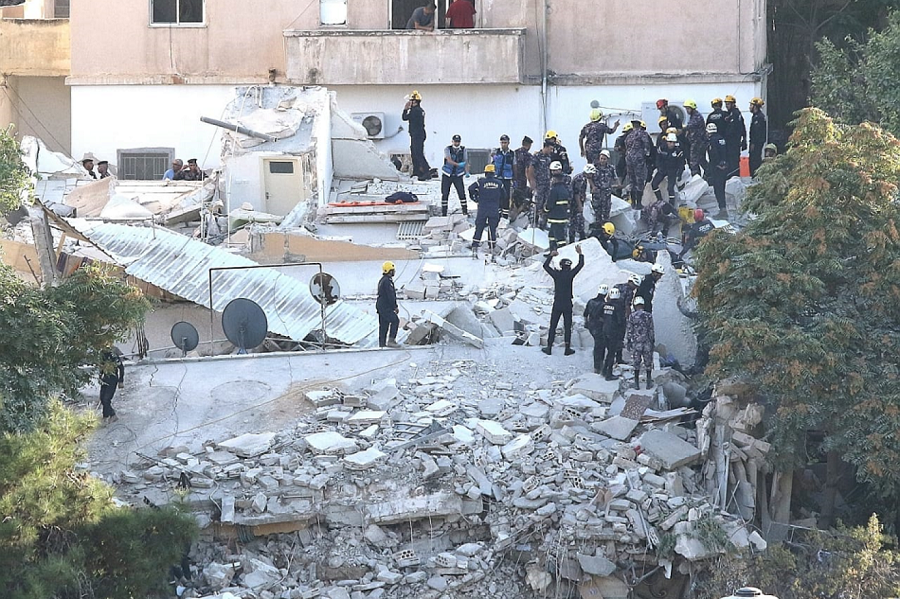
Last October, Jordanians expressed their fears of an impending disaster after the collapse of a residential building in the Al-Luweibdeh area of the capital Amman, killing dozens under its rubble. The fear stems from the existence of thousands of old and historic houses and buildings, some dilapidated and on the verge of collapse, in the capital Amman, which geographically lies on seven hills, raising the level of concern in the event of a strong earthquake. Estimates suggest that 'about a quarter of old buildings are dilapidated and on the verge of collapse,' according to the head of the Jordanian Engineering Offices Authority, Abdullah Ghosheh, amid calls to open the file of 'old buildings' and conduct a geographical survey and treat them before it is too late.
Read more
This section contains related articles placed in the Related Nodes field
Calls for Caution and Preparedness
In contrast to opinions that downplay the likelihood of an earthquake in Jordan, the Crisis and Disaster Management, Modeling and Simulation Center called for taking preventive steps to prepare and mitigate the impact of earthquakes in the future to reduce damage and loss of life and property. Among these preventive measures are following building standards and codes, as the disaster revealed the need for stronger building laws and codes to ensure structures can withstand earthquakes. Specialists called for involving the local community in disaster response and recovery efforts, in addition to risk assessment and the need for appropriate infrastructure such as bridges and roads to support rescue and recovery efforts and facilitate the reconstruction process. They also emphasized the importance of mental and psychological support for those affected by earthquakes. Observers pointed to the importance of early warning systems and promoting public education on disaster preparedness and risk reduction.
Scientific Data Denies
Professor of Geology Ahmed Mala'ba from the Hashemite University confirmed that the indicators and data on a major earthquake in Jordan deny its occurrence, calling on Jordanians not to fear or worry and not to listen to rumors. He pointed out that predicting an earthquake is difficult, even miraculous, despite the many studies and research conducted for centuries in all global laboratories. Mala'ba added, 'Jordan contains two major rifts: first, the Jordan Valley Rift, part of the African-Arabian Rift extending from Lake Victoria in Kenya through the Gulf of Aden, Red Sea, Gulf of Aqaba, Wadi Araba, Dead Sea, Jordan River, Lake Tiberias, through Lebanon and Syria to Turkey, with a length of about 7,000 kilometers; second, the Wadi Sirhan Rift, extending from northwestern Saudi Arabia through the Jordanian-Saudi border to the Azraq area in Jordan and the city of Ramtha, and from there to southern Syria and Lebanon, with a length of about 400 kilometers.' Despite this, Mala'ba stressed that scientific logic says there is no region in the world completely safe from earthquakes.
Mala'ba traced the history of earthquakes in Jordan and the surrounding region, mentioning the Jericho earthquake of 1927, which had a magnitude of 6.2 on the Richter scale, and the Safed earthquake of 1837 with a magnitude of seven.
Different Seismic Pattern
For his part, Najeeb Abu Karaki, professor of geology at the University of Jordan, ruled out the occurrence of a devastating earthquake in Jordan, explaining that the type of plates in the region is strike-slip, and historically among the earthquakes recorded in the region, no earthquake of such strength has been recorded. 'Our region is far away from earthquakes of this destructive pattern.' Abu Karaki indicated that most earthquakes in our region are of 6.5 magnitude on the Richter scale.
Regarding the Dead Sea area, which is expected to be the epicenter of any upcoming earthquake, Abu Karaki said, 'Scientifically, it may be more or less prone, but historically, the pattern of earthquakes in the Dead Sea area will not exceed 6.5 on the Richter scale and a depth of eight kilometers,' concluding, 'Our region cannot experience anything similar to what happened in Turkey, and those spreading rumors are seeking false fame.'
Original source: Independent Arabia




Comments (0)
Be the first to comment.