‘Ishterak’ Exhibition... Generator Connections: Scars on Beirut’s Face
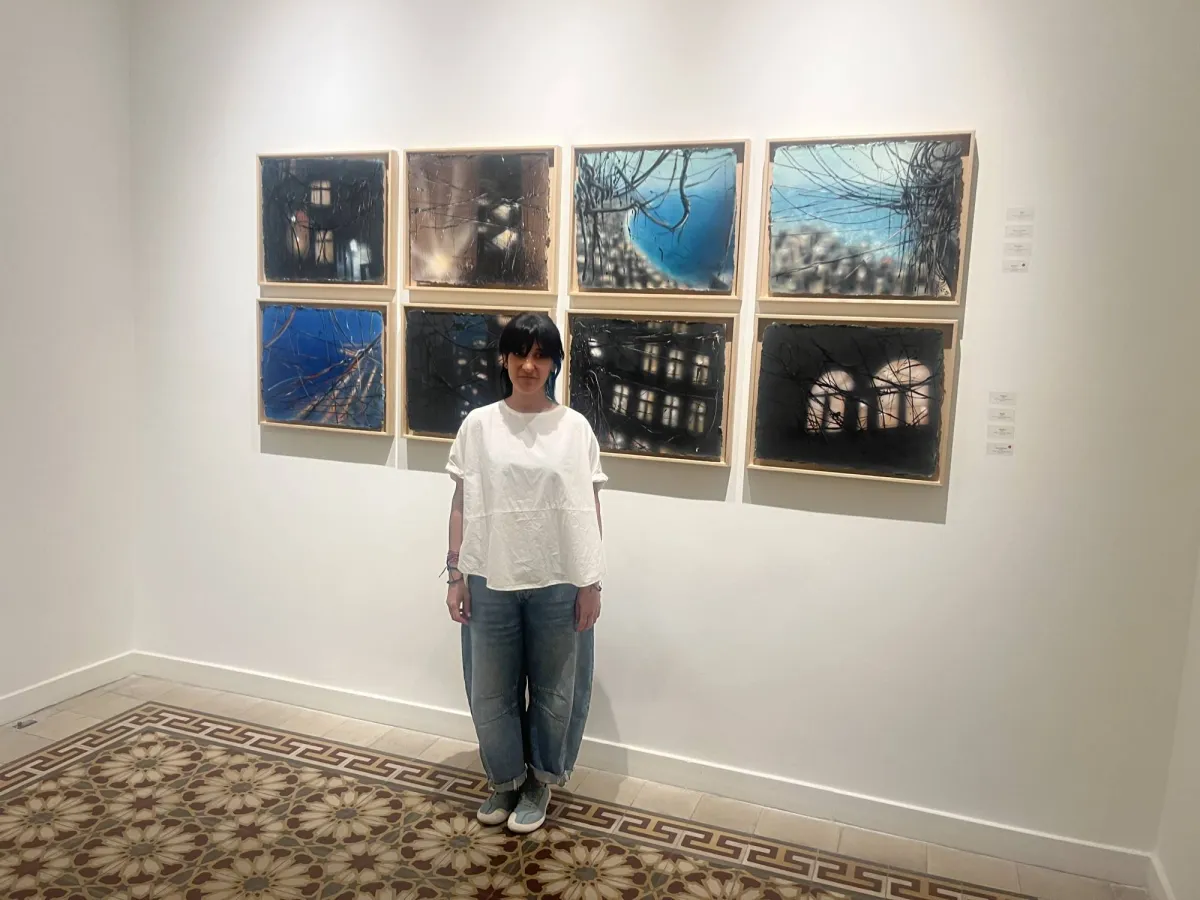
Dialah Khodri weaves her paintings with various accessories and tools, making them look like an exact replica of the daily scene...
French-Malian director Fan Sissoko affirmed that her short animated film 'Sundruð – Hold It Together' arose from her desire to express emotions that words cannot describe, noting that resorting to magical realism was a means that gave her the ability to embody internal conflicts and turn them into tangible visual images, bringing the film closer to the audience through a human language that transcends borders and cultures.
Fan Sissoko added, in an interview with Asharq Al-Awsat via Zoom, that animation gave her a wide space to explore feelings of belonging and alienation in a way that traditional cinema cannot achieve, explaining that she always strives in her works to blur the boundaries between reality and imagination, because a person experiences many of their feelings in a way that is difficult to express in words, whereas images and symbols can condense these sensations into impactful visual moments.
The film 'Sundruð – Hold It Together' participated in the last edition of the Annecy International Animated Film Festival, where it won the André Martin Award, one of the important awards dedicated to outstanding works in the field of animation. The film tells the story of 'Nima', a woman trying to adapt to a new society, but finds herself caught between a sense of belonging and the desire to escape, turning her psychological journey into a series of surreal transformations that reflect her internal struggle with identity, isolation, and the search for a place she can call home.
Film director Fan Sissoko (Production company)
Sissoko explained that she is naturally drawn to the style of magical realism because it gives her the opportunity to explore the inner world of characters more honestly, noting that she loves turning invisible emotions into material elements within the image, so that fear, loneliness, or anxiety become part of the world the viewer sees, not just a feeling narrated through dialogue.
Lack of belonging
She pointed out that the sense of not belonging experienced by the film's heroine, which appears on the surface to be related to migration, is actually a human feeling that anyone can go through. She affirmed that what delighted her most after the first screenings of the film was discovering that the audience engaged with this idea, as several viewers told her they found themselves in the character of 'Nima' even though they had not experienced migration.
She added that the character of 'Svana' initially appears completely different from the heroine; she is outgoing, confident, and acts as if she owns the place, but the development of events reveals that she too suffers from a deep feeling of loneliness. She noted that the film attempts to demonstrate in its ending that isolation can turn into a shared space that brings people together rather than separating them.
She pointed out that the physical transformations the heroine undergoes throughout the events were not just visual solutions or fantastical effects, but rather came as a direct extension of her psychological state. She explained that she believes emotions leave a real impact on the body, and that language often fails to contain emotional complexities, which is why she resorts to visual metaphor as the language closest to expressing those states.
She touched upon the impact of her personal experience on the film, affirming that the work carries part of her life as a woman belonging to more than one culture, but she does not consider it an autobiography. She noted that her stay in Iceland during the scriptwriting period had the greatest influence on the film's features; she drew inspiration from details of daily life there, starting from social customs in geothermal pools, through the way people communicate, to the weather and the nature of human relationships in Icelandic society.
Production collaboration
She affirmed that the production collaboration between Iceland, France, and Belgium gave the film exceptional richness, explaining that each country added a different element to the project. The development and musical composition took place in Iceland, while the animation was executed in France, and post-production was completed in Belgium, which allowed her to benefit from multiple expertise. Moreover, working with artists who had not lived in Iceland pushed her to rethink many details that seemed obvious to her and helped her highlight the aspects most important to the viewer.
The director presented her second experience in the field of animation (Production company)
Sissoko affirmed that the film relies on symbolic transformations that are difficult to present with the same degree of freedom in live-action cinema, whereas animation allows the director to transcend the laws of reality and physics, turning imagination into a natural part of the narrative. She noted that geothermal pools hold a special place in Icelandic culture, so she chose them as the main stage for the events, as a microcosm of society with all its relationships and unwritten rules.
The director added that water itself carries deep human significance for her; it symbolizes transformation, time, and constant change, and has a dual nature; it can be frightening and violent at one moment, then turn into a source of tranquility and healing at another, which gives it a great capacity for visual expression in cinema.
Broken sentences
She pointed out that the absence of a common language between the film's characters was not just a dramatic detail, but an essential element in its construction. Therefore, she deliberately used broken sentences, misunderstandings, and silent moments because they accurately reflect the feeling a person has when they find themselves in a society that does not master their language or understand their rules.
She affirmed that what affected her most after the world premiere at the Annecy Festival was not the applause or critical acclaim, but the meetings she had with viewers after the screenings; she was surprised that many spoke to her about their personal feelings of alienation, which she considered evidence that the film transcended the specificity of place to reach a shared human experience.
The film was shown at the Annecy Festival recently in France (Production company)
Regarding the film winning the André Martin Award, she said that this honor came as a surprise to her, especially since she does not have an academic background in animation, and 'Sundruð' is only her second film in this field. She pointed out that she completed the work during times when she was balancing her family responsibilities and her daily job, so this recognition represents a great incentive for her to continue. She also hopes that the film will gain a wider presence in Iceland, especially amid rising discussions about migration.
Your Premium trial has ended
Original source: Asharq Al-Awsat



Comments (0)
Be the first to comment.