Lapid calls for broad coalition to remove Netanyahu and 'his extremist allies' from power
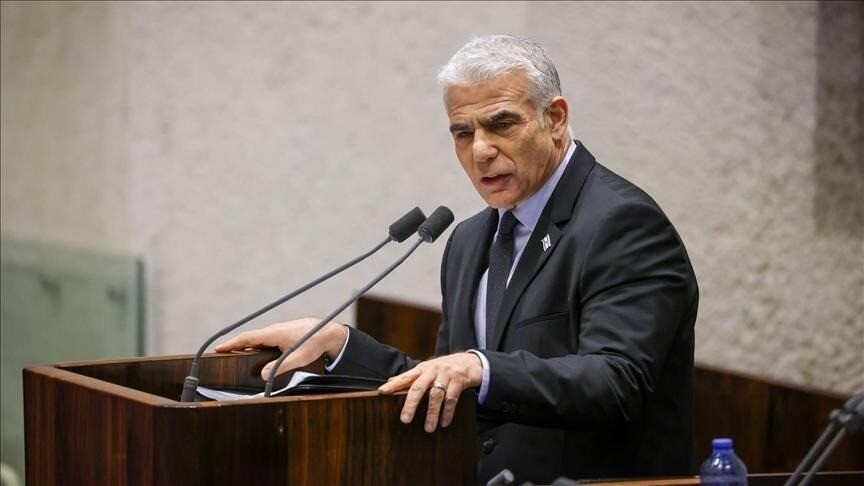
Israeli opposition leader Yair Lapid accused what he called 'extremists' of exploiting democratic rules to eliminate democracy.
International/Israel
Lapid calls for broad coalition to remove Netanyahu and 'his extremist allies' from power
Israeli opposition leader Yair Lapid accused what he called 'extremists' of exploiting democratic rules to eliminate democracy.
Khaled Yousef
July 18, 2026•Updated: July 18, 2026
İSTANBUL
Istanbul/ Khaled Yousef / Anadolu
Israeli opposition leader Yair Lapid attacked Prime Minister Benjamin Netanyahu on Saturday over his alliance with 'extremist religious parties and his support for legislating laws that serve them,' describing him as 'extremist,' while also calling for forming a broad coalition against them and excluding them from power if necessary.
In a post on his page on the American platform 'X,' Lapid said: 'There is no point in getting close to extremists, or trying to reach an agreement with them, or appeasing them, because they do not appreciate good faith.'
He stressed that 'extremists see only one thing: more power. They will exploit the opportunity by any possible means, at the first available chance, and whoever allows them to get close to power will be their first victim.'
Lapid emphasized the need to 'confront extremism,' accusing those he described as 'extremists' of exploiting democratic rules to eliminate democracy.
He continued: 'There is no way to counter extremism except by confronting it, looking it straight in the eye, and saying enough. If laws are needed against you, they will be enacted; if we have to exclude you, we will exclude you without hesitation.'
Lapid called for forming a 'broad and firm coalition against extremists,' saying it must 'realize that not an inch should be conceded to them.'
He addressed Netanyahu's alliance with extremist religious parties, saying: 'Look what happened to Netanyahu, the most cunning politician. He thought he would control Itamar Ben-Gvir (leader of the extremist Jewish Power party), but what happened? Who ended up controlling whom? What laws did they pass? What policies did they implement? Not because they are geniuses, but because they are extremists.'
Lapid continued: 'Someone must shut the door in their faces and tell them clearly and firmly: There is no place for these views here,' adding: 'We will be the ones to confront them.'
This call comes a day after the Israeli Knesset dissolved itself, paving the way for general elections scheduled for October 27 next.
Netanyahu seeks to run in the elections in an effort to remain in power, while opposition parties, despite their differing positions, agree on the goal of removing him and his associates from power.
Days before the Knesset dissolved itself, on Monday it gave final approval to the Basic Law: Torah Study, which grants students of religious seminaries (yeshivot) a special legal status.
The newspaper Yedioth Ahronoth said the law could strengthen the position of the Haredim before the Supreme Court and pave the way for passing a future law exempting them from military service.
The newspaper added that the understanding between Netanyahu and the Haredi parties is based on the government coalition supporting laws that serve the Haredim, foremost among them the Basic Law: Torah Study and the law freezing the arrest of draft evaders, in exchange for the Haredi parties voting in favor of bills aimed at weakening the media and reducing the powers of the government's legal adviser.
The Haredim make up about 13 percent of Israel's population, which exceeds 10 million, and they refuse to perform military service on the grounds of devoting themselves to Torah study, believing that integration into secular society threatens their religious identity.
For decades, members of this community have managed to avoid conscription upon reaching the age of 18 by obtaining repeated deferments under the pretext of studying in religious seminaries, until reaching the current exemption age of 26.
However, the Israeli Supreme Court ruled in June 2024 that Haredim must perform military service and stop financial support for religious institutions whose students refuse to enlist.
Original source: Anadolu Agency





Comments (0)
Be the first to comment.