Libya: Public Outrage Over "Double Standards" in Power Load Shedding
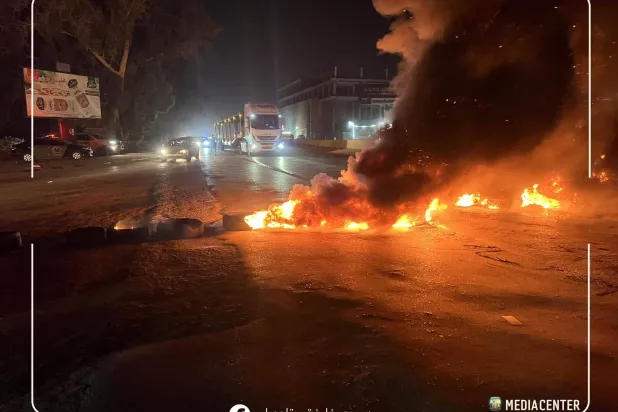
Citizens in western Libya blocked roads after setting fire to tires in protest against what they called "a lack of fairness in power load shedding," demanding that authorities take action to resolve the crisis.
Libyans in both western and eastern Libya suffer from power outages lasting for long hours throughout the day, but the majority of them do not hide their intense anger over what they termed "a lack of fairness in load shedding" between cities.
Most regions of Libya suffer from power outages, which have disrupted daily life in the oil-rich country and affected dozens of wells belonging to the "Great Man-Made River."
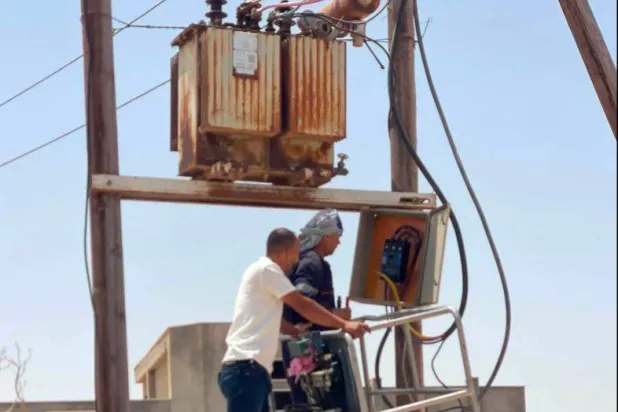
Work inside the electricity company in eastern Libya (The Company)
In several regions of western Libya, a state of popular anger prevailed after citizens took to the streets, burned tires, and blocked roads to protest "double standards" in the load-shedding process.
In the coastal city of Tajura (21 kilometers east of the capital, Tripoli), citizens gathered in the streets and set tires on fire on Wednesday evening, threatening authorities with closing the entrances and exits of their city due to frequent power outages and "a lack of fairness in load shedding." They pointed out that "the disappearance of electricity" has turned their lives into hell, amid temperatures soaring above 45 degrees Celsius in areas like Al-Jameel (south of Zuwara), with expectations of reaching 47 degrees, according to the "Roya" Space Science Foundation on Thursday.
The Municipality of Tripoli was forced on Thursday to suspend work across all its affiliated departments, offices, and sectors, granting its staff a holiday due to high temperatures and ongoing power outages. Meanwhile, protests recurred in the Abusليم municipality in Tripoli, where citizens organized a protest on Wednesday evening to express their anger over frequent power outages lasting for many hours.
The "Man-Made River" announced the withdrawal of 143 wells from service due to power outages on July 23 (Implementation and Management Agency of the Great Man-Made River Project)
Many areas in Tripoli also reacted to the electricity crisis. In "Souq al-Jumaa," social media pages reported that protesters blocked Tripoli's eastern entrance (Al-Bifi) in both directions due to power outages lasting for extended hours for over a week.
The repercussions of the power outage crisis reached the "Man-Made River," whose administrations announced the disruption and decommissioning of dozens of wells. The Implementation and Management Agency of the "Great Man-Made River" Project announced on Thursday that 143 wells in the Sarir and Tazirbo well fields were put out of service due to power outages resulting from the shutdown of the first unit at the Sarir gas power plant.
The agency stated on Thursday that the power outage led to the decommissioning of 51 wells in the Tazirbo well field and 92 wells in the Sarir well field, noting that "to protect the pipeline network and maintain the water level in the Ajdabiya reservoir, water supplies to some cities will be reduced."
Aguila Saleh, Speaker of the Libyan House of Representatives, stepped into the crisis, and his office stated that he discussed the power outage crisis with Belqassim Haftar, "Head of the Development and Reconstruction Fund," alongside updates on the development and reconstruction file.
Saleh receiving Belqassim Haftar on Wednesday evening (Saleh's Office)
Saleh's media center explained that his meeting with Belqassim discussed "the necessity of taking urgent measures and rapid solutions to address the electricity crisis, and setting immediate treatments to reduce its repercussions on citizens."
According to the meeting, this includes the importance of "stabilizing the electricity supply to alleviate the suffering of citizens, maintaining the continuous provision of basic services through the accelerated implementation of priority projects, and supporting efforts aimed at enhancing the efficiency of the electricity sector infrastructure."
The Libyan electrical grid had suffered a near-total collapse following the decommissioning of several generation plants and main transmission lines, resulting in the loss of about 1,350 megawatts of production capacity.
Egypt intervened to resolve the crisis by resuming electricity exports to Libya with an initial capacity of 70 megawatts, following the payment of about $100 million out of accumulated Egyptian electricity import dues dating back to 2023.
Asharq Bloomberg agency quoted an official at the Egyptian Ministry of Electricity as saying that the two sides agreed on a payment schedule for the remaining $41 million before the end of 2026, out of a total debt of $141 million, ensuring the continued flow of electricity and the possibility of gradually increasing exported quantities.
Prime Minister of the "Government of National Unity" Abdul Hamid Dbeibah had previously directed that the power outage crisis in several cities be addressed, "solutions be developed to end the suffering of citizens, and the challenges facing the sector be discussed."
With the onset of summer, Libyan regions began complaining of power outages lasting up to 7 hours amid "load shedding" and a significant spike in temperatures, especially in southern Libyan cities.
The General Electricity Company attributed the grid crisis and the total blackout witnessed by most regions of Libya on Saturday to technical and security factors, in addition to declining gas and fuel supplies.
Libyan bloggers and activists circulated what they said were documents revealing the causes of the electricity crisis, represented by "the loss of 1,700 megawatts" due to clashes recently witnessed in the city of Zawia in western Libya, also pointing out that "shortages in gas and fuel supplies caused the loss of 1,000 megawatts".
Original source: Asharq Al-Awsat



Comments (0)
Be the first to comment.