Mazagan and El Jadida: A City’s Tale from Portugal to Morocco
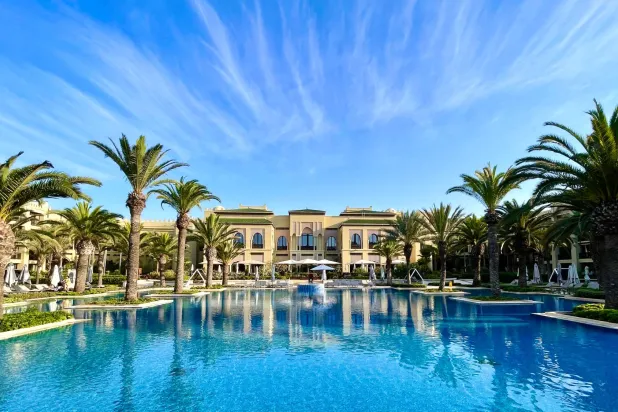
The journey began from London to Casablanca, a trip lasting about three and a half hours, before continuing south by car for approximately 90 kilometers toward the city of El Jadida, historically known as Mazagan. Along the coastal road, the scene gradually shifts from the bustling economic capital of Morocco, with its remarkable cleanliness and new residences, to a quiet city that preserves five centuries of history, where the old Portuguese ramparts still overlook the Atlantic Ocean, while modern tourism projects reflect some of the transformations the region has experienced in recent decades.
Traditional Moroccan architectural design everywhere (Asharq Al-Awsat)
Mazagan offers a model destination that combines history and heritage on one hand, and tourism investment on the other, making it a worthwhile stop for those seeking to explore a different side of Morocco.
Our trip coincided with the heatwave that swept across large parts of Europe, pushing temperatures in several cities to record levels. However, arriving at the Moroccan Atlantic coast revealed a different climatic scene; in Mazagan, the weather was milder thanks to the Atlantic breezes, which tempered the summer heat and gave the city a comfortable climate compared to what London and other European cities experienced during the same period.
Sandy beach and clear blue waters (Asharq Al-Awsat)
From a Portuguese fortress to a Moroccan city
On the Atlantic coast of Morocco, about 90 kilometers south of Casablanca, lies the city of Mazagan, or El Jadida as it is now known, one of the cities that encapsulates multiple phases of Morocco's history. From a fortified city built by the Portuguese in the 16th century to a tourist destination attracting visitors from within the country and abroad, El Jadida reflects how it has managed to preserve its historical heritage alongside the economic and tourism transformations that Morocco is experiencing.
The city's story begins in 1514 with the Portuguese construction of the Mazagan fortress, which later became a military and commercial center on the Atlantic coast. After more than two centuries, the Moroccan state recaptured the city in 1769, beginning a new phase in its history that was reflected in its urban development and cultural identity.
Mazagan is characterized by its mild climate year-round (Asharq Al-Awsat)
The Portuguese city remains the most prominent landmark of El Jadida, with its defensive walls, towers, and historic gates, as well as the Portuguese cistern, which gained worldwide fame after appearing in several film works. The old city was inscribed on the UNESCO World Heritage List as an outstanding example of Portuguese military architecture outside Europe and a testament to the historical interaction between Moroccan and European cultures.
Outside the walls, El Jadida appears as a modern coastal city whose economy relies partly on tourism, alongside agriculture, industry, and services. Visitors come to enjoy the beaches overlooking the Atlantic Ocean, visit traditional markets, and taste the seafood for which the region is famous.
Beautiful designs and a city that blends heritage and modernity (Asharq Al-Awsat)
Among the most notable projects that have boosted tourism in the area is the Mazagan Beach & Golf Resort, which opened in October 2009 with an investment of $370 million, as part of the 'Blue Plan' program aimed at developing tourism in Morocco. The resort extends over approximately 250 hectares along the Haouzia Beach, and includes more than ten restaurants, a spa, an 18-hole golf course designed by world golf champion Gary Player, as well as an open farm that welcomes visitors of all ages, featuring a number of animals, a section dedicated to growing vegetables used by the resort's chefs in preparing some of their dishes, and a space prepared for children to play and spend time in the lap of nature.
The Moroccan hammam is a must-try experience (Asharq Al-Awsat)
Thanks to the diversity of its facilities, some visitors choose to spend their entire stay within the resort, which offers multiple options for relaxation and entertainment. These options include the traditional Moroccan hammam experience, massage sessions provided by specialists, swimming in the main pool, or strolling through the vast gardens spread throughout the resort.
Moroccan style is clearly evident in the architectural design of the resort, which welcomes visitors with an entrance inspired by the traditional riad. Moroccan zellige (mosaic tilework) appears as one of the most prominent elements of architectural identity, adorning walls, floors, fountains, and arches, as an extension of a centuries-old handicraft. This art relies on small ceramic pieces hand-assembled to form harmonious geometric patterns that reflect the precision of Moroccan craftsmanship and the aesthetics of Islamic art. The use of zellige is no longer limited to historical buildings but has become a key element in many modern hotel and tourism projects that draw inspiration from Moroccan style and integrate it with contemporary designs, giving them a character that combines authenticity and modernity.
Restaurants offering Moroccan cuisine in a modern style (Asharq Al-Awsat)
There are numerous activities for families, including a kids' club and entertainment programs suitable for all ages. Along the sandy beach, visitors can engage in activities such as riding ATVs or scoot bikes, and horseback riding along the ocean waters; sunset is one of the best times to experience this.
The resort houses about 15 restaurants and cafes offering diverse culinary experiences, ranging from traditional Moroccan cuisine at 'Bouchra by Buddha-Bar,' which blends Moroccan and Lebanese cuisines under the supervision of Chef Joe Barza, to seafood at 'Ciel de Mer' and French cuisine at 'La Café,' which transports you to the ambiance of small French restaurants, and Asian and Japanese dishes at 'Buddha-Bar Beach.' Additionally, 'Studio 42' is inspired by the studios where the most famous scenes of the classic film 'Casablanca' were shot.
King Hassan II Mosque in Casablanca (Getty)
Casablanca and Azemmour: Two Nearby Stops
A visit to El Jadida or Mazagan is not limited to itself; many visitors choose to combine it with Casablanca in one trip. The economic capital of Morocco, about an hour's drive away, features a number of prominent tourist attractions, most notably the Hassan II Mosque overlooking the Atlantic Ocean, the old city with its traditional markets, and the Habous district, which is one of the most famous shopping destinations for purchasing traditional Moroccan products.
If you are a fan of traditional cafes, you must try the historic 'La Scala' cafe overlooking the old ramparts in the city, and the Ain Diab corniche which houses restaurants and cafes overlooking the sea. This place is divided into two sections: one dedicated to tea, coffee, and Moroccan sweets, and the other for dining in beautiful outdoor settings, serving traditional dishes and ending with Moroccan desserts full of sugar and almonds, so don't miss tasting the delicious 'kaab el ghazal' (gazelle horns).
Portuguese remnants in Mazagan, known today as El Jadida (Getty)
Original source: Asharq Al-Awsat





Comments (0)
Be the first to comment.