In Turkey.. Discover the Secrets of the Sultans' Palace Where Concubines and Eunuchs Lived
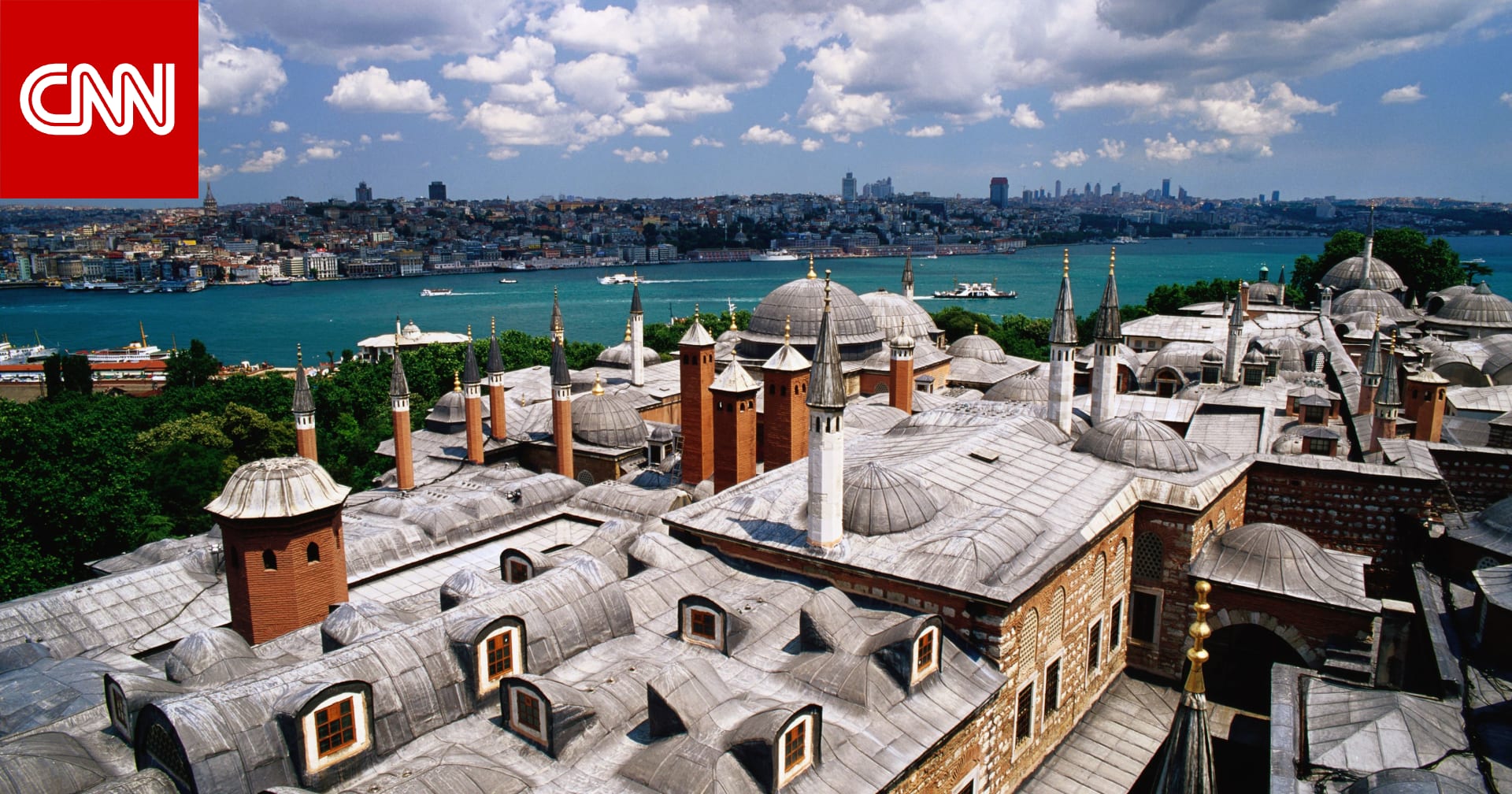
Topkapi Palace in Istanbul was the seat of the Ottoman Empire's power for about 400 years. The palace was a vast walled maze covering an area of 700,000 square meters, functioning like a bustling city within a city.
(CNN)-- Some countries and empires declare their greatness through towering castles and fortresses that impose their presence on the horizon, but Topkapi Palace in Istanbul, Turkey, differs from this model.
Despite the grandeur of the 15th-century Imperial Gate, the palace seems hidden among the major historical landmarks in the Sultanahmet area, such as Hagia Sophia, the Blue Mosque, and the Basilica Cistern. The palace is surrounded by a wall about five kilometers long, making it a symbol of authority based on prestige and seclusion.
Topkapi Palace was the beating heart of the Ottoman Empire for nearly four centuries. From within, affairs of an empire that at its peak in the 17th century stretched across three continents, from Vienna to Algiers and Mecca, were managed. Today, it is considered one of the greatest surviving historical palaces in the world, alongside the Palace of Versailles and the Forbidden City in China.
The Circumcision Room was built by Ibrahim I in 1640. Its exterior walls are adorned with particularly beautiful tile work. Credit: Izzet Keribar/Stone RF/Getty Images
The palace is located on a strategic site at the tip of a peninsula overlooking the Bosphorus Strait, the Golden Horn, and the Sea of Marmara, the site of the ancient Byzantine city's acropolis. After the conquest of Constantinople in 1453, Sultan Mehmed II ordered the construction of the palace in 1459, utilizing ancient Byzantine fortifications to establish his new complex.
The palace consists of four main courtyards plus the Harem wing, which contains about 400 rooms. Each courtyard was more private than the one before, with gradually decreasing freedom of entry. As for the Harem, where the sultan and his family resided, no foreign male was allowed entry except eunuchs.
This fur-lined kaftan belonged to Sultan Mehmed II, also known as Mehmed the Conqueror, who ordered the construction of Topkapi Palace in 1459. Credit: Oguz Yeter/Anadolu/Getty Images
The first courtyard was open to the unarmed public and housed the ancient Hagia Irene Church, the Imperial Mint, bakeries, and several fountains. Among the most famous is the Executioner's Fountain, associated with a legend that the executioner would wash his sword there after carrying out death sentences.
As for the Gate of Peace, it marked the beginning of the sultan's private world, and only the sultan and his mother were allowed to enter it on horseback. Silence was mandatory inside, and violators would be punished, a clear embodiment of discipline and prestige within the court.
The palace is surrounded on all sides by a wall approximately 5 kilometers long. Credit: Jakub Porzycki/NurPhoto/Getty Images
In the second courtyard, meetings of the Imperial Council were held led by the Grand Vizier, while the sultan observed the discussions from behind a gilded window without being seen by those present. The palace buildings, despite their modest height, feature stunning Ottoman decorations, especially the gilded arches and colorful Iznik tiles covering the walls. The former royal kitchens also house one of the largest collections of Chinese and Japanese porcelain in the world.
The third courtyard was more private and included reception halls, the Imperial Treasury, and the Palace School where pages were trained for senior administrative positions. This system helped form a ruling elite loyal directly to the sultan, strengthening the centralization of power.
The magnificent dome of the Imperial Hall. Credit: StefanoZaccaria/iStockphoto/Getty Images
The treasury contains precious treasures, most notably the famous Spoonmaker's Diamond weighing 86 carats, and the Topkapi Dagger adorned with emeralds, along with gifts and artifacts from across the empire.
The Imperial Hall is the most magnificent room within the Harem. Credit: DEA / Archivo J. Lange/De Agostini/Getty Images
The Harem is one of the most controversial and misunderstood parts of the palace in Western narratives. It was the residence of the sultan, his wives, concubines, and family members. One of its most prominent figures was Hürrem Sultan, who went from being a concubine to the legal wife of Sultan Suleiman the Magnificent, becoming one of the most powerful women in Ottoman history.
Despite the splendor of the Harem's decorations, the lives of many women inside it were filled with isolation and restrictions. Its guard was entrusted to black eunuchs who were brought from Africa after being castrated in childhood, while white eunuchs, mostly from the Balkans and the Caucasus, assumed administrative and supervisory responsibilities within the palace.
The complex contains dozens of fountains, as flowing water played an important role in palace culture. Credit: Sean Gallup/Getty Images
As for the fourth courtyard, located at the highest point of the palace, it was the sultan's private retreat, featuring gardens, beautiful pavilions, and terraces overlooking the Bosphorus and Istanbul.
Even today, this place gives the visitor a sense of the grandeur of the Ottoman Empire, allowing them to imagine the scene that the sultans saw as they stood on the edge of Europe, contemplating a vast empire that stretched across continents.
Original source: CNN Arabic


Comments (0)
Be the first to comment.