One of the Strangest Fish in the World: Its Head Reveals What's Inside
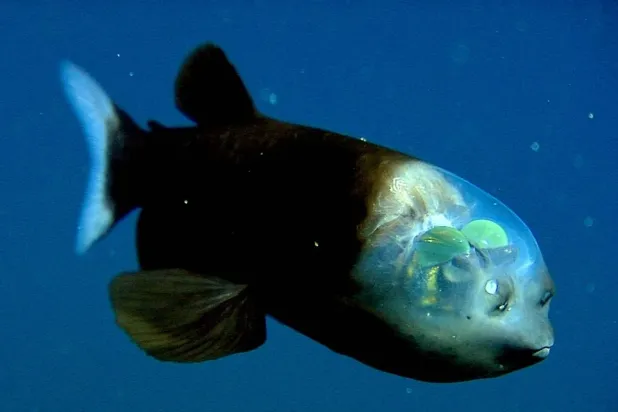
This fish, about 15 centimeters long, has several strange characteristics, including large scales that resemble cartoon drawings on its sides.
Harsh environments require exceptional adaptations from living organisms, and many of them appear strange and bewildering to our minds in an astonishing way. The deep sea is one of the richest environments that biologists seek out in search of these unique creatures, as extremely strange beings lurk in those abyssal depths.
The barrel-eye fish, scientifically known as Macropinna microstoma, which lives in the depths of the North Pacific, is a perfect example.
According to Discover Wildlife, this fish, about 15 centimeters long, has several strange characteristics, including large scales resembling cartoon drawings on its sides, a large pelvic fin to help maintain balance, and a very small mouth. But most astonishing is that the front part of its head is completely transparent.
Early scientific drawings of this fascinating creature showed a strange animal resembling a duckbill, with two rigid tubular eyes pointing upward, and a thin, shallow, elongated snout. But the barrel-eye fish does not actually look like that.
It turned out that the shock the fish experienced during capture, followed by the rapid pressure drop when brought up from deep water, actually caused it to burst before scientists could see it properly for the first time in 1939.
Scientists were not able to see the first live specimens of this fish in their natural habitat until 2004, 60 years later, thanks to the enormous leap in deep-sea exploration technology. However, this live sighting did not make the fish seem any less strange.
It was known that these deep-dwelling creatures have relatively large tubular eyes, but what the distorted early specimens failed to reveal is that these eyes, unusually, are not on the surface of the animal's body but are located inside its head.
And what a unique head it is: a round, transparent, fluid-filled dome, much like a fighter jet cockpit. This means that the fish's brain, nervous system, and all the internal parts of its head are fully visible.
To understand the benefit behind this peculiar structure, one must imagine the environment in which this fish lives. At depths between 600 and 800 meters below the surface, specifically in the 'twilight zone' (mesopelagic zone: intermediate depth waters), light becomes very scarce.
Under these conditions, having tubular eyes instead of traditional spherical eyes is the most efficient adaptation for capturing the tiny amount of light that penetrates these depths. A large lens at one end and a retina backed by a huge number of light-sensitive rod cells at the other work like a telephoto camera lens to increase focal length and form a larger image on the retina.
It is believed that those strange lenses, which look out from inside the transparent fish head, are tinted green to help see its bioluminescent prey.
Many ocean creatures use adjustable bioluminescence to hide their shadow, changing their glow to match the light from above in order to deceive predators.
However, this bioluminescence has a broader spectrum than the ambient light, and it is believed that the barrel-eye fish's eyes allow this greener light to pass while blocking some of the remaining light, enabling it to precisely locate its prey.
As for its upward-pointing gaze, it is likely because this fish hunts either 'siphonophores' (colonies of tiny organisms that look like jellyfish connected in chains) or prey entangled in the stinging cell curtains of these creatures; the faint light from above reveals their silhouettes.
But what is the purpose of that transparent head? Scientists could not figure out the reason until 2008, when they noticed that this fish's eyes can rotate.
While its small mouth is in its usual place, about 90 degrees from the direction its eyes typically look, the fish, once it spots prey, orients its body upward to face it 'mouth to mouth'.
Then, these two strange eyes rotate forward by up to 75 degrees, allowing the fish to capture its meal precisely. Its transparent head enables this exceptional visual mechanism while also protecting its delicate sensory organs from the stinging and toxic cells of its prey.
Now, everything has a completely logical explanation.
Original source: Asharq Al-Awsat






Comments (0)
Be the first to comment.