Passing of Lindsey Graham, one of the most prominent U.S. foreign policy hawks
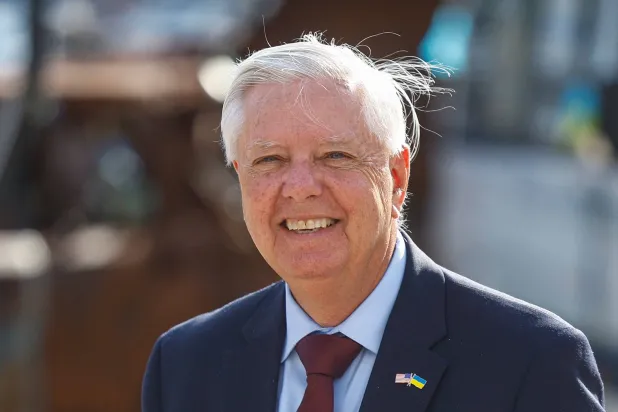
The death of Senator Lindsey Graham on Sunday marks a turning point within the Republican Party and the U.S. administration, coming at a time when Trump is navigating one of his most sensitive political phases.
The death of prominent Republican Senator Lindsey Graham at the age of 71 on Sunday morning was no ordinary event in Washington, D.C.; rather, it represented a turning point within the Republican Party and the U.S. administration at a time when President Donald Trump is navigating one of his most sensitive political phases ahead of the midterm elections.
With Graham's passing, Trump does not just lose an influential member of the Senate, but also one of his most loyal and vocal defenders in Congress, and one of the most prominent foreign policy hawks who played a pivotal role in files related to the war in Iran, the Russia-Ukraine war, and the war in Gaza, as well as a powerful role in U.S. relations with Middle Eastern countries.
Graham's office announced his death on Sunday morning following a heart attack at his residence near the Capitol, according to a Wall Street Journal reporter and emergency services dispatch logs. Graham had been scheduled to appear on NBC's 'Meet the Press' on Sunday morning.
President Trump was quick to mourn Graham on the 'Truth Social' platform, describing him as a 'true American patriot' and 'one of the greatest senators I have known,' asserting that the United States has lost a 'loyal friend and a tireless warrior.' This eulogy was not merely ceremonial, but reflected the exceptional nature of the relationship that developed between the two men over the last decade, having started with sharp antagonism and ending in a close political alliance.
From antagonism to loyalty
It is difficult to understand Graham's position within Trump's inner circle without returning to the 2016 elections, when the prominent senator was one of the harshest critics of Republican candidate Donald Trump, describing him at the time as unfit to lead the party or the country, and labeling him an instigator of racial division, xenophobic, and a religious bigot. The relationship between the two men saw significant tension following the attack on the Capitol on January 6, 2021, and Graham was among those who accused President Trump of inciting the assault. However, American politics often reshapes alliances, and Graham voted against convicting Trump in his second impeachment trial.
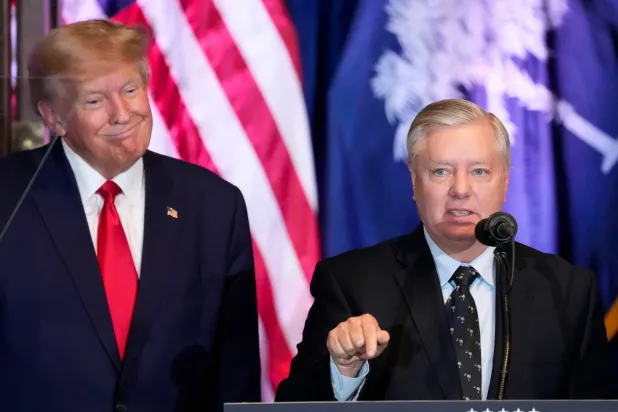
U.S. President Donald Trump watches U.S. Senator Lindsey Graham (R-South Carolina) address the crowd during a 2024 campaign event in Columbia, South Carolina, on January 28, 2023. (AFP)
Although Graham rejected Trump's claims that the 2020 election was rigged, he supported Trump's efforts to win a second presidential term. After Trump arrived at the White House, Graham gradually transformed into one of his closest advisors in the Senate, especially after the passing of Senator John McCain, who represented the primary reference point for the traditional Republican wing. Graham later became the most important link between the White House and Congress, strongly defending Trump's policies, supporting him in battles to appoint Supreme Court justices, standing by him during impeachment proceedings, and playing a pivotal role in maintaining Republican cohesion during the most difficult stages of Trump's first presidency.
His beginnings and journey
In 1994, Graham was first elected to the House of Representatives before being elected to the Senate in 2002, with re-elections in 2008, 2014, and 2020. He most recently served as the ranking member of the Senate Budget Committee.
He grew up in Central, South Carolina, received his bachelor's degree in 1977, followed by a law degree in 1981, and joined the U.S. Air Force during his university studies. Graham served as a military lawyer and reached the rank of colonel in the Air Force, an experience that contributed to shaping his foreign policy positions favoring U.S. intervention.
In 2002, he voted in favor of the invasion of Iraq following the September 11, 2001 attacks, and later supported maintaining a long-term U.S. military presence in Afghanistan. Graham is considered one of the most prominent critics of former President Barack Obama's foreign policy, describing him after the signing of the 'Joint Comprehensive Plan of Action' between Iran and the P5+1 group in 2015 as a 'weak adversary of evil.'
The voice of the hawks
Within the Republican Party, Graham represented the 'peace through strength' school; therefore, his name was associated with almost every hot topic facing the United States. Regarding the Iran file, he was among the loudest voices calling for tighter sanctions and consistently adopted the option of using military force if necessary, considering Iran's possession of a nuclear weapon a direct threat to American and Israeli security.
As for the Russia-Ukraine war, he was one of the most frequent visitors to Kyiv since the outbreak of the war, defended continued military aid, and contributed to pushing for a stricter sanctions project against Moscow just days before his death. He also believed that any American retreat from supporting Ukraine would undermine Washington's credibility before its allies in Europe and Asia. Ukrainian President Volodymyr Zelenskyy mourned him, writing on the 'X' platform that he 'visited Ukraine 10 times during the years of the full-scale Russian invasion and was here with our people in the darkest circumstances,' noting that he 'worked on initiatives aimed at achieving peace.'
Graham and Israel
Conversely, Graham remained one of the closest American politicians to Israel. After the October 7 attacks, he defended its right to a military response against its adversaries and called for deepening security cooperation with it, which earned him close relations with most successive Israeli leaders. He was also one of the strongest supporters of the 'Abraham Accords' and made numerous visits to countries in the Middle East region. Israeli Prime Minister Benjamin Netanyahu wrote on the 'X' platform: 'Israel has lost one of its greatest friends. America has lost a great patriot. And I have lost a dear friend.' He also rushed to appear on Fox News on Sunday morning for more than 20 minutes, speaking about Graham's political stances in support of Israel.
Israeli and American media reports discuss the possibility of Netanyahu attending the official funeral ceremony in his hometown in South Carolina, with speculation that the visit could turn into an opportunity to hold a meeting with President Trump to discuss the issues of Iran, Gaza, and bilateral relations.
A political vacuum
Politically, Graham's death opens a vacuum that is difficult to fill quickly; the man was not just a chairman of an influential Senate committee, but one of the most prominent architects of Republican foreign policy and held wide influence within the American military and security establishment. Sadness and confusion have prevailed in Republican circles, as Lindsey Graham's death forces a recalculation for Republicans and temporarily reduces their majority in the Senate until a successor is appointed according to South Carolina law. This gives Democrats a wider margin for maneuver on a number of sensitive legislative files, but the biggest impact lies in the absence of a personality who bridged his closeness to Trump with the trust of traditional Republicans, a rare equation within the party.
What does Trump lose?
Original source: Asharq Al-Awsat

Comments (0)
Be the first to comment.