Peace Process Between Turkey and PKK Faces Slowdown
Summary: Sources in the Justice and Development Party said that the law's entry into force would be contingent on first laying down arms, with implementation remaining suspended until field reports from intelligence and armed forces are issued.
The dialogue and preparation process between the Turkish government and the Kurdistan Workers' Party is evolving, with preparations to enter a new phase; both sides are moving according to very precise criteria and sensitivities, fearing a slip into forbidden territory and the deterioration of the historic process anew.
For its part, the Turkish government is preparing to submit a framework law to parliament in the near future, containing articles that would accelerate the stalled peace process with the PKK. Turkish President Recep Tayyip Erdogan said last week that work is underway on a legal framework to speed up the process, adding that it would be placed on parliament's agenda urgently.
The Turkish president stressed their determination to continue reaching peace with the PKK, speaking on his behalf and on behalf of his ally, Nationalist Movement Party leader Devlet Bahçeli, who initiated the opening of the process with the Kurdish side in October 2024. Erdogan said that as the People's Alliance, they have the will, determination, and courage to do what is required, and they will continue until the success of this process.
But practical steps appear more complex than the smooth Turkish statements; the path is intricate and passes through multiple decision-making centers on both sides, including the PKK, whose leader has been imprisoned in solitary confinement on İmralı Island in the Sea of Marmara since 1999, while the party's leadership is distributed across locations and hideouts in the mountains of Iraqi Kurdistan in the border triangle with Iran and Turkey. Inside Turkey's parliament, the pro-Kurdish Peoples' Equality and Democracy Party is active, where its leaders Mithat Sancar and Pervin Buldan form the delegation that visits Öcalan and conveys his messages to both his party leadership and Turkish officials, including parliament, the presidency, and political parties in the country.
In turn, the party welcomed the step of issuing the law, considering that providing legal cover and clear guarantees for PKK members who have abandoned arms is a basic condition for the success of the process and opens the door for their transition to political work and participation in public life within a legal framework. At the same time, it demanded that the adoption of this law not exceed the current July, before the closure of the current legislative session.
Details of the draft law
For its part, the Turkish newspaper Zaman published details of the draft legal framework set to be voted on in the Turkish parliament. Sources in the Justice and Development Party said that the law's entry into force would be contingent on first laying down arms, with implementation remaining suspended until field reports from intelligence and armed forces are issued, followed by a decision from the National Security Council officially confirming the organization's dissolution and surrender of weapons.
According to the same sources, the targeted draft excludes PKK leader Abdullah Öcalan, along with senior leaders sentenced to aggravated life imprisonment, from any benefit from the law. The proposed formula also stipulates not including any clauses that could be interpreted as a general or partial amnesty.
In contrast, some elements returning to Turkey, whom the government deems not involved in specific crimes, may benefit from the provisions of 'effective remorse' stipulated in the Turkish penal code, while files of those involved in criminal cases will be subject to independent judicial review. The sources added that the government is also considering limiting the law's validity to a specific period, imposing judicial supervision on returnees for several years, and temporarily prohibiting them from working in government institutions or engaging in political activity during the transitional period, according to the newspaper.
PKK's Rejection
The party, for its part, said that no progress can be made as long as the isolation imposed on its leader Öcalan continues and communication with him is absent, reiterating its previous calls and what Öcalan proposed about moving the process to the legal level, but this time in a firm tone.
A statement issued by the Kurdistan Communities Union (KCK) the day before yesterday, Thursday, revealed the government's failure to implement the procedures that should have been carried out after Öcalan's proposals on May 24 last, when he presented a set of proposals to the government side regarding the legal framework. The government was supposed to evaluate the proposals submitted by leader 'Apo' Öcalan after the May 24 meeting, then inform him of the evaluation results, and also inform the Kurdistan Communities Union of these results.
The statement says, 'This procedure has not been implemented yet. Therefore, no communication or development worth evaluating has occurred since that date,' stressing that isolation has been imposed on their leader Öcalan since then and they have received no information.
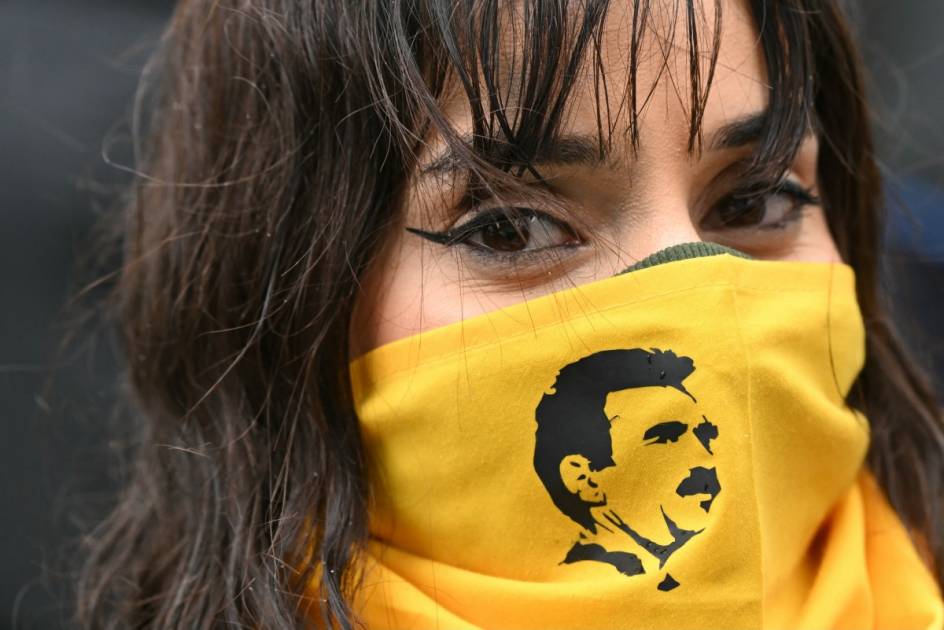
Kurds hold a picture of Abdullah Öcalan during a celebration in Istanbul (AFP)
The Union rejected what AKP officials proposed regarding the legal framework that includes some PKK members and excludes others, saying, 'Our liberation movement only deals with comprehensive, unified, serious, and clear laws and steps; the approach of implementing part and leaving another part is unacceptable.'
It explained that 'if the government has a genuine desire to solve the problem that has lasted for 100 years, and to end the division and war that have continued for 50 years, then a correct and wise approach must be demonstrated.'
Pressure on Rear Bases
The PKK statement drew attention to the visit of the Turkish intelligence director to Erbil and Baghdad and his meetings with both Kurdish and Iraqi officials, questioning his intentions, considering that the current situation 'appears as if preparations for a new war are underway.'
The Kurdish statement questioned whether Turkey plans to launch an attack on the PKK in cooperation with Iraq after the Baghdad government's decision regarding armed forces outside the army, adding that similar meetings were also held with Iran. 'If the Turkish state has such plans, we believe Iraq should not accept them.'
Read more
The Kurds... A diaspora of land and loss of rights
Öcalan wants to address Turkish public opinion freely
Turkish parliamentary delegation visits Öcalan in his prison
Öcalan: Transition to democratic integration in Turkey needs laws
But the PKK stressed that they and their leader Öcalan do not accept what they called any 'forced imposition' and that the continuation of the policy pursued for 100 years has not yielded results, calling on the Turkish government to deal 'seriously and responsibly' with their movement and its leader.
At the same time, the party expressed its readiness and its will and determination to end the armed conflict and achieve 'democratic integration', noting that the Turkish state has a historical responsibility 'to fulfill its duty and responsibility in achieving this will and determination, and to implement democratic integration through its policies and steps.'
Calculations of Peace Engineering
Original source: Independent Arabia
Comments (0)
Be the first to comment.