Purchasing Power and Unemployment: The Key Bet for Algeria's New Parliament Members
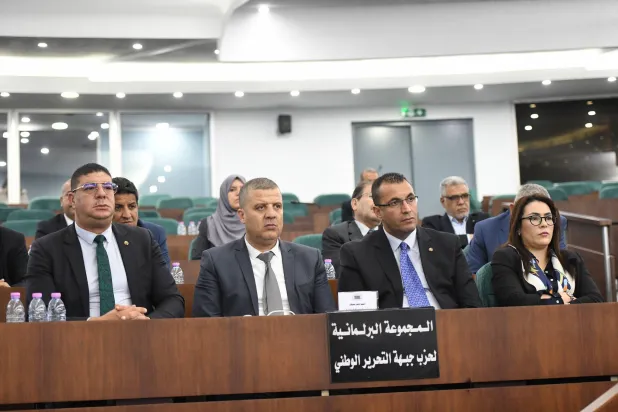
New members of the Algerian parliament face an overwhelming public aspiration to provide real and sustainable job opportunities that absorb unemployment rates.
While the ballot box engineering in Algeria showed the National Liberation Front (FLN) leading the legislative election results held on Thursday, in a version similar to the 2021 elections, the new MPs face an overwhelming popular demand to provide real and sustainable job opportunities that absorb unemployment rates, and to halt the decline in purchasing power that has burdened Algerian families due to inflation and the high cost of living.
Political and media circles in Algeria are currently awaiting the announcement of the final results of the legislative election by the Independent National Election Authority, to open the door for appeals to the Constitutional Court.
Secretary-General of the National Liberation Front casting his vote in the elections (Party media)
On Thursday evening, the Authority presented partial results showing the overall turnout rate at around 20.79 percent, with the number of parliamentary seats won by each of the 34 participating parties yet to be determined.
The results presented by each party on their social media pages showed that the National Liberation Front maintained its lead in most of the 69 provinces, thus consolidating its control over the National People's Assembly (the lower house of parliament), winning 7 seats in the capital out of a total of 31, followed by the Future Front with 6 seats, then the National Democratic Rally with 5 seats.
These three parties, along with the National Construction Movement, form the so-called "presidential majority" supporting the policies of President Abdelmadjid Tebboune.
President of the Future Front (Party media)
The elections saw the return of two opposition parties to parliament seats allocated to the capital: the Islamist Justice and Development Front of Sheikh Abdallah Djaballah (with 3 seats) and the leftist Socialist Forces Front (with 2 seats), the oldest opposition party founded by the late revolutionary figure Hocine Aït Ahmed. The competition for these seats also saw the entry of the emerging party "Voice of the People" (with 4 seats) led by university professor Lamine Osmani, outperforming established parties. Most notably, the Workers' Party failed to win any seat in the capital.
The results also confirmed the FLN's lead in most major provinces, such as Oran in the west and Constantine in the east. In the Kabylie region, where voter apathy was high, continuing a trend from previous elections, the Rally for Culture and Democracy and the Socialist Forces Front, both deeply rooted in the region, shared the seats of Tizi Ouzou and Bejaia provinces with the FLN and the National Rally.
List of candidates of the "Voice of the People" party in Oran
The president of the Rally for Culture and Democracy, Othmane Maazouz, expressed concern on Friday about the transparency of the processes for collecting, aggregating, and publishing the results of the legislative elections in Bejaia province.
In a post shared on his Facebook account, Maazouz asserted that his party is leading in the province, which is its main stronghold, according to reports from his party's representatives at various polling stations. He explained that "the reports from our representatives across different polling stations are clear and unambiguous: our party is in the lead in Bejaia." However, he stated that "the technical difficulties observed during the process of aggregating the results" raise concerns for his party, particularly pointing to internet outages and malfunctions in the digital platform of the Independent National Election Authority.
Secretary-General of the Workers' Party inside a polling station (Party media)
Othmane Maazouz stated that any breach of the integrity of the legislative elections would constitute "a serious violation of the popular will," reminding that "the will of the citizens is not negotiable and must be respected."
In light of the legislative election results, the new MPs (numbering 407) find themselves facing a great responsibility that can no longer be postponed, according to observers. The scene is dominated by an overwhelming popular demand, especially among the youth, to provide real and sustainable job opportunities that absorb unemployment rates. This aspiration is coupled with an urgent demand to halt the decline in purchasing power, which has burdened Algerian families due to inflation and the high cost of living.
While the opposition asserted that the "popular rejection" of the elections (only 4 million out of 24 million voters cast their ballots) is due to the "state of political and media closure" prevailing in the country, major newspapers in their Saturday editions blamed the parties for the "lack of enthusiasm" for these elections.
Candidates from the Justice and Development Front during the election campaign in a neighborhood in the capital (Party media)
The francophone newspaper El Watan wrote that the turnout figure "would have caused panic within party headquarters or triggered the electoral engineering mechanisms used in the past; but today, this figure must be read in a completely different reality. This rate is a mirror of the naked truth, the truth of an election that officially signs the bankruptcy of traditional political parties."
"The diagnosis of this bankruptcy," according to the newspaper, is based on "the absence of leadership and vision; party structures still operate with old methods, entrenched in narrow loyalties, and in the absence of figures capable of carrying a modern societal project, the political discourse has failed to convince a young, demanding population connected to the challenges of the era."
The newspaper Echorouk affirmed that "the ballot boxes have been freed (from fraud), and political parties are left face to face with Algerians, to fail in the electoral test and in convincing citizens to vote based on their programs." It stressed that "the authorities were not candidates, so they do not bear responsibility for the abstention; raising participation rates falls exclusively, ethically, politically, and socially, on the shoulders of the parties."
Your Premium trial has ended
"); googletag.cmd.push(function() { onDvtagReady(function () { googletag.display('div-gpt-ad-3341368-4'); }); }); }
Original source: Asharq Al-Awsat


Comments (0)
Be the first to comment.