Reconstruction in Lebanon Delayed... Required Funds Not Yet Secured
Reconstruction in Lebanon is not a massive project to attract foreign investment but a test of government reforms and anti-corruption. The process faces delays due to political, security, and economic conditions, with foreign companies cautious. International security oversight is expected, and funding remains insufficient.
Summary: Perspectives on reconstruction in Lebanon differ; it is not a massive workshop through which the state seeks to attract foreign investment and companies, but rather a test of the progress of government procedures and their responsiveness to international conditions regarding implementing reforms and fighting corruption, imposing state authority and sovereignty over all its territory, and not repeating past experiences by involving sanctioned companies in reconstruction and contracts. The reconstruction process is expected to be subject to security oversight by international parties under the pretext of preventing the rebuilding of military infrastructure in southern Lebanon and areas targeted by the Israeli army.
The appropriate conditions have not yet been met to launch the reconstruction process in Lebanon, pending the completion of the political, security, and economic reform landscape. Foreign companies are very cautious about operating in an unstable environment and in a country that does not provide sufficient guarantees for the stability and continuity of their work. To make matters worse, the reconstruction process in Lebanon is not merely technical; it is not a huge project that is awarded to an investor through a tender and that is it. Rather, it is a process with political and security dimensions, starting from returning people to their villages and homes and ensuring their stability on their land, rebuilding destroyed infrastructure in villages that have been geographically erased, and adhering to international conditions regarding not building new military structures or digging tunnels. In other words, this process will be within a general vision for the future and role of the country on the line of regional and international reconciliation and conflict.
Economic policy specialist Muhammad Fuhaili emphasized the caveats of the expected reconstruction process, 'because investment and reconstruction require huge sums and liquidity in foreign currencies' (Reuters).
The burden of reconstruction
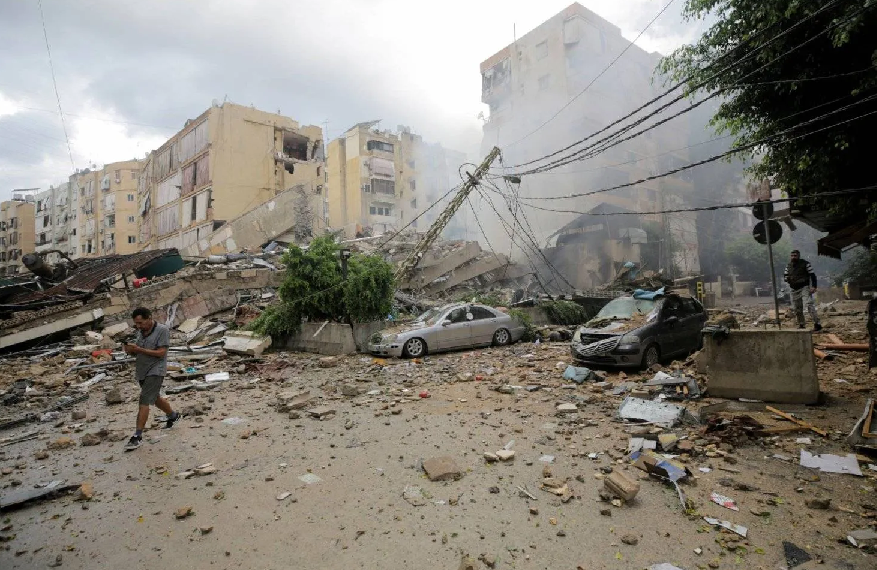
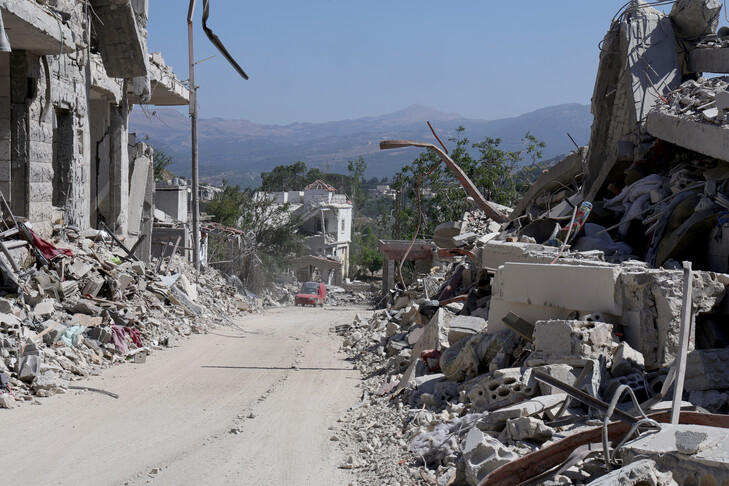
At first glance, some think that as soon as the ceasefire takes effect, foreign companies will race and come from all over to participate in the reconstruction process, but this has not happened. What is certain is the scene of massive destruction that has affected vast areas of southern Lebanon, the southern suburbs of Beirut, and areas of the Bekaa (east).
According to estimates by the National Council for Scientific Research in Lebanon, nearly 40,000 housing units were completely destroyed or severely damaged between March 2 and April 7 of last year, in addition to more than 230,000 units that were destroyed or completely damaged in the 2023-2024 war, whose reconstruction process has not yet begun.
The council confirmed that large areas of agricultural land were subjected to severe and medium fires, in addition to significant environmental damage to soil, water, and air. In a state assessment prepared by the Arab Center for Research and Policy Studies on 'Opportunities for Reconstruction in Lebanon,' researchers pointed to the accumulation of burdens due to successive wars and crises. The losses from the 66-day war, which ended with the ceasefire agreement on November 27, 2024, are estimated at approximately $6.9 billion, with losses reaching $7.2 billion according to World Bank estimates in March 2025, and the cost of reconstruction estimated at about $11 billion.
Only months passed until another devastating war broke out on March 2, 2026, for which no estimates of damage and costs are yet available. The state assessment indicates that the bulk of material damage from the 2024 war was concentrated in the residential sector. In the 2026 war, the scope of damage expanded to include infrastructure and public services, including electricity, water, and sanitation networks, as well as a decline in the operational capacity of health and educational institutions.
The assessors noted a financing gap compared to 2006 after the war that broke out on July 12 under the pretext of capturing two Israeli soldiers. At that time, the reconstruction process enjoyed regional and political support that allowed a rapid and large flow of external aid money, especially from Gulf Cooperation Council countries.
At the Stockholm Conference, Lebanon received more than $940 million, and at the Paris-3 Conference, it received subsidized and concessional loans worth $7.6 billion, as well as Gulf government deposits at Banque du Liban. In contrast, the scene changed after the 2024 war in terms of limited funding compared to needs, as the World Bank estimates the recovery need at $11 billion. Financial flows for rebuilding infrastructure or the residential sector remain negligible, with a near-total absence of direct Gulf grants that formed the cornerstone of the 2006 model.
The state assessment presents a hybrid model for funding sources, attempting to combine international funding through grants or loans from UN agencies, support from friendly countries according to verifiable political conditions acceptable to the Lebanese consensus, and local empowerment directed toward destroyed economic sectors and sectors capable of development and job creation. It notes that 'the success of this model remains conditional on the state's ability to play an effective regulatory role within a bloated institutional structure and corruption in the political system, which constitutes the greatest challenge in the coming stage.'
A deferred desire
Finally, Lebanese media outlets spoke of an anticipated step of Gulf businessmen coming to Lebanon, which was denied by an economist who said, 'We hear many rumors, but no visits can be expected before the travel ban to Lebanon is lifted.'
In this context, the director of the Market Studies Institute, Patrick Mardini, considered that 'it is unlikely at the present stage due to the connection of foreign investments to the political and security dimensions,' adding, 'No one will participate in reconstruction without security guarantees that war will not break out again.' He also said, 'No party is ready to finance the Lebanese state for reconstruction, so the state will be called upon to open the door to investment in monopolized sectors, and we do not know the extent of Lebanon's readiness to abolish monopolies and grant foreign companies the ability to establish private companies for electricity production, distribution, transmission, and management. This also applies to other sectors such as waste, water, sanitation, etc.' Therefore, 'betting on reconstruction according to the old formula is an unlikely project due to the crisis of confidence, the experience of collapse, and suspicions of corruption.'
For his part, economic policy specialist Muhammad Fuhaili confirmed the caveats of the expected reconstruction process, 'because investment and reconstruction require huge sums and liquidity in foreign currencies.' He pointed out that 'reconstruction is a social necessity for residential homes and villages destroyed by Israeli attacks on Lebanon, but investment is subject to risk assessment.' He stressed that Lebanon needs investments for years to grow the economy, 'but conditions have prevented that.'
Fuhaili also touched on the importance of having a banking sector and the availability of necessary conditions for huge investments, 'as large sums needed cannot be transferred in cash or through money transfer companies, and they need unpolluted channels in the banking sector due to Lebanon's presence on the gray list of the Financial Action Task Force.' Thus, there is no enthusiasm 'among European correspondent banks to transfer money to banks in countries that lack precautionary measures against money laundering and terrorism financing, and an economy whose officials in decision-making positions have been accused of corruption and waste of public funds.'
Original source: Independent Arabia




Comments (0)
Be the first to comment.