Russia launches largest ballistic attack on Kyiv with 41 missiles, casualties

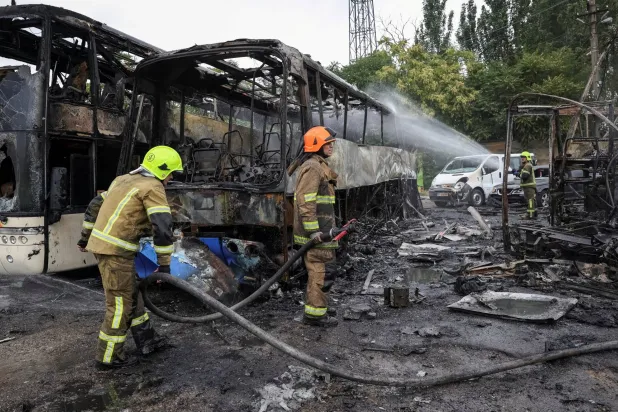
Ukrainian President Volodymyr Zelensky announced on Sunday that Russia launched an overnight attack with a volley of ballistic missiles on Kyiv, one of the largest in the history of the war, killing at least one person and injuring 16 others.
The Ukrainian Air Force reported that the attack included 41 missiles of various types, causing widespread destruction in several districts of the capital.
Kyiv Mayor Vitali Klitschko revealed that the damaged facilities include residential buildings, warehouses, a large grocery store, and a student dormitory, noting that three of the injured are in critical condition.
In western Kyiv, rescue teams spread out among the charred rubble searching for survivors, while working to extinguish fires in destroyed apartments. The attacks also hit a subway station near the city center, causing a pedestrian underpass nearby to collapse.
In other cities, the governor of Kharkiv in eastern Ukraine announced that 4 people were killed and 19 injured in an attack targeting a postal warehouse on the outskirts of the city. Meanwhile, rescue teams in Zaporizhzhia in the southeast continued searching for survivors under the rubble of residential buildings, with a death toll of at least 2 and 14 injured.
Shortage of air defenses exacerbates crisis
Russian forces have intensified their ballistic strikes on Kyiv and other Ukrainian cities in recent weeks, amid a severe shortage of U.S.-made air defense systems on the Ukrainian side.
The Ukrainian army announced it shot down 18 missiles heading toward the capital, as well as 108 drones out of 125 launched during the attack.
Zelensky noted that Washington and Kyiv have reached a political agreement on licenses to manufacture interceptor missiles for the Patriot system, expressing hope that production will begin by the end of this year.
The Ukrainian president stressed that 'protection against ballistic missiles is the top priority at present, and interceptor missiles have become a daily necessity,' as pressure mounts on Kyiv's Western partners to speed up the supply of anti-ballistic missile defense systems, as the war enters its fifth year.
Original source: Sabq




Comments (0)
Be the first to comment.