Series of Explosions Rock Kyiv
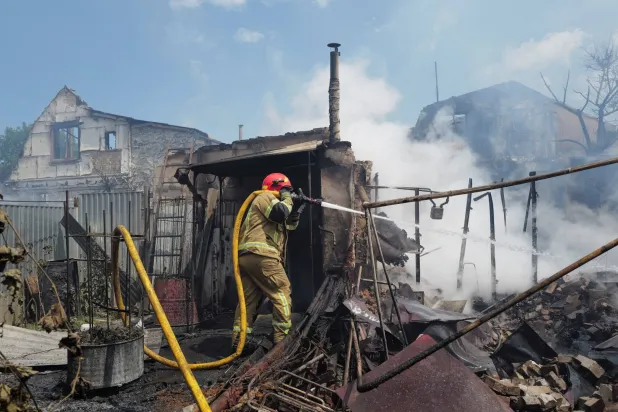
A series of explosions rocked Kyiv late Tuesday night as Russia continues its attacks on the Ukrainian capital, coinciding with a NATO leaders' summit in Turkey.
The NATO summit in Ankara concluded with new pledges to support Ukraine and a renewed commitment to collective defense, as leaders sought to demonstrate unity in the face of the Russian threat, the repercussions of the Iran war, and criticism from the White House.
US President Donald Trump dominated the summit, praising its outcomes and calling the meetings 'good,' while announcing a significant step for Kyiv by granting it a license to manufacture Patriot defense systems. However, Trump's positive tone toward Ukraine was met with sharp criticism of European allies within NATO. He expressed displeasure with the alliance's stance on his efforts to take control of Greenland, and singled out Spain for direct criticism, calling it a 'bad partner' in the alliance, and renewing his threat to cut trade ties.
The summit appeared to be a dual attempt to reassure Kyiv and bolster European defense responsibility, without fully succeeding in containing the tensions Trump reopened with several Atlantic partners.
Support for Ukraine
NATO leaders pledged $80 billion in support for Ukraine over the current and next year, in the form of military equipment and training assistance.
The leaders affirmed in the final declaration of their 36th summit, held in Ankara on Tuesday and Wednesday under the name 'Ankara Declaration,' that Ukraine contributes to transatlantic security and that allies stand united in their unwavering support for Ukraine's defense of its freedom, sovereignty, and territorial integrity.
A side meeting between Trump and Zelensky on the sidelines of the NATO summit in Ankara on July 8 (AP)
The statement also noted that European allies and Canada currently fund the vast majority of security assistance to Ukraine through bilateral and multilateral channels, and that NATO stresses the need for this support to be fair, predictable, and sustainable in the long term. The leaders emphasized the 'long-term threat' posed by Russia to Euro-Atlantic security, as concerns grow among some countries bordering Russia that Moscow might resort to hybrid attacks combining conventional military means, cyberattacks, and indirect pressure tactics.
Patriot Systems
During his meeting with Ukrainian President Volodymyr Zelensky on the sidelines of the NATO summit, the US president adopted a more positive tone toward the alliance after the summit meetings, saying that leaders had held a 'good meeting,' and expressing admiration for Ukraine's progress in drone production, hinting at the possibility of importing them in the future.
In a notable shift, Trump announced that the United States would grant Ukraine a license to manufacture Patriot air defense systems. During his meeting with Zelensky, he said: 'We will give them the right to manufacture Patriot. We will show them how to do it.' He added that he believes Ukraine can produce them 'very quickly.' This announcement is a major gain for Kyiv, which has been demanding for years to obtain more of these systems and then a license to produce them locally, given their high cost, high demand, and long production time, as reported by the Associated Press.
Trump addresses journalists at a press conference with members of his delegation in Ankara on July 8 (AP)
Unlike previous meetings marked by tension, Trump appeared more friendly toward the Ukrainian president, praising what he called his readiness to reach an agreement to end the war. He said Zelensky has 'done an amazing job' and has been 'very effective' during the war, adding: 'We have actually developed a good relationship. It's hard to believe.' He also indicated that he believes an agreement to end the war is on the horizon, and that Washington will work on some kind of 'security package' to provide to Ukraine.
Trump also said he would like to meet Putin and Zelensky, but clarified that the meeting would likely not be in Moscow. He noted that Putin was open to meeting but wanted to host him in the Russian capital, which Trump rejected on behalf of Zelensky. When Trump directly asked the Ukrainian president whether he would accept a meeting in Moscow, Zelensky joked: 'It's difficult, there are many Ukrainian drones there... it's dangerous.'
On the sidelines of the summit, Zelensky renewed Ukraine's demand to join NATO, stressing that Ukrainian forces have gained significant combat experience that would enhance the alliance's defensive capabilities. He also highlighted Ukraine's ability to adapt militarily and carry out strikes deep inside Russian territory, saying that his country's forces eliminate an average of 30,000 Russian soldiers per month.
Article Five and the Greenland Challenge
Alliance leaders affirmed their steadfast commitment to collective defense under Article Five of the Washington Treaty, noting that an attack on one ally is an attack on all.
They stressed that the preservation of unity, solidarity, and collective strength is the foundation for peace, security, and prosperity for one billion citizens of 'free and democratic' countries, and committed to the comprehensive approach to deterrence and defense.
Group photo of NATO leaders at the conclusion of the NATO summit in Ankara on July 8 (EPA)
But Trump did not hide his displeasure with several of his NATO partners, saying he is dissatisfied with the alliance because of its opposition to his efforts to take control of Greenland and the lack of support from its members for his war against Iran. He also renewed his claim to Greenland, which belongs to Denmark, asserting that it is 'very important' for the United States, and that Washington 'needs it to protect the world, not just the United States.'
Danish Prime Minister Mette Frederiksen responded by saying that her country is 'ready to defend every inch of NATO territory, including our own,' stressing that she would rely on allies to fulfill their collective defense commitment in case of an attack. In a direct response to Trump's remarks, she stressed that 'Greenland is not for sale, of course.'
Trump also directed sharp criticism at European countries that refused to participate in the war against Iran, singling out Spain for attack, calling it a 'bad partner in NATO,' and renewing his threat to cut trade ties with it.
In response, Spanish Prime Minister Pedro Sanchez sought to downplay Trump's threats, saying that the bilateral relationship between Madrid and Washington is 'positive,' and that Spain has met its defense spending commitments for 2026. Sanchez explained that he spoke briefly with Trump on the sidelines of the Ankara summit, and that the conversation between them did not go beyond 'friendly and kind words,' adding: 'We talked about football, about the World Cup in the United States... it was an informal chat.'
Defense Spending
NATO leaders sought to show that they are responding to Trump's demands for increased defense spending. Secretary General Mark Rutte pointed to countries such as Estonia, Latvia, Poland, and Denmark that have raised their defense investments, but noted that the Trump administration expects Europeans and Canada to 'equal' their spending with the United States.
Original source: Asharq Al-Awsat




Comments (0)
Be the first to comment.