Ukraine strikes major oil terminal in Russian city of St. Petersburg
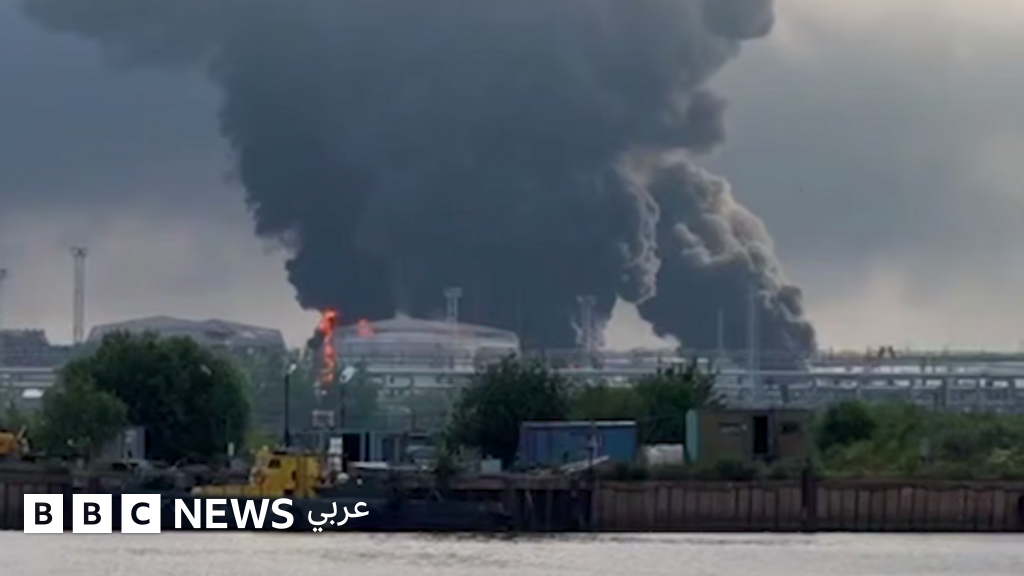
Ukrainian President Volodymyr Zelensky says the target is key infrastructure 'that generates revenue for Russia's war.'
Ukraine strikes major oil terminal in Russian city of St. Petersburg
Image caption: The Ukrainian army described the oil terminal in St. Petersburg as 'one of the largest' in Russia
Article Information
Author, Yaroslav Lukiev, Role, BBC News
Published 4 July 2026
Reading time: 4 minutes
Ukrainian President Volodymyr Zelensky announced that Ukraine targeted a major oil terminal in St. Petersburg, Russia's second-largest city in the northwest, overnight.
Zelensky described the terminal as 'vital infrastructure that generates revenue for Russia's war.' Ukraine also announced it targeted a major Russian naval base in the region.
St. Petersburg Governor Alexander Beglov said the city came under a 'large-scale' drone attack, acknowledging the oil terminal was targeted, with no casualties reported.
Ukraine has recently intensified its long-range drone attacks on critical energy infrastructure in Russia, causing severe fuel shortages. Kyiv says about 43 percent of Russia's oil refining capacity has been 'disabled' as a result.
But the claim has not been independently verified.
Ukraine says Russian oil and gas facilities are legitimate targets, as Moscow relies heavily on fossil fuel exports to sustain its war effort.
For his part, Russian President Vladimir Putin - who last week in a rare admission acknowledged fuel shortages caused by Ukrainian attacks - signed a law on Saturday aimed at boosting fuel supplies on the domestic market.
Putin launched a full-scale invasion of Ukraine in February 2022.
Skip the most read and continue reading
Do you really need to avoid gluten?
"A meal I had during my vacation ended with me having 38 parasites in my brain"
Funeral music and 'selected verses': how social media read Khamenei's farewell ceremony?
Popular funeral ceremony for Khamenei in Iran more than four months after his killing
Russian missile and drone attack on Kyiv
Skip the podcast and continue reading
Worth paying attention to
In-depth explanation of the most prominent events and topics, to help you understand the most important changes around you and their impact on your life
Episodes
Podcast end
Zelensky said on Saturday morning that the targets in St. Petersburg and the surrounding area are about 850 km (528 miles) from the Ukrainian border.
The extent of the damage was not immediately clear, but a video posted by the Ukrainian president showed a drone flying toward a target and a huge column of black smoke rising from the area after the strike.
The BBC later confirmed the targeting of the oil terminal in St. Petersburg.
The Ukrainian army described the terminal as 'one of the largest' in Russia, capable of producing 12.5 million tons of petroleum products annually.
The army also announced the targeting of a major naval base of the Russian Baltic Fleet in Kronstadt.
Russia has not officially commented on this claim.
Governor Beglov said 72 Ukrainian drones were shot down over St. Petersburg and the wider Leningrad region.
He urged city residents to stay indoors until the drone threat passed. He warned of possible disruptions to mobile internet services.
More than five million people live in St. Petersburg.
In a separate development on Saturday, the Ukrainian army denied that the town of Kostiantynivka, in eastern Ukraine, was under full Russian control.
Ukrainian military spokesman Major Andriy Kovaliov told the BBC that 'Kostiantynivka remains under the control of the Ukrainian Armed Forces.'
He acknowledged 'cases of infiltration by small infantry groups deep into our combat formations,' but added that these groups are being detected and eliminated.
His remarks came a day after Putin's announcement last June that Russia had taken control of Kostiantynivka.
The Kremlin leader provided no evidence to support his claim.
Later on Saturday, Zelensky wrote on Telegram: 'If Kostiantynivka is now under Russian control, then Putin would likely have no problem meeting me there and finding diplomatic solutions to finally end the war. But he still won't cross the front line: the truth is completely different from Putin's words.'
Kostiantynivka is one of the heavily fortified cities forming the Ukrainian 'fortress belt' in the Donetsk region, most of which is under Russian control.
In its latest operational statement on Saturday afternoon, the Russian Defence Ministry said it had shot down more than 500 Ukrainian drones and missiles launched overnight and in the morning.
Ukrainian prisoner of war uses Harry Potter stories to help others survive their prison ordeal
The Russian Foreign Ministry described the Ukrainian attacks as an attempt by Zelensky to 'distract' Ukrainians and 'foreign supporters' from the aftermath of one of the largest and most violent Russian strikes on the Ukrainian capital Kyiv on 2 July, as well as the 'abject failure' of Ukrainian forces in Kostiantynivka.
The ministry stressed that Ukrainian attacks on Russian civilian facilities 'will not go unanswered.'
Both sides appear to be seeking an advantage ahead of the NATO summit scheduled for next week in Turkey.
On Saturday, Putin sent a congratulatory message to US President Donald Trump on the occasion of the Fourth of July celebrations in the United States, calling for 'constructive relations' between the two countries.
The Russian leader visited military commanders on Friday, where he claimed to have regained control of Kostiantynivka.
Zelensky said Putin chose to mislead the world about the situation on the front.
This war is as much one of words as it is of missiles.
BBC diplomatic correspondent James Landale in Moscow contributed to this report.
Skip short clips and continue reading
Short clips
End of short clips
Zelensky calls for direct meeting with Putin, Kremlin welcomes meeting in Moscow 'at any time' - 5 June 2026
Putin attacks NATO during 'limited' Victory Day celebrations - 9 May 2026
Robot wars: What Ukraine reveals about the future of battles? - 7 May 2026
Original source: BBC Arabic


Comments (0)
Be the first to comment.