US Push to Implement the Experimental Zone in Southern Lebanon Coinciding with Rome Meeting
Lebanese and international contacts have intensified to bring the experimental zone in southern Lebanon into effect next week, coinciding with the sixth round of Lebanon-Israel negotiations.
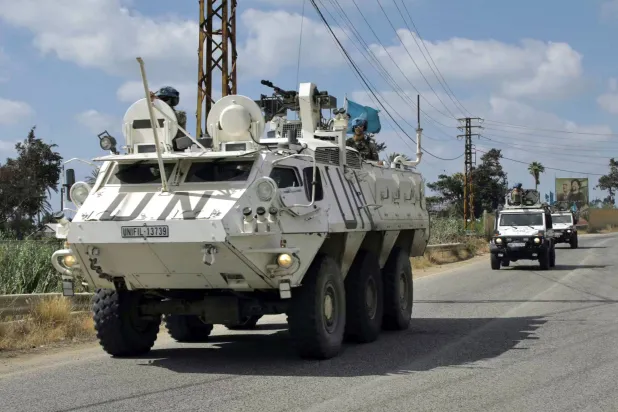
Lebanese and American contacts have intensified to bring the experimental zone in southern Lebanon into effect next week, coinciding with the sixth round of the Lebanese-Israeli negotiations under American auspices in Rome, alongside parallel European movement to advance the Lebanese negotiation track and fill the security vacuum in southern Lebanon after the end of UNIFIL's mandate.
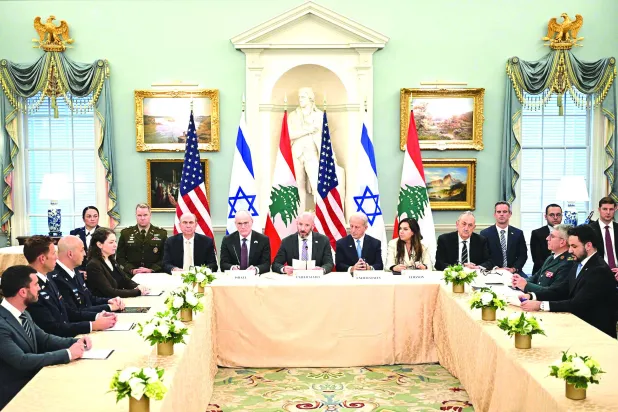
The sixth round of negotiations between Lebanon and Israel will be held under American auspices in the Italian capital Rome on July 15 and 16 this year, discussing the completion of the items of the "Framework Agreement" signed in Washington last month, with technical delegations including political and military officials participating to discuss implementation mechanisms.
Representatives of Lebanon, Israel, and the United States sign the Framework Agreement at the US State Department on Friday last June (Archival - Reuters)
Lebanese ministerial sources told Asharq Al-Awsat that intensive contacts precede the meeting, carried out by the American side on the Beirut-Tel Aviv line, adding: "If the contacts succeed, the practical steps to implement the experimental zone in southern Lebanon will be announced concurrently with the conference."
An American military delegation arrived in Beirut on Friday to discuss arrangements related to the army's deployment in the experimental areas, which in the first phase include the towns of Froun, Ghunduriya, and Zoutar al-Gharbi, after its visit to Tel Aviv, where it held meetings with Israeli military officials to make necessary arrangements to allow the Lebanese army to deploy, withdraw Hezbollah weapons from those villages, and ensure the return of residents and reconstruction.
The contacts focus on the mechanism for deploying the Lebanese army in the villages from which the Israeli army withdraws simultaneously with its withdrawal, "to prevent a security vacuum in those villages," according to the sources.
Problem of the Experimental Zone
A problem has emerged in the experimental zone announced in three villages southeast of the city of Nabatieh, given that these towns (Froun, Ghunduriya, and Zoutar al-Gharbi) are under Israeli fire control and are not occupied, except for the outskirts of Zoutar al-Gharbi, and some residents have already returned.
Lebanese President Joseph Aoun receives US Ambassador to Lebanon Michel Issa at the Presidential Palace on Thursday (AFP)
Sources following the contacts told Asharq Al-Awsat that Hezbollah says its fighters are not present in those southern towns; rather, those present are residents and locals, and some families have returned after the ceasefire agreement came into effect. The party says that "Israel must withdraw its forces from the occupied towns, not from towns not under occupation." In contrast, Israel considers that those present in those villages may have ties to Hezbollah. The Qatari side handles communication with Hezbollah. The same sources said that Qatari officials "are making efforts in this context to ensure the success of the first phase of the experimental zones."
International Movement
International initiatives are crowding the Lebanese scene to push toward establishing long-term stability between Lebanon and Israel. Alongside direct American military and political involvement on the Beirut-Tel Aviv line to gradually implement the Framework Agreement, German Foreign Minister Johann Wadephul announced a joint German-French initiative regarding Lebanon, aiming to develop a unified policy to enhance peace opportunities in the Near and Middle East.
The German site "Deutschland" reported on Saturday that the German-French ministerial council meeting, scheduled for next week, will focus significantly on peace efforts in the Middle East, alongside notably strengthening the European Union's foreign policy.
European Initiative to Fill Security Vacuum
While official Lebanon has not received any details about the initiative, or whether it is diplomatic or security, government sources told Asharq Al-Awsat that there is a European initiative to fill the security vacuum in southern Lebanon after the end of UNIFIL's mandate later this year, which Germany and Britain may be part of, following confirmation of participation by France, Italy, and Spain.
Israeli flag raised on a building in a town in southern Lebanon (Reuters)
The French Foreign Ministry announced last month that preparations are underway, in coordination with Italy, to form a new international force to deploy in southern Lebanon after the end of UNIFIL's mission, supported by the United States, with the participation of several European countries, based on a request from Lebanese authorities, and that its mission will focus on supporting the Lebanese army in carrying out its tasks and contributing to enhancing security and stability in the southern regions.
Ministerial sources close to the Lebanese presidency said that French President Emmanuel Macron is working to expand the alternative force to UNIFIL, pointing out in statements to Asharq Al-Awsat that what has been confirmed so far is the participation of France, Italy, and Spain in the force, in addition to Indonesia and Ireland declaring their readiness to participate.
Proposals for the Alternative Force to UNIFIL
The planned force seeks to gain UN approval, but if that fails, the trend is for it to be a European force in light of European desire to be part of efforts to stabilize and support legitimate Lebanese institutions in the country.
Lebanese sources following the contacts said: "If the force's deployment under a Security Council resolution is obstructed, work is being done on a formula that receives UN approval in one way or another and operates under its flag," noting that this file "is currently being discussed with the UN Under-Secretary-General for Peacekeeping Operations, Jean-Pierre Lacroix, to reach the ideal formula."
According to sources, the force must be under the UN umbrella as a priority, noting several proposals including expanding the UN Observer force or forming a special peace and development force operating in southern Lebanon.
Israeli fighter jet flies over the coast of Tyre city coinciding with two airstrikes targeting the coastal town of Mansouri in southern Lebanon (circulating)
Field Escalation
Amid these contacts and initiatives, international efforts to end the crisis in southern Lebanon collide with Israeli obstacles, although Lebanon believes that a breakthrough in this crisis is possible if Israel commits and begins its actual withdrawal from Lebanese territory, allowing residents to gradually return and start reconstruction.
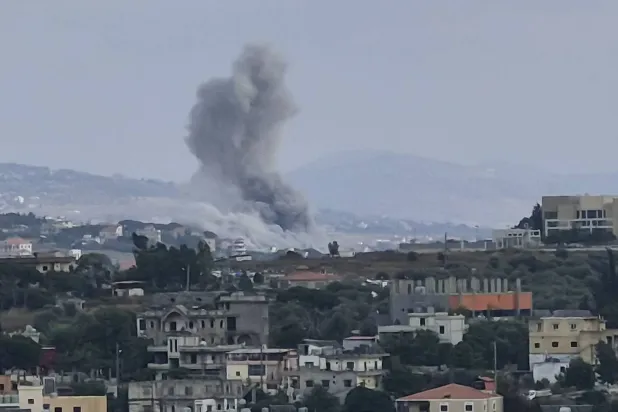
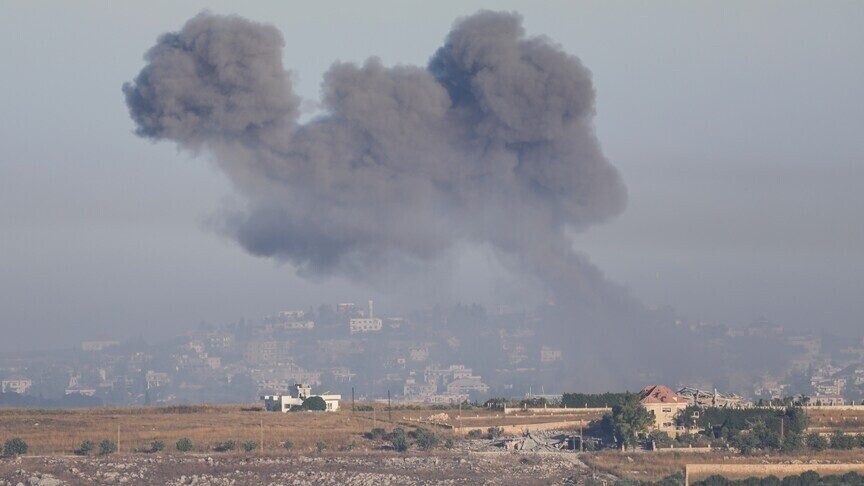
Israel resumed its raids on southern Lebanon, as Israeli warplanes conducted two airstrikes in two waves targeting several residential neighborhoods in the town of Mansouri south of Tyre city, and drone aircraft raided the towns of Majdal Zoun and Kfar Tebnit, while an Israeli drone dropped a sound bomb near the Teacher's House in Nabatieh al-Fawqa. It also carried out demolitions of houses in Houla and Deir Siriane.
Original source: Asharq Al-Awsat

Comments (0)
Be the first to comment.