Visa file for Algerians sparks widespread debate in France
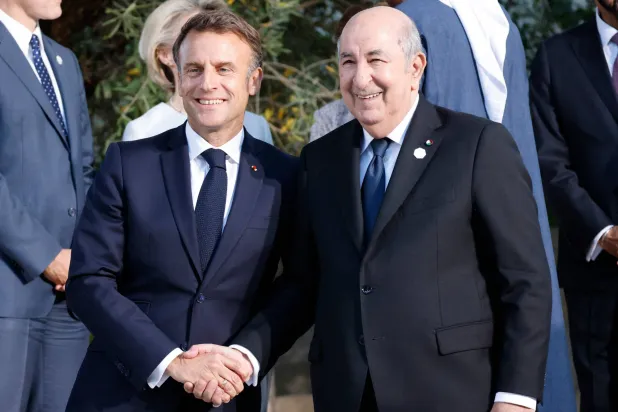
The visa file for Algerians sparks widespread debate in France, and President Macron intervenes to correct his ambassador's statements to Algeria, denying the figures he presented.
On May 8, French ambassador Stéphane Romatet returned to the Algerian capital, after more than a year since his departure due to a diplomatic crisis that struck bilateral relations at their core. This return only happened after strenuous efforts by both sides to overcome a real crisis, directly caused by the content of the letter sent by President Emmanuel Macron in summer 2024 to the King of Morocco on the occasion of the Moroccan national holiday, stating that 'the future of the (Western) Sahara is part of the framework of Moroccan sovereignty,' which constituted a break from Paris's traditional position on this old conflict.
French Minister of Foreign Affairs in a visit to Algeria at the end of 2024 (Algerian Presidency)
Over two years, the relationship between the two countries remained 'icy' until it improved recently after a series of official visits, culminating in the return of Ambassador Romatet to his duties, while the position of Algerian ambassador in Paris remains vacant to this day.
However, the new honeymoon did not last long, as Romatet's statements to the site 'Everything about Algeria' sparked a new crisis, but this time within France, while Algeria is busy with the fires sweeping the country. Romatet addressed a highly sensitive topic on both sides of the Mediterranean: visas granted annually by France to Algerian citizens. He said: 'We are working to restore the upward trend in the number of visas granted, and likely return to the level prevailing before the crisis,' i.e., 250,000 visas per year.
Members of the Algerian memory committee with President Tebboune (Algerian Presidency)
Romatet, an ambassador with extensive diplomatic experience and aware of the 'sensitivity' of the immigration file, went on to say: 'I returned to Algeria with a mandate and desire from President Macron to put (bilateral) relations on the (right) track, which President (Algerian) Abdelmadjid Tebboune confirmed to me.' His mission is to restart cooperation between the two sides in the areas of security, justice, and immigration matters, including the visa file.
It is surprising that Romatet did not expect his words to spark a wave of protests within France, particularly among the right and far-right. It also placed the presidency and the government in a bind. Bruno Retailleau, former Interior Minister and head of the traditional right-wing party 'The Republicans' and its candidate for the presidency, wrote on platform 'X': 'How unfortunate to see our diplomacy forced to bow its head due to the concessions made by the President of the Republic to the Algerian regime.'
Algerian President receiving the French Foreign Minister on April 6, 2025 (Algerian Presidency)
For his part, Jordan Bardella, head of the far-right National Rally party, expressed regret saying: 'The French ambassador in Algeria announces that our country wishes to grant 250,000 visas annually to Algerian citizens, despite provocations and the detention of a French journalist... We categorically reject this surrender by Macronism to the Algerian regime.'
European deputy Marion Maréchal, from the far-right, also expressed rejection of this approach, citing a series of figures: 'One in two Algerian immigrants lives in social housing, two out of three immigrants are unemployed, Algerians form the largest foreign nationality in French prisons, about one in four illegal immigrants arrested is Algerian, while nearly 65% of deportation requests for Algerians are rejected.' Her fellow European deputy Sarah Knafo affirmed that Algeria 'already costs France about 9 billion euros.'
In the face of this campaign, the French government or presidency could not remain silent. Interior Minister, who holds authority over visa issuance, quickly denied what Ambassador Romatet said, stating after the Council of Ministers meeting on Wednesday: 'I participated in the discussions with Algeria, and this subject was never raised.'
French Parliament during its vote against the cancellation of the Algerian-French immigration agreement (archive image of a plenary session at the National Assembly)
More importantly, what government spokesperson Minister Maud Bregeon reported from President Macron, who seemed keen to clarify and correct what Romatet said. According to the minister, Macron said: 'France has begun serious and intensive work on key issues and files with Algeria. However, there is no specific numerical target regarding visas, and there is no leniency on France's part in this file.'
The aforementioned minister added: 'Since his election in 2017, President Macron has decided to reduce these numbers so that they correspond, on the one hand, to France's needs, and on the other hand, to geopolitical realities,' recalling that France was then granting about 500,000 visas per year. The meaning of the presidential statement is that Paris does not arbitrarily and pre-decide the number of Algerians who will be granted visas, but each application must be examined individually.
It is not certain that Macron's words will extinguish the controversy, because France has already entered the atmosphere of the presidential elections to be held in the spring of next year. Therefore, any pretext can turn into an election argument, while Marine Le Pen, candidate of the far-right National Rally party, is running from a position of strength according to all polls to date.
Algerian President receiving the French Interior Minister on February 18 last (Algerian Presidency)
There is no doubt that other pitfalls could arise in Paris's relations with Algeria, one of which is what France is currently seeking to conclude an exceptional and unprecedented friendship treaty with the West, which it hopes to sign perhaps during a state visit by Moroccan King Mohammed VI to France before the end of Macron's term.
Original source: Asharq Al-Awsat



Comments (0)
Be the first to comment.